How to Use Umami-Rich Ingredients to Reduce Salt Without Losing Flavour
# How to Use Umami-Rich Ingredients to Reduce Salt Without Losing Flavour
There's a common assumption that cutting back on salt means accepting blander food — that flavour is somehow the price you pay for eating with your health in mind. But that's not quite how taste works, and understanding one particular flavour dimension can change the way you cook entirely.
That dimension is umami, and it might be the most useful thing you've never been taught about in the kitchen.
What Umami Actually Is
Umami is the fifth basic taste, alongside sweet, sour, bitter, and salty. The word comes from Japanese — roughly translating to "pleasant savoury taste" — and it was first identified by chemist Kikunae Ikeda in 1908 when he isolated glutamate from kombu seaweed.
Glutamate is an amino acid that occurs naturally in a wide range of foods, and when your taste receptors detect it, the result is that deep, mouth-coating, lingering savouriness you get from a slow-cooked stew, aged cheese, or a really good bowl of ramen. It's not quite saltiness, not quite richness — it's something that sits underneath both and makes everything feel more satisfying.
What makes umami particularly interesting from a cooking perspective is that it enhances the perception of other flavours, including salt. This means that when you increase the umami content of a dish, you can often reduce the actual salt you add while keeping the food tasting just as — or even more — complex.
Why Salt Reduction Matters (Without the Lecture)
The average person in the UK consumes around 8.4g of salt per day, which is notably above the recommended 6g. Most of that doesn't come from the salt shaker — it comes from processed foods, bread, sauces, and ready meals.
When cooking from scratch, you have direct control over what goes in. The goal here isn't to demonise salt — it's a genuinely useful ingredient that does important things in food, from seasoning to texture to preserving. The point is that if you want more flavour with less reliance on sodium, umami is a powerful tool, not a compromise.
The Science Behind the Salt-Umami Connection
Research published in the journal Food Quality and Preference found that adding umami-rich compounds to low-sodium foods significantly improved their palatability — in some cases making reduced-salt versions taste comparable to fully salted ones.
The mechanism involves how glutamate interacts with sodium receptors on the tongue. Umami doesn't replace salty taste, but it does increase overall flavour intensity and complexity, which means the brain registers a more satisfying eating experience even when less sodium is present. Some studies have shown reductions in salt of 20–40% are achievable without perceived flavour loss when umami compounds are used strategically.
There's also a synergistic effect worth knowing about. Glutamate (found in many plant and animal foods) combines with inosinate (found in meat and fish) and guanylate (found in dried mushrooms) to multiply the umami effect dramatically — far beyond what either compound would produce alone. This is why dishes that combine ingredients from different umami sources tend to taste so much more rounded.
Umami-Rich Ingredients Worth Keeping in Your Kitchen
You don't need to overhaul your pantry. A handful of well-chosen ingredients can make a significant difference.
Tomato paste is one of the most concentrated sources of glutamate available, and it's cheap. A tablespoon added early in cooking — particularly if you let it fry briefly in oil before adding liquid — adds extraordinary depth. It doesn't make things taste of tomato so much as it makes everything else taste more like itself.
Parmesan and other aged cheeses are exceptionally high in glutamate because the ageing process breaks down proteins into free amino acids. A small amount grated into pasta, risotto, or soup goes a long way. The rind, often discarded, is even more concentrated — drop it into soups and stews while they cook.
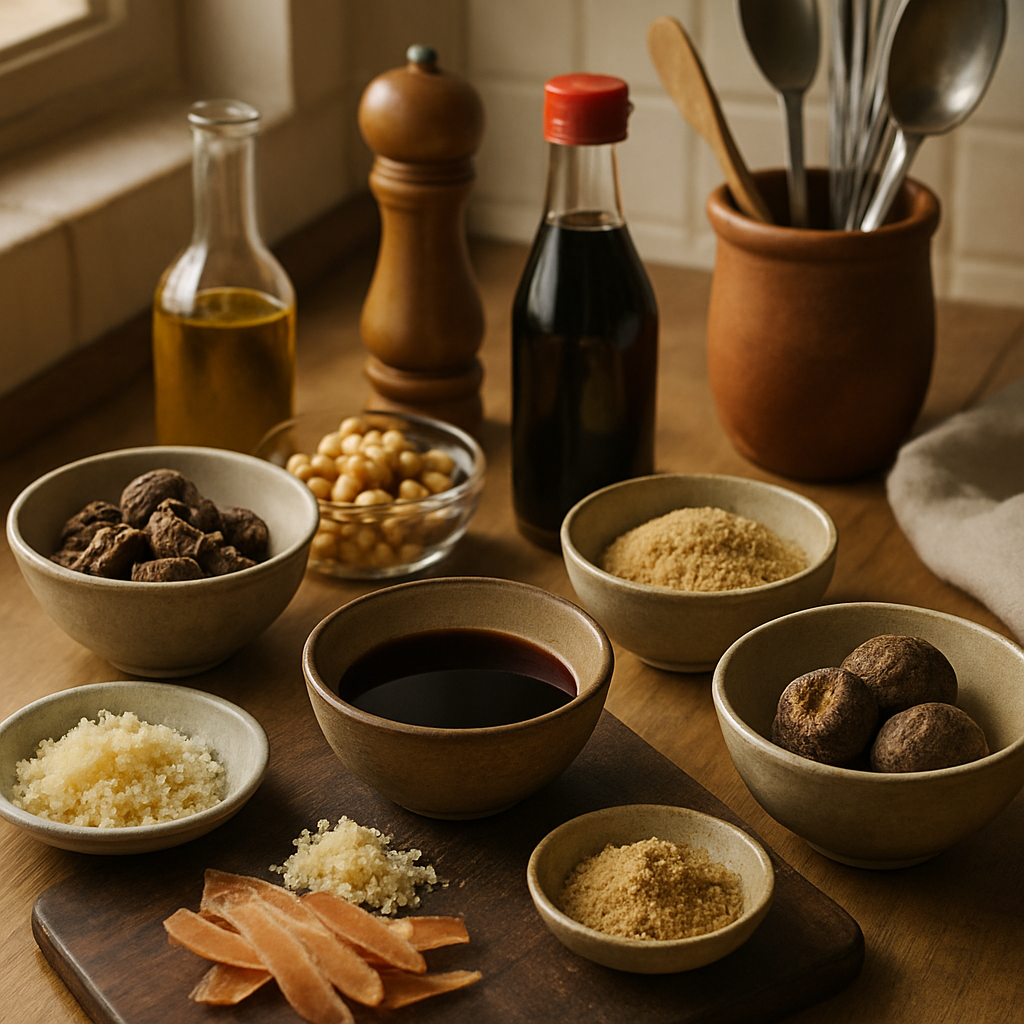
Soy sauce and tamari are obvious choices, but they do contain sodium, so they're most useful as a replacement for salt rather than an addition. A small splash into a braise, a marinade, or even scrambled eggs adds umami without the flat hit of pure salt.
Fish sauce follows a similar principle — a small amount (far less than you'd think) dissolved into a dish adds extraordinary savoriness. It's used throughout Southeast Asian cooking but works brilliantly in non-Asian contexts too. Nigel Slater puts it in pasta sauces. It doesn't make food taste fishy; it makes it taste rounder.
Dried mushrooms — particularly porcini or shiitake — are among the richest sources of guanylate. Rehydrate them in warm water and use both the mushrooms and the soaking liquid. The liquid is intensely flavoured and makes a remarkable addition to stocks, gravies, and risottos.
Miso paste is fermented soybean paste, and the fermentation process dramatically concentrates its glutamate content. A teaspoon stirred into dressings, soups, or even mashed potato adds complexity that's difficult to achieve any other way.
Nutritional yeast is worth mentioning for those who don't eat animal products — it has a distinctly cheesy, nutty umami flavour and works well sprinkled over dishes or stirred into sauces.
How to Use These Ingredients in Practice
Knowing which ingredients are umami-rich is useful; knowing how to deploy them is what actually changes your cooking.
The key principle is layering. Rather than reaching for salt when a dish tastes flat, ask whether it needs more umami first. Add a spoonful of tomato paste, a splash of soy sauce, or a teaspoon of miso, stir it through, and taste again. You'll often find the dish doesn't need the salt at all — it needed more complexity.
Browning matters. When you brown meat, onions, or tomato paste in a hot pan, you're creating new flavour compounds through the Maillard reaction. This deepens both umami and overall flavour, which again reduces your dependence on salt for impact.
Combining sources is more powerful than using one ingredient heavily. A braise built on fried tomato paste, a splash of soy sauce, and a rehydrated porcini mushroom or two will have layered, sustained flavour that no amount of salt could replicate on its own.
Add umami early, not at the end. Salt can be adjusted at the table, but umami ingredients work best when they've had time to cook into the dish and integrate with everything else.
What the Evidence Shows
Beyond the taste mechanics, there's a broader body of evidence supporting umami as a practical strategy for sodium reduction in cooking.
A 2010 review in Flavour journal noted that glutamate enhances the salty taste of sodium, which means foods can taste adequately seasoned with less actual salt present. Research from Unilever's food science division (published in Chemical Senses) found that substituting a portion of sodium chloride with flavour-enhancing umami compounds in soups reduced sodium by up to 40% without significant palatability loss.
The WHO recommends reducing sodium intake as one of the most cost-effective interventions for reducing cardiovascular disease risk globally. Practical cooking strategies — rather than processed low-sodium products — are arguably the most sustainable way to get there.
Practical Takeaways
Here's what you can actually do with this today:
- Keep a jar of tomato paste in the fridge and fry a spoonful into oil before adding any liquid to soups, stews, or sauces.
- Save your Parmesan rinds in a bag in the freezer and add them to anything that simmers for more than 20 minutes.
- Swap half your salt for a small splash of soy sauce or fish sauce in savoury dishes — you'll likely get more flavour overall.
- Rehydrate dried porcini mushrooms and use the soaking water as a base for gravies, risottos, or braises.
- Add a teaspoon of miso to dressings and sauces when they taste a little flat.
- Layer your umami sources — two or three different ingredients together will produce something far greater than the sum of their parts.
None of this requires special equipment or expensive ingredients. It's mostly about using what's already in well-stocked kitchens more deliberately.
If you want to build meals that are full of flavour and hit your nutritional targets without the guesswork, Macrology generates macro-perfect meal plans in seconds — [https://macrology.app/signin](https://macrology.app/signin)
Want meals like this planned to your exact macros?
Macrology generates a personalised meal plan in seconds — breakfast, lunch, dinner and snacks, all hitting your daily targets.
Start your free 14-day trial