How to Use Stock Reductions to Build Intense Flavour with Minimal Effort
# How to Use Stock Reductions to Build Intense Flavour with Minimal Effort
There's a reason restaurant sauces taste so much richer than anything most of us make at home — and it's not a secret ingredient or professional equipment. It's time, and a relatively simple technique called reduction. The good news is that it requires almost no active effort, just patience and a bit of know-how.
What Is a Stock Reduction, Exactly?
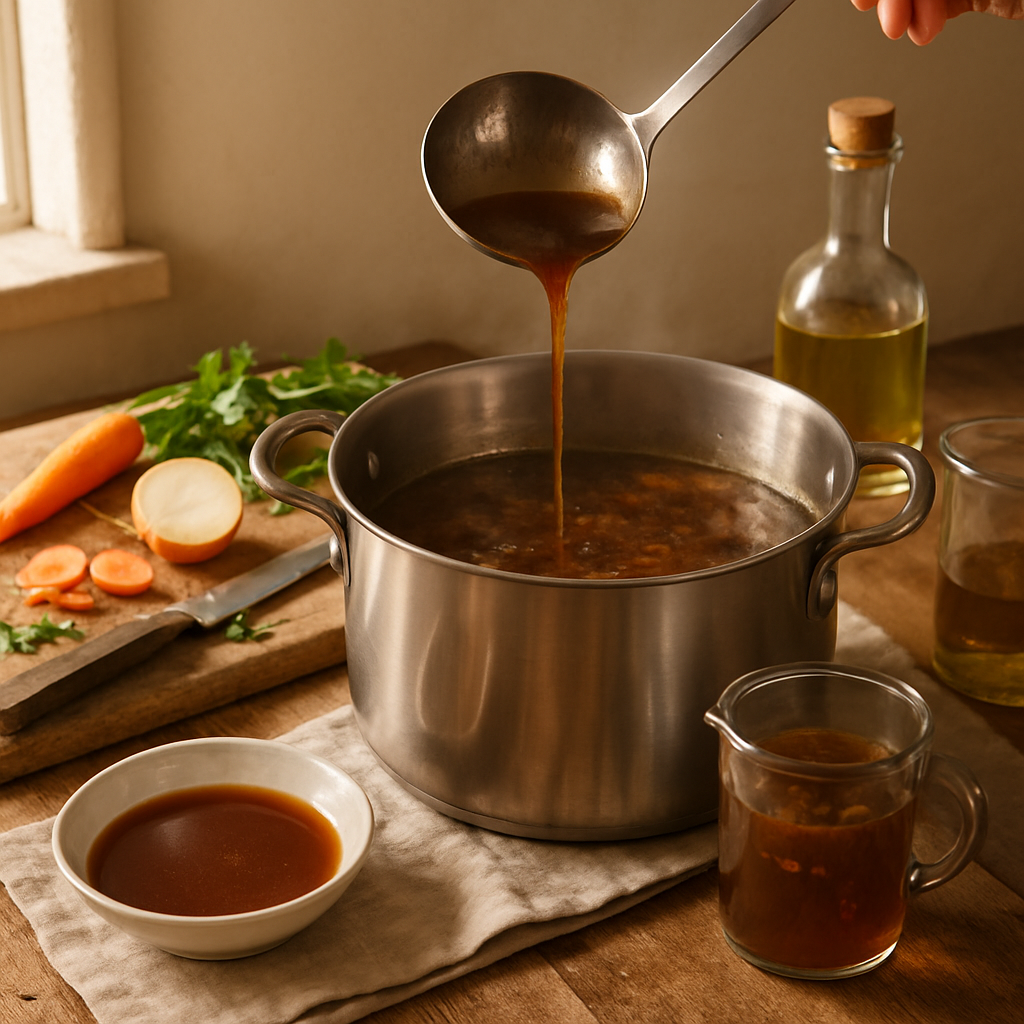
A stock reduction is simply the process of simmering a liquid — usually stock, wine, or a combination of both — until a significant portion of the water evaporates. What's left behind is a more concentrated version of the original liquid, with a deeper colour, thicker consistency, and dramatically more intense flavour.
The science here is straightforward. Stock is mostly water carrying dissolved proteins, gelatin, sugars, and flavour compounds. When you drive off the water through heat, those remaining compounds become more concentrated. The Maillard reaction and caramelisation can also contribute as the liquid reduces, adding complexity beyond simple concentration.
This is different from making a gravy or sauce by adding a thickener like cornflour. Reduction achieves flavour intensity and body entirely from the ingredients themselves, which is why the result tastes so much more rounded and natural.
The Two Main Types Worth Knowing
Glace (or glaze) refers to a stock that's been reduced all the way down to a thick, syrupy consistency — sometimes by as much as 80–90%. A proper glace de viande, made from beef stock, will set solid in the fridge like jelly. A tiny spoonful stirred into a pan sauce transforms it completely.
Demi-glace is a halfway point — typically a brown stock reduced by around half, often with some wine. It's the workhorse of classical French cooking and the foundation of dozens of sauces. It has a glossy, coating consistency and pours rather than scoops.
For home cooking, you don't need to commit to either extreme. Even reducing a stock by a third or half gives you a noticeably better result than using it straight from the carton. Start wherever feels manageable.
Why It's Easier Than You Think
The main misconception about reductions is that they're high-maintenance. In reality, once your liquid is simmering, you can mostly leave it alone. There's no constant stirring required — just an occasional check to make sure it hasn't boiled too aggressively or caught on the bottom.
The key watch-outs are simple. Keep the heat at a gentle simmer, not a rolling boil — a rapid boil drives off water too quickly and can make a stock turn cloudy or bitter. Use a wide, heavy-bottomed pan if you have one, because more surface area means faster, more even evaporation. And don't add salt until after reducing, because concentrating a seasoned stock will leave you with something unpleasantly salty.
For a practical sense of timing: a litre of good chicken stock reduced by half typically takes around 30–40 minutes on a medium-low flame. You can do this while doing other prep, or even while you're getting on with something else in the kitchen entirely.
Building Flavour Before You Reduce
The quality of your reduction depends entirely on what you start with. A good-quality bought stock — the chilled, fresh varieties from a supermarket rather than a stock cube dissolved in water — will give you a far superior result. That said, even a decent stock cube can be improved by reduction if you dilute it conservatively and use it as a base.
If you want to build even more complexity, try deglazing first. After searing meat or softening aromatics in your pan, pour in a splash of wine, port, or even just extra stock and scrape up all the caramelised bits stuck to the bottom. Those bits — known as fond — are extraordinarily flavourful, and they dissolve straight into your liquid when you deglaze. Then you add your stock on top and begin reducing.
Adding aromatics like a bay leaf, a sprig of thyme, a halved shallot, or a few peppercorns during the reduction itself also helps. These infuse into the liquid as it concentrates. Just remember to strain them out before serving.
How to Use Your Reduction
Once you've got a reduced stock, the ways to use it are almost limitless. Here are some of the most practical applications:
Pan sauces are the classic use. After roasting or pan-frying a piece of meat, deglaze the pan and add your reduced stock. Swirl in a small knob of butter off the heat at the end (this is called mounting — it gives gloss and richness), and you have a sauce that would look entirely at home in a restaurant.
Braising liquids benefit from starting with a reduced stock rather than a fresh one. The finished braise will be more intensely flavoured, and the sauce won't need as much reduction at the end.
Risotto takes on a new dimension when made with a well-reduced chicken or vegetable stock. You'll notice the difference in both flavour depth and the silkiness of the finished dish.
Soups — particularly those with subtle flavour profiles like a simple leek and potato — can feel flat when made with a weak stock. A reduction fixes this without adding anything artificial.
You can also portion reduced stock into ice cube trays and freeze it. A cube or two dropped into a weeknight pasta sauce, stew, or even a simple vegetable sauté adds an immediate background richness that's hard to pinpoint but impossible to miss.
Common Mistakes and How to Avoid Them
Reducing too quickly is the most common error. High heat makes a stock boil vigorously, which can make it cloudy (as proteins get agitated), and in some cases creates a slightly bitter, overcooked flavour. Patience with a lower flame pays off.
Starting with a salted stock causes real problems. Whether it's a commercial stock or homemade seasoned broth, reducing it will amplify the saltiness significantly. Either choose unsalted or very lightly seasoned stock, or hold all seasoning until the very end.
Leaving it unattended for too long in the final stages is a risk as the reduction gets closer to a glace consistency. At that point the liquid is thick enough to catch and burn in seconds. Check in more frequently as it approaches your target consistency.
Not tasting as you go means you can miss the moment it's exactly right. Dip a spoon in every few minutes during the latter half of the process. You're looking for the point where the flavour is rich without being sharp or one-dimensional.
Practical Takeaways
Here's what you can do today without buying anything extra or committing to a long project:
- Buy a litre of fresh chilled stock (chicken, beef, or vegetable depending on what you're cooking), and reduce it by half before using it anywhere you'd normally use stock straight from the pack. Notice the difference.
- Deglaze your pan after cooking any meat. Even a splash of water or white wine picks up the fond and gives you an instant flavour boost before you add stock.
- Freeze your reductions in ice cube trays. A batch of reduced chicken stock takes under an hour to make and provides weeks of flavour boosts with no extra work.
- Never season before reducing. Add salt only once you've reached your final consistency and are ready to serve.
- Don't rush it. A gentle simmer over 40 minutes gives you something meaningfully better than a vigorous boil for 15. The chemistry needs time to work properly.
The technique asks very little of you in terms of skill or attention. What it does ask for is a small investment of time upfront — and it pays back many times over in every dish that follows.
---
If you want meal plans that make smarter use of your time in the kitchen, Macrology generates macro-perfect meal plans in seconds — https://macrology.app/signin
Want meals like this planned to your exact macros?
Macrology generates a personalised meal plan in seconds — breakfast, lunch, dinner and snacks, all hitting your daily targets.
Start your free 14-day trial