How to Use Saltiness, Fat and Heat Together to Balance a Dish
# How to Use Saltiness, Fat and Heat Together to Balance a Dish
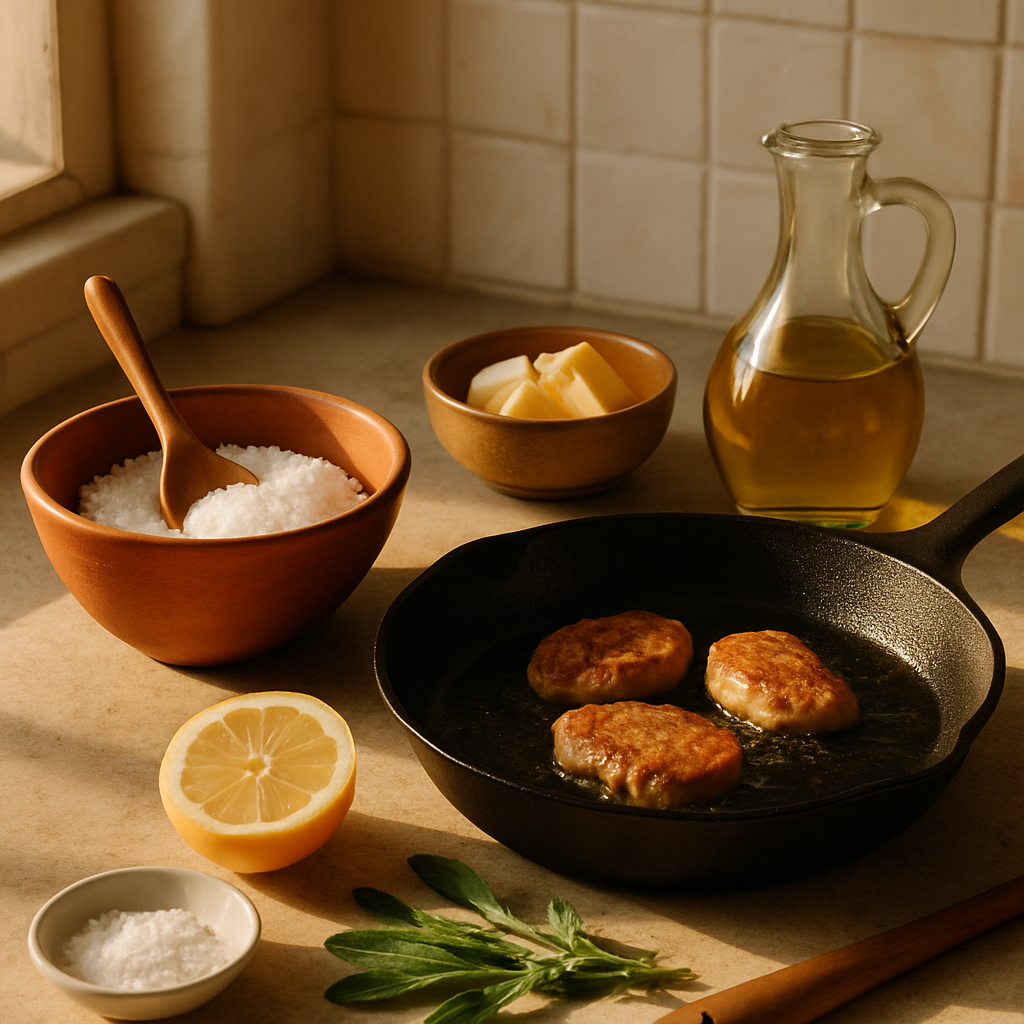
There's a reason restaurant food tastes different to home cooking — and it's rarely about secret ingredients or professional equipment. More often, it comes down to how chefs use three fundamental elements in combination: salt, fat, and heat. Understanding how these three interact can genuinely transform the way you cook.
Why These Three Elements Matter More Than Any Recipe
Most people treat salt, fat, and heat as separate considerations — season at the end, add butter here, turn up the hob there. But in practice, they're constantly influencing each other, and the results you get depend on how you use them together, not in isolation.
Salt doesn't just add a salty flavour — it suppresses bitterness, enhances sweetness, and amplifies aroma compounds in a way that makes food taste more like itself. Fat carries fat-soluble flavour molecules and slows the release of taste on your tongue, which means richness and depth. Heat drives chemical reactions — caramelisation, the Maillard reaction, evaporation — that create entirely new flavours from raw ingredients.
When these three work in harmony, food becomes balanced. When one is off, the whole dish can feel flat, heavy, or sharp.
How Salt Actually Works in a Dish
Salt's role goes far beyond making things taste "salty." At lower concentrations, sodium ions suppress bitter taste receptors, which is why a small pinch of salt in a chocolate cake or a pot of coffee makes it taste smoother and more rounded.
Salt also draws moisture out of ingredients through osmosis, which matters enormously for technique. Salt a courgette or a cucumber early, and you pull out excess water before it can make your dish soggy. Salt a steak 45 minutes before cooking and that moisture is reabsorbed along with dissolved salt, seasoning the meat from within rather than just on the surface — a process backed by food science research on brining and dry-brining techniques.
Timing matters. Adding salt at the start of cooking, during, and at the finish all do different things. Early salt seasons throughout. Late salt gives brightness and contrast. Finishing salts — flaky sea salt, for instance — add texture and a sharp initial hit that wakes a dish up just before it reaches the table.
The Role of Fat in Flavour
Fat is often thought of as a vehicle for calories, but in cooking it's primarily a vehicle for flavour. Many of the most important aromatic compounds in herbs, spices, and alliums are fat-soluble — meaning they only fully release their flavour when they come into contact with fat. This is why blooming spices in oil or butter before adding liquid makes such a noticeable difference.
Fat also affects mouthfeel and the pace of flavour release. A dish with sufficient fat feels satisfying and rounded; one with too little can taste sharp or thin even when the seasoning is technically correct. This is why a squeeze of lemon on roasted vegetables brightens them, but a drizzle of good olive oil after the fact makes them feel complete.
Different fats behave differently, too. Butter brings sweetness and richness. Olive oil brings grassy, peppery notes. Coconut oil brings a faint sweetness. Rendered animal fats — lard, duck fat, beef dripping — bring deep, savoury depth. Using the right fat for the dish is part of the balance.
Heat as a Flavour-Creation Tool
Heat isn't just a cooking mechanism — it's a flavour-creation tool. Two reactions are worth understanding properly: caramelisation and the Maillard reaction.
Caramelisation happens when sugars are exposed to high heat (around 160°C and above), breaking down and creating hundreds of new flavour compounds with bitter, nutty, and complex sweet notes. This is what happens to onions when you cook them low and slow, or to the cut side of a butternut squash in a hot oven.
The Maillard reaction is different — it's a chemical reaction between amino acids and reducing sugars that produces brown colour and deeply savoury, complex flavour. It's responsible for the crust on a seared steak, the golden colour of toasted bread, and the roasted character of coffee and chocolate. It only happens above around 140°C, and it requires a relatively dry surface — which is why patting meat dry before searing makes such a dramatic difference.
Understanding heat also means knowing when not to use high temperatures. Delicate proteins like fish, eggs, and cream-based sauces need gentle heat to avoid toughening, curdling, or splitting.
How Salt, Fat, and Heat Interact with Each Other
Here's where it gets interesting. These three elements don't just do their own jobs — they modify each other's effects.
Fat tempers heat. When you cook aromatics in oil or butter, the fat regulates the temperature around the ingredients, distributing heat more evenly than water does. This is why sautéing garlic in butter gives a different result to simmering it in stock — the fat drives more even browning and more thorough flavour development.
Salt affects how heat changes food. Salting vegetables before roasting draws out surface moisture, which then evaporates quickly in the oven. This means the surface dries faster and browns sooner, getting you better caramelisation with less risk of steaming. The opposite is true if you salt pasta water — that's not primarily about seasoning the pasta (though it helps), it's about raising the boiling point slightly and changing the starch gelatinisation behaviour.
Fat carries salt's effect. When you finish a pan sauce with a cold knob of butter — a technique called monter au beurre — the fat emulsifies into the sauce, rounding out any sharp edges and integrating the seasoning. The butter doesn't just add richness; it makes the salt and other flavours taste more cohesive.
Common Mistakes and How to Think Differently
The most common home cooking pitfall isn't under-seasoning — it's not tasting and adjusting throughout. Most recipes give you a starting point, not a finish line. Your tomatoes might be sweeter than the recipe writer's. Your butter might be saltier. Your hob might run hotter.
Another common mistake is adding too much fat all at once without enough heat to handle it. A pan that isn't hot enough before the oil goes in leads to food that stews rather than sears. Fat needs heat to do its job — and once the food goes in, you need to resist the urge to move it too soon. Let the Maillard reaction do its work.
People also underestimate the value of contrast. A dish doesn't have to be perfectly uniform — sometimes a little more salt in one component, a drizzle of fat over the top after cooking, or a hit of residual heat from a chilli makes the whole thing more interesting. Balance doesn't mean everything tasting the same. It means everything tasting right together.
Practical Takeaways for Cooking with All Three
Here are specific things you can put into practice tonight:
- Salt in layers. Season your onions when they go in the pan. Season the protein before it hits the heat. Taste the dish before serving and adjust — don't wait until the plate.
- Use fat early and late. Cook with a fat that suits the heat level. Finish with a different fat for flavour — a drizzle of extra virgin olive oil, a knob of butter, a spoonful of tahini — to add depth at the end.
- Get your pan genuinely hot before the fat goes in (for most high-heat cooking). Then let the food sit. Movement is the enemy of browning.
- Taste for sharpness vs. flatness. If a dish tastes flat, it usually needs salt. If it tastes sharp or thin, it often needs fat. If it tastes dull and grey, it probably needed more heat — or more time on heat — earlier in the process.
- Use salt to correct fat, and fat to correct salt. A dish that's slightly too rich can be lifted with a pinch of flaky salt or a squeeze of acid. A dish that's slightly over-salted can be rounded with a small amount of butter or cream.
If you want your meals to be as well-balanced nutritionally as they are in flavour, Macrology generates macro-perfect meal plans in seconds — [https://macrology.app/signin](https://macrology.app/signin)
Cooking is a skill that builds on itself. Once you start thinking about salt, fat, and heat as a system rather than three separate variables, the way you approach every dish — from a weeknight pasta to a Sunday roast — starts to shift in a way that's genuinely hard to un-see.
Want meals like this planned to your exact macros?
Macrology generates a personalised meal plan in seconds — breakfast, lunch, dinner and snacks, all hitting your daily targets.
Start your free 14-day trial