How to Use Rendered Fat to Add Flavour and Reduce Food Waste
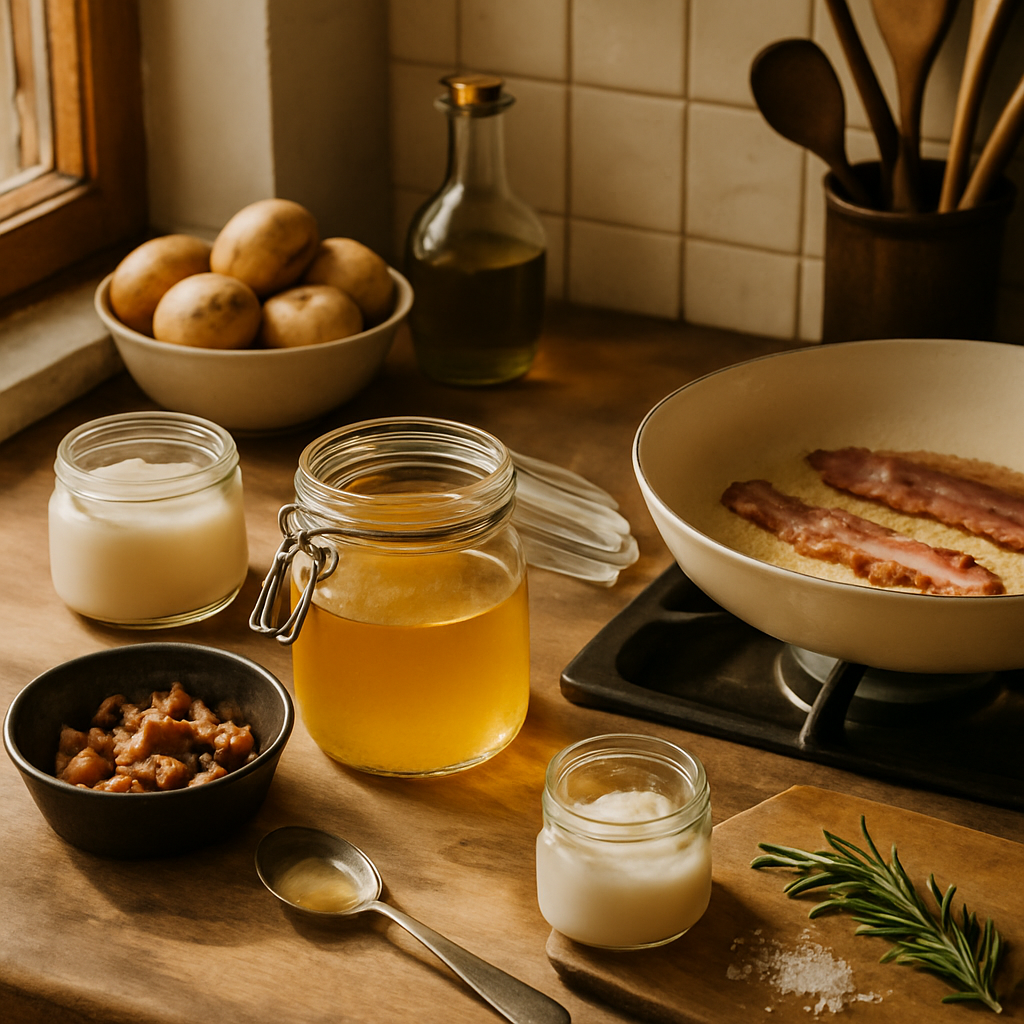
# How to Use Rendered Fat to Add Flavour and Reduce Food Waste
There's a reason your grandparents kept a jar of dripping on the kitchen counter — food cooked in rendered fat just tastes better. Yet somewhere along the way, we started pouring that golden liquid down the sink, buying expensive cooking oils to replace it, and wondering why our roast potatoes never quite matched the ones we remember from childhood.
Rendering fat is one of the oldest cooking techniques in the world, and it's also one of the most practical things you can do in a modern kitchen. Here's everything you need to know to start using it well.
What Is Rendered Fat, Exactly?
Rendering is simply the process of melting solid animal fat — from bacon, duck, chicken skin, beef, pork, or lamb — so that the pure fat separates from any remaining water and protein. What you're left with is a flavourful, stable cooking fat with a relatively high smoke point.
The most common types you'll encounter are:
- Bacon fat — smoky, salty, brilliant for frying eggs or roasting veg
- Duck fat — rich and mellow, the gold standard for roast potatoes
- Chicken schmaltz — the rendered fat from chicken skin, widely used in Jewish cooking and deeply savoury
- Lard — rendered pork fat, historically the most common cooking fat in Britain before vegetable oils took over
- Beef dripping — intense and beefy, classic for chips and Yorkshire puddings
Each has its own flavour profile and works better in some dishes than others, but the principle for using them is the same.
Why Rendered Fat Got a Bad Reputation (And Why That's Complicated)
The shift away from animal fats happened largely in the mid-20th century, driven by dietary guidelines that linked saturated fat to heart disease. Butter, lard, and dripping were replaced by margarine and vegetable oils, which were marketed as the healthier alternative.
The science behind that shift has been significantly revised since then. The original research linking dietary saturated fat to cardiovascular disease — most notably Ancel Keys' Seven Countries Study — has been criticised for cherry-picking data and failing to distinguish between different types of saturated fat.
That doesn't mean rendered fat is a health food you should pile onto everything. But it does mean the blanket demonisation was an oversimplification. Most nutrition researchers now take a more nuanced view, focusing on the overall dietary pattern rather than singling out individual fats.
What the Evidence Shows
Saturated fat is still an area of active research and genuine scientific debate, so it's worth being precise about what we do and don't know.
What the evidence does support is that replacing saturated fat with refined carbohydrates — which is largely what happened when households switched from lard to vegetable oils and processed spreads — doesn't appear to improve cardiovascular outcomes. A 2010 meta-analysis published in the American Journal of Clinical Nutrition by Siri-Tarino et al. found no significant association between saturated fat intake and cardiovascular disease when the replacement nutrient wasn't considered.
More recently, research has focused on the food matrix — the idea that how a fat is packaged in a whole food matters as much as the fat itself. Bacon fat used occasionally to roast a tray of vegetables is a very different thing from a diet built around ultra-processed foods high in industrially produced fats.
The practical takeaway from the evidence: rendered fat used in moderate quantities as part of a varied diet isn't something to worry about. Treating it as a flavour-enhancing cooking fat — rather than a primary source of calories — keeps it in sensible perspective.
The Food Waste Argument Is Genuinely Compelling
Set aside nutrition entirely for a moment, and the case for rendering fat is still strong. Most households throw away fat that has genuine cooking value — the white strips trimmed from a pork chop, the skin pulled off a chicken thigh, the pool of bacon grease left in the pan.
In the UK, we waste approximately 9.5 million tonnes of food per year according to WRAP (the Waste and Resources Action Programme). Not all of that is recoverable, but fat is. It's stable, it keeps well, and it's essentially a free cooking ingredient if you'd otherwise be binning it.
Rendering fat also connects to a broader principle of whole-animal or nose-to-tail cooking — using more of what you buy and extracting maximum value from it. You're already paying for the fat when you buy a packet of streaky bacon or a whole chicken. Rendering it means you actually use what you've paid for.
How to Render Fat at Home
It's easier than most people expect. There are two main methods:
On the hob (wet rendering): Cut the fat into small pieces and place in a heavy-bottomed pan with a splash of water. The water prevents the fat from scorching before it starts to melt. Cook on a very low heat, stirring occasionally, until the fat has liquefied and any solid bits (called cracklings or grieven) have turned golden and crisp. Strain through a fine sieve or muslin cloth into a clean jar.
In the oven (dry rendering): Place the fat pieces in a roasting tray and cook at around 150°C for 1–2 hours, depending on the quantity. The fat slowly melts out and collects in the tray. Strain and store as above.
Storage: Rendered fat keeps in the fridge for several weeks in a sealed jar, or in the freezer for months. Label it clearly — duck fat and chicken schmaltz can look very similar once rendered.
A quick note on bacon fat: You can collect this directly from the pan after frying. Let it cool slightly, then pour through a fine strainer into a heatproof jar to remove any burnt bits or crispy remnants that would cause it to spoil faster.
Practical Ways to Use Rendered Fat in Cooking
Once you've got a jar in the fridge, the uses are genuinely wide-ranging:
Roasting vegetables: Toss parsnips, potatoes, carrots, or cauliflower in duck fat or beef dripping before roasting. The higher smoke point means better browning and significantly more flavour.
Frying and sautéing: Bacon fat works brilliantly for frying eggs, cooking onions, or starting a shakshuka. Schmaltz is exceptional for sautéed cabbage or potato latkes.
Pastry: Lard produces flakier, more tender shortcrust pastry than butter alone. Many traditional British recipes — suet puddings, lard-based hot water crust — relied on this for good reason.
Seasoning cast iron: Rendered fat is excellent for maintaining a cast iron pan's seasoning layer.
Enriching sauces and gravies: A small spoonful of dripping stirred into a gravy adds depth and body that's difficult to replicate with butter.
Spreading on toast: Beef dripping on toast with a pinch of sea salt is a classic that deserves a comeback.
Practical Takeaways
Here's what you can act on straight away:
- Next time you fry bacon, don't wash the pan immediately. Let the fat cool, strain it into a jar, and keep it in the fridge. That's the simplest entry point.
- Buy a cheap roasting chicken, render the fat from the skin and cavity before or after cooking, and use it to roast your next batch of vegetables.
- Get a small, labelled jar in your fridge specifically for collected fats. Once it becomes a habit, it's effortless.
- Match fat to dish: duck fat for potatoes and root veg, bacon fat for eggs and brassicas, schmaltz for Jewish-inspired dishes, lard for pastry, dripping for chips and toast.
- Start with small amounts. A tablespoon of rendered fat goes a long way — you're using it for flavour and cooking performance, not as the main ingredient.
If you want to build meals that actually use up what's in your fridge — fats included — Macrology generates macro-perfect meal plans in seconds — https://macrology.app/signin
Rendered fat isn't a trend or a nostalgic quirk. It's a practical, flavourful, low-waste cooking ingredient that the best kitchens never stopped using. The jar of dripping on the counter was always the right idea — we just briefly forgot why.
Want meals like this planned to your exact macros?
Macrology generates a personalised meal plan in seconds — breakfast, lunch, dinner and snacks, all hitting your daily targets.
Start your free 14-day trial