How to Use Gentle Heat to Cook Eggs Perfectly Every Time
# How to Use Gentle Heat to Cook Eggs Perfectly Every Time
There's a good chance you've been cooking eggs on too high a heat your whole life — and nobody told you. The difference between a rubbery scramble and a silky one, or a bouncy fried egg and a perfectly set one, often comes down to a single dial on your hob.
Gentle heat is one of those cooking fundamentals that sounds almost too simple to matter. But once you understand why it works, you'll never reach for full blast again.
Why Heat Level Changes Everything with Eggs
Eggs are largely made up of protein, and protein behaves in a very specific way when it meets heat. At lower temperatures, egg proteins coagulate slowly and gently, forming soft, tender curds or a smooth, cohesive set. Crank the heat up, and those same proteins contract fast and forcefully — squeezing out moisture and turning your eggs tough, dry, or rubbery.
This isn't just feel — it's basic food science. Egg whites begin to set at around 60°C, while yolks firm up a little higher, around 65–70°C. A screaming hot pan shoots well past these thresholds in seconds, which is why high-heat eggs so often disappoint.
The good news is that working with those temperatures rather than against them is completely achievable on a standard home hob. You don't need specialist equipment — just a bit of patience and an understanding of what's actually happening in the pan.
Scrambled Eggs: Low and Slow is the Way
Scrambled eggs might be the most commonly ruined egg dish in British kitchens. They're also the one where gentle heat makes the most dramatic difference.
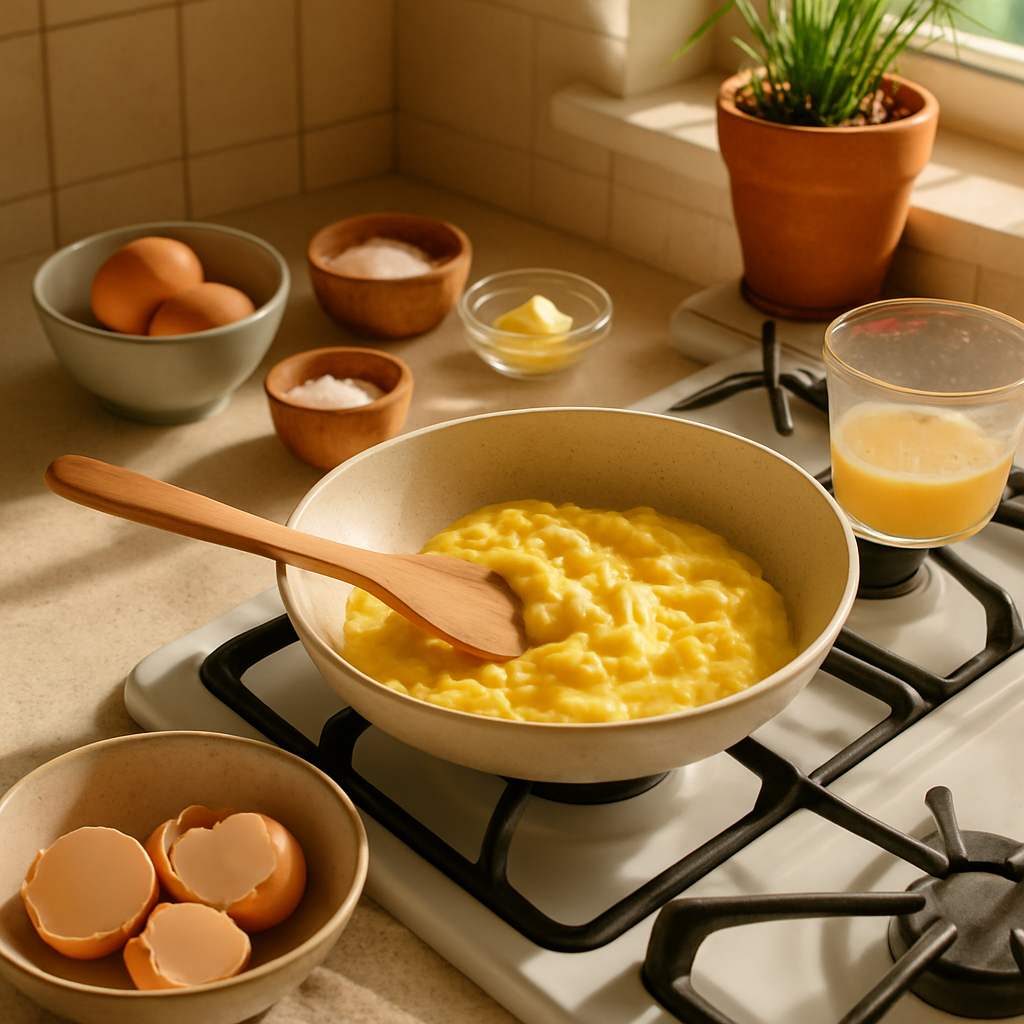
The method is straightforward: beat your eggs (two or three per person), add a small knob of butter to a cold pan, and set it over the lowest heat your hob will manage. Add the eggs before the butter has fully melted. Then stir — slowly and continuously — moving the eggs around the pan with a spatula or wooden spoon.
The whole process will take longer than you're used to, probably four to six minutes. That's entirely normal and very much the point. The eggs will look underdone for a while, then suddenly come together into soft, creamy folds. Pull the pan off the heat just before they look fully set, because residual heat will finish them off.
A common misconception is that adding milk makes scrambled eggs creamier. In practice, milk dilutes the egg proteins and can actually make the texture slightly watery. A small splash of cream, or nothing at all, tends to give better results.
Fried Eggs: The Case Against a Screaming Hot Pan
The sizzle of an egg hitting a searingly hot pan feels satisfying, but the result is usually an egg with frilly, browned, slightly crispy whites and a yolk that's started cooking from the sides inward — not always what anyone was after.
For a fried egg with fully set, tender whites and a yolk you can control, use a non-stick pan over medium-low heat with a small amount of butter or oil. Let the fat warm gently — you're not aiming for smoking oil — then crack in your egg. The white should spread slowly and cook quietly, without aggressive bubbling around the edges.
Cover the pan with a lid if you want the yolk to set without flipping. The trapped steam gently cooks the top of the yolk while the bottom sets on the pan. This gives you a "basted" egg without actually basting — a clean, easy technique that works consistently.
For a runny yolk, keep a close eye from about two minutes in. For a firmer set, leave it a little longer. Gentle heat means you're in control rather than racing against a pan that's too hot to manage.
Poached Eggs: Water Temperature is Everything
Poached eggs have a reputation for being fiddly, but most of the difficulty comes from one thing: boiling water. A rolling boil tears the egg white apart before it has a chance to set around the yolk.
What you actually want is water that's just below a simmer — around 80–85°C. You'll see small bubbles rising from the base of the pan, but the surface should be mostly still. Add a splash of white wine vinegar if you like (it helps the white coagulate a little faster), but it's not essential.
Crack your egg into a small cup or ramekin first, lower it close to the water's surface, then tip it in gently. Set a timer for three minutes for a runny yolk, or up to four for something a little firmer. Use a slotted spoon to lift it out, and rest it briefly on kitchen paper to remove excess water.
The vinegar tip is worth addressing directly: it does help, but it can also leave a faint taste if you use too much. A teaspoon is plenty. Freshness of the egg matters more — a very fresh egg has a tighter white that holds together naturally.
Boiled Eggs: Starting Cold Makes a Real Difference
Most people start boiled eggs in already-boiling water, which works — but starting them in cold water gives you more even cooking and more predictable results, particularly for soft-boiled eggs.
Place your eggs in a pan and cover with cold water. Bring to a gentle boil, then reduce to a simmer immediately. From the point of simmering, six minutes gives a soft, jammy yolk, seven minutes gives a mostly set yolk with a slightly soft centre, and nine to ten minutes gives a fully hard-boiled egg.
Once the time is up, transfer the eggs to a bowl of cold water or run them under the cold tap to stop the cooking. This prevents the greenish ring that can form around the yolk of an overcooked boiled egg — that ring is caused by a reaction between iron in the yolk and sulphur in the white, and it's entirely harmless but not particularly appealing.
Steaming is worth a mention here too. Some cooks swear by steaming eggs over a small amount of boiling water rather than submerging them. It produces very consistent results and the shells often peel more easily, which is a genuine quality-of-life improvement if you're making several at once.
Omelettes: Fast but Still Controlled
Unlike scrambled eggs, a classic French omelette does use a slightly higher heat — but it's still a controlled, medium heat rather than a high one, and the technique demands full attention throughout.
Melt butter in a non-stick pan over medium heat. Add beaten, seasoned eggs and immediately start moving them with a fork or spatula, drawing the cooked edges toward the centre. Once the eggs are mostly set but still slightly wet on top, stop stirring and let the base colour just a little — maybe thirty seconds.
Tilt the pan and fold the omelette away from you onto a plate. It should be pale gold on the outside, soft and almost custardy within. If it's turning golden brown or firm all the way through, the heat was too high.
Fillings — cheese, herbs, finely diced vegetables — go in just before the fold, while there's still enough heat in the egg to melt them slightly.
Practical Takeaways
Here's what to take away from all of this, in plain terms:
- Turn the heat down — most egg problems come from too much heat, not too little
- Use a heavy-based or non-stick pan where possible; thin pans heat unevenly and spike quickly
- Give yourself an extra two or three minutes; slow cooking is almost always forgiving, fast cooking rarely is
- Remove eggs from heat slightly early — residual heat continues cooking, so factor that into your timing
- Fresh eggs behave better for poaching and frying; slightly older eggs can actually be easier to peel when boiled
- A lid is underused — it creates gentle, even heat from both directions without needing to flip
None of this requires expensive equipment or unusual skill. It's just about understanding that eggs respond to patience in a way that almost nothing else in the kitchen does quite so noticeably.
If you want meal plans built around high-protein, practical cooking just like this, Macrology generates macro-perfect meal plans in seconds — https://macrology.app/signin
Want meals like this planned to your exact macros?
Macrology generates a personalised meal plan in seconds — breakfast, lunch, dinner and snacks, all hitting your daily targets.
Start your free 14-day trial