How to Use Finishing Techniques to Elevate Simple Weeknight Dishes
# How to Use Finishing Techniques to Elevate Simple Weeknight Dishes
There's a gap between food that's cooked and food that tastes finished — and most of us have eaten on both sides of it without quite knowing why. A bowl of pasta that somehow tastes restaurant-quality. A roasted chicken thigh that makes you pause mid-bite. The difference is rarely a fancy ingredient or an extra hour in the kitchen.
It's almost always technique.
What "Finishing" Actually Means
Finishing is what happens in the last minute or two of cooking — or even after the heat is off. It's the layer of decisions that turns something adequate into something memorable. A squeeze of lemon over a pan of wilted greens. A knob of cold butter swirled into a sauce just before serving. A pinch of flaky salt dropped onto scrambled eggs at the very end.
These aren't decorative gestures. They change the chemistry of the dish — adjusting acidity, adding richness, altering texture, and sharpening flavour in ways that heat alone can't achieve.
The good news is that none of this requires skill that takes years to develop. Most finishing techniques are fast, cheap, and immediately learnable.
Acid: The Most Underused Tool in a Home Kitchen
Ask most professional cooks what separates a dish that sings from one that falls flat, and the answer is almost always acid. A splash of something sharp — lemon juice, red wine vinegar, a spoonful of capers — cuts through richness, brightens dull flavours, and makes everything taste more like itself.
The classic mistake is adding acid too early. When you cook lemon juice into a sauce, much of its bright, volatile flavour cooks off and you're left with a dull sourness. Add it at the very end — right before serving, sometimes even in the bowl — and it lifts everything.
Try this tonight: finish your next roasted vegetables with a small squeeze of lemon juice and a tiny pinch of salt before they leave the tray. You'll notice the difference immediately. The same principle works for soups, braises, and grain dishes — a few drops of sherry vinegar stirred into lentil soup just before serving is transformative.
Fat at the End: Why Cold Butter Changes Everything
Swirling cold butter into a hot sauce is one of those techniques that feels almost too simple to matter. In French cooking, it's called monter au beurre, and it does several things at once: it adds richness, creates a glossy sheen, slightly thickens the sauce, and rounds out any harsh edges in the flavour.
The key word is cold. Room-temperature or melted butter just adds grease. Cold butter emulsifies into the sauce, creating a velvety texture that clings to pasta, fish, or vegetables in a completely different way.
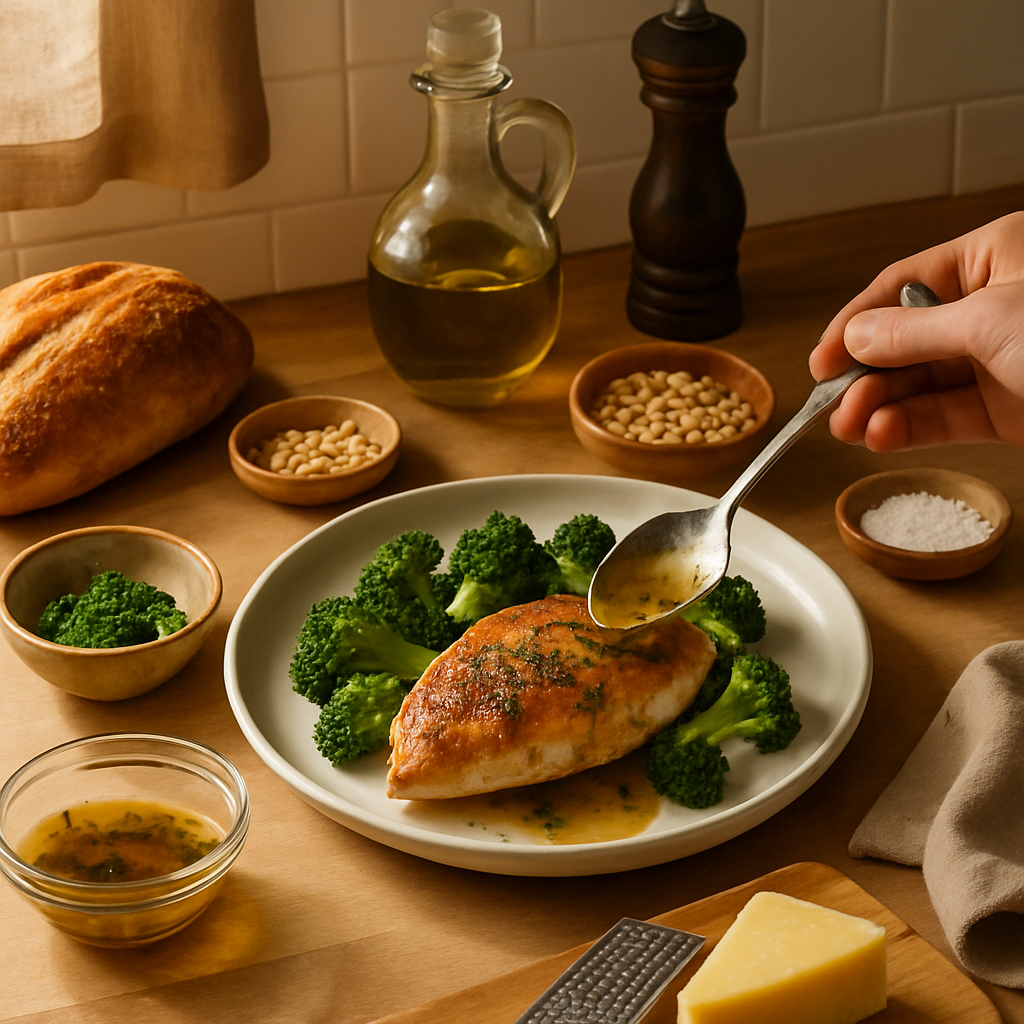
You don't need much. A 15g cube of cold butter swirled into a simple pan sauce made from the residual fat and juices of a chicken breast is enough to make it taste considered. Drizzling good olive oil over a finished dish — especially soups, grains, or roasted root vegetables — works on the same principle. The fat carries fat-soluble flavour compounds and adds mouthfeel.
Texture Is a Finishing Decision
One of the easiest ways to make a weeknight meal feel more complete is to add textural contrast at the end, rather than during cooking. Crunch, in particular, is something most home cooks overlook.
A handful of toasted breadcrumbs scattered over pasta. Roughly chopped toasted nuts on roasted carrots. Crispy shallots (even from a jar) over a lentil dal. Seeds — sesame, pumpkin, sunflower — on top of a grain bowl. None of these elements need to cook; they just need to arrive at the last moment so they stay crisp.
The reason texture matters so much is that eating is a whole-body experience. Research in food perception consistently shows that texture plays a significant role in how satisfying we find a meal — not just how it tastes on the tongue. A bowl of food that offers only one texture, however well-seasoned, tends to feel incomplete. Adding crunch costs almost no time and no cooking skill.
Herbs: Fresh at the End, Not Before
Dried herbs can go in early — they need heat and moisture to bloom. But fresh herbs are volatile, and their flavour and colour degrade quickly with heat. Adding fresh parsley, coriander, basil, or tarragon right at the end — sometimes after you've turned off the heat entirely — is the difference between herbs that taste bright and grassy and herbs that taste muddy and grey.
The other thing worth knowing is that hardy herbs and delicate herbs behave differently. Rosemary and thyme can take some heat, but they're still better added towards the end rather than the very beginning for most dishes. Delicate herbs like basil, mint, and flat-leaf parsley should almost always be a finishing element — torn or roughly chopped rather than finely minced, so their essential oils don't all escape onto your cutting board.
Pairing herbs thoughtfully makes a real difference too. Mint and lemon over roasted courgette. Coriander and lime over a simple black bean dish. Dill stirred into Greek yoghurt alongside salmon. These combinations are classics because they work — the herbaceous note completes a flavour profile that would otherwise feel unfinished.
Salt: When You Add It Matters as Much as How Much
The finishing salt conversation has somewhat taken over from the actual principle, so let's be clear: flaky sea salt at the end of cooking is not just aesthetic. It provides a burst of saltiness that lands differently to salt that has dissolved into a sauce during cooking.
Salt that's cooked in distributes evenly and seasons from within. Salt added at the finish provides punctuation — small hits of intensity that make the palate work. It's why a pinch of Maldon salt on a piece of dark chocolate is such an effective combination. It's also why finishing a simply grilled piece of fish or a soft-boiled egg with flaky salt makes it taste noticeably more complete than if you'd salted it only during cooking.
This doesn't mean doubling your salt intake. It means splitting your seasoning — season during cooking for baseline flavour, then add a small amount of flaky salt right at the end for contrast and brightness. Many people find that food seasoned this way feels more satisfying, which can mean eating less overall to feel content.
Putting It Together on a Weeknight
The best part about finishing techniques is that they require no planning, no extra shopping trip, and almost no extra time. The ingredients involved — lemons, butter, olive oil, fresh herbs, flaky salt, a bag of breadcrumbs or mixed seeds — are cheap and last well. Having them in your kitchen as standard changes what's possible on a Tuesday evening.
Here's how a simple weeknight plate might look when you apply these principles:
A pan of quick-cooked salmon fillets, finished with a small squeeze of lemon juice and a swirl of cold butter in the pan to create a quick sauce. Served over simple steamed rice. Scattered with a handful of roughly torn dill and a pinch of flaky salt. A spoonful of toasted sesame seeds for crunch.
The salmon took twelve minutes. The finishing took ninety seconds. But the result is a plate that feels intentional — because it is.
Practical Takeaways
Start with acid. If a dish tastes flat or one-dimensional, try a squeeze of lemon or a small splash of vinegar before adding anything else. It costs nothing and it's usually the answer.
Keep cold butter and flaky salt within reach. Not buried in the fridge or at the back of a cupboard — actually accessible when you're cooking.
Build a finishing shelf. Flaky sea salt, a good olive oil, a lemon or two, a jar of capers, a bag of mixed seeds or nuts, and dried chilli flakes will take you a very long way.
Taste after every finishing addition. One extra squeeze of lemon or one more pinch of salt can tip a dish from good to great — or from great to over-seasoned. Tasting as you go is the only way to know where you are.
Treat fresh herbs as a finishing ingredient by default. Buy them, store them properly (upright in a glass of water in the fridge), and use them at the end of cooking rather than the beginning.
If you want meal plans that already account for balanced, satisfying meals built around these kinds of principles, Macrology generates macro-perfect meal plans in seconds — https://macrology.app/signin
Want meals like this planned to your exact macros?
Macrology generates a personalised meal plan in seconds — breakfast, lunch, dinner and snacks, all hitting your daily targets.
Start your free 14-day trial