How to Use Emulsification to Build Richer Sauces and Dressings
# How to Use Emulsification to Build Richer Sauces and Dressings
Ever wondered why a homemade vinaigrette always separates into two sad layers within minutes, while a good mayonnaise stays perfectly creamy for weeks? The answer is emulsification — and once you understand it, your sauces and dressings will never be the same.
What Is Emulsification, Actually?
At its core, emulsification is the process of combining two liquids that don't naturally mix — usually oil and water (or something water-based, like vinegar or lemon juice). Left to their own devices, oil and water will always separate, because oil molecules are non-polar and water molecules are polar. They're fundamentally incompatible.
An emulsion forms when one liquid is dispersed as tiny droplets throughout the other, held in suspension. The result is something new — a texture that's creamy, cohesive, and far more complex than either ingredient alone.
There are two main types: oil-in-water emulsions, where oil droplets are suspended in a water-based liquid (think vinaigrette or hollandaise), and water-in-oil emulsions, where the reverse is true (think butter). Most sauces and dressings you'll make at home fall into the first category.
The Secret Ingredient: Emulsifiers
Here's the key piece of the puzzle. Oil and water won't stay mixed on their own — you need an emulsifier to hold them together. Emulsifiers are molecules with a split personality: one end is attracted to water (hydrophilic) and the other is attracted to fat (lipophilic). They sit at the boundary between the two liquids, essentially acting as a bridge.
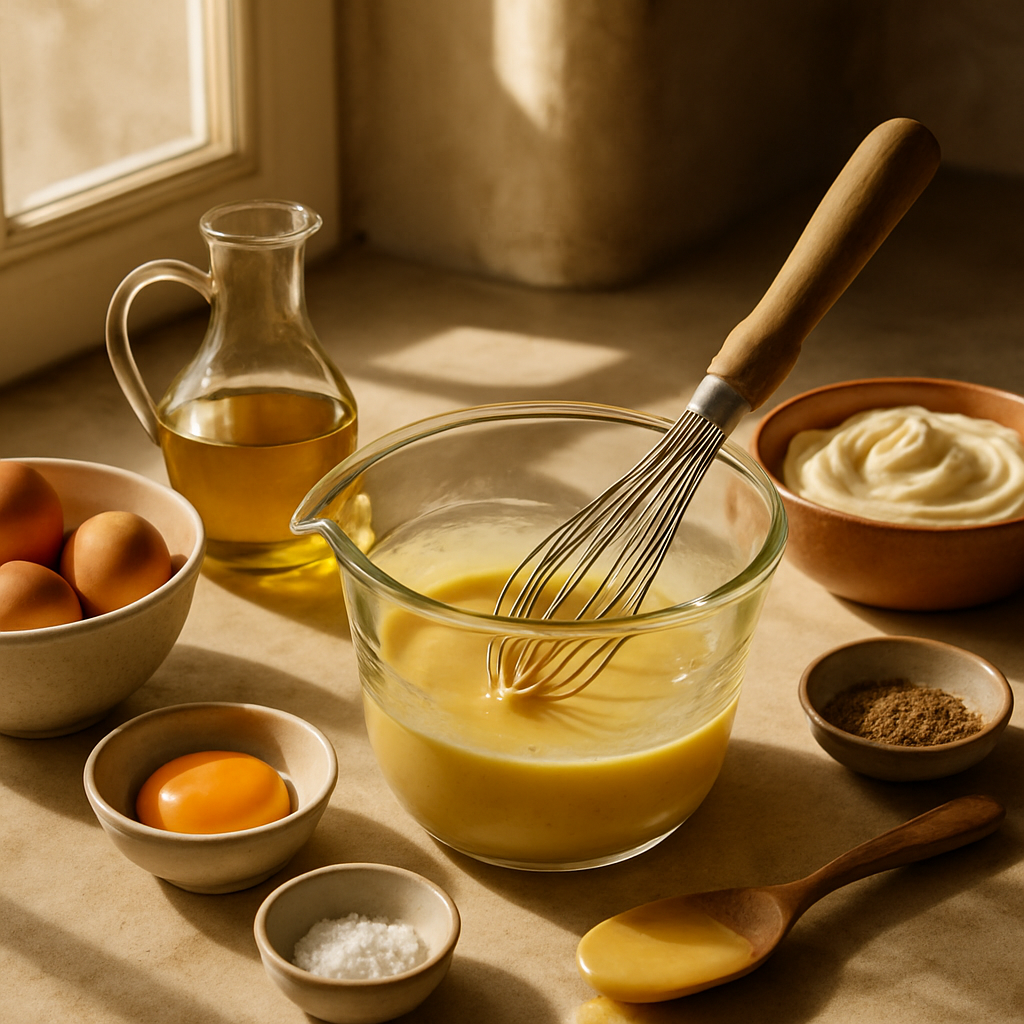
The most famous emulsifier in cooking is lecithin, found in egg yolks. This is why egg yolk is the backbone of mayonnaise, hollandaise, and béarnaise — it contains enough lecithin to hold a surprisingly large amount of oil in suspension.
Other natural emulsifiers you probably already have in your kitchen include mustard (specifically the mucilage in mustard seeds), honey, and garlic. These won't create as stable an emulsion as egg yolk, but they'll meaningfully improve the consistency of a vinaigrette compared to oil and vinegar alone. Even the starchy water left over from cooking pasta contains emulsifying compounds — which is exactly why pasta water is such a valuable addition to a good cacio e pepe.
Temporary vs. Stable Emulsions
Not all emulsions are created equal, and understanding the difference helps you troubleshoot when things go wrong.
A temporary emulsion — like a basic vinaigrette shaken in a jar — will hold together for a short time but eventually separate. The oil droplets aren't small enough or stable enough to stay suspended. You can shake or whisk it back together, but it won't last.
A stable emulsion — like mayonnaise or a properly made hollandaise — holds together much longer because the emulsifier has properly coated the oil droplets and locked them in place. The process of making these sauces involves adding the oil very slowly, giving the emulsifier molecules time to arrange themselves around each droplet.
A semi-stable emulsion sits in the middle. A good Dijon vinaigrette, for example, will hold together longer than a plain oil-and-vinegar mix thanks to the mustard, but won't stay emulsified indefinitely. For everyday dressings, this is often perfectly sufficient.
What the Evidence Shows
The science of emulsification has been studied extensively in food science, and a few practical findings are worth knowing about.
Research published in food science literature consistently shows that droplet size matters enormously for emulsion stability. The smaller and more uniform the oil droplets, the more stable the emulsion. This is why vigorous whisking or blending produces a better result than gentle stirring — mechanical force breaks the oil into finer droplets that are easier for emulsifiers to coat.
Studies on lecithin, the emulsifier in egg yolk, confirm that it's remarkably effective even in small quantities. A single egg yolk contains enough lecithin to emulsify well over a litre of oil under the right conditions — far more than you'd ever need in a home kitchen recipe. The limiting factor in practice is usually technique, not the amount of emulsifier.
Temperature also plays a significant role. Cold fat emulsifies poorly — which is why making mayonnaise with refrigerator-cold oil often leads to failure or a greasy, broken sauce. Room-temperature ingredients allow the emulsifier molecules to move more freely and do their job more effectively.
Common Mistakes and How to Avoid Them
The most frequent cause of a broken emulsion is adding oil too quickly. If you pour a large amount of oil in at once, the emulsifier simply can't coat all the droplets fast enough, and the sauce splits. The fix is to start with just a few drops of oil, whisking constantly, until the emulsion begins to form — then gradually increase the rate as the sauce becomes more stable.
A broken sauce isn't always a disaster. Mayonnaise that has split can often be rescued by starting fresh in a clean bowl with a new egg yolk and slowly whisking the broken sauce back into it as if it were oil. The new yolk provides fresh emulsifier to stabilise everything.
Another common mistake is using too much acid too early. Acid (vinegar or lemon juice) is important for flavour and helps thin the sauce slightly, but adding all of it at the beginning can interfere with the emulsification process. A useful technique is to add half the acid at the start and the rest once the emulsion is established.
Finally, don't overlook salt. Salt doesn't directly emulsify anything, but it affects the texture and perceived body of a sauce in ways that make it taste richer and more cohesive. Add it early so it dissolves properly and integrates into the flavour.
Building Better Dressings Without a Recipe
Once you understand the principles, you don't need to follow a dressing recipe to the letter. A reliable framework for a stable vinaigrette looks something like this:
Start with your emulsifier — a teaspoon of Dijon mustard is the most practical choice for everyday cooking. Add your acid (around one part vinegar or citrus juice to three parts oil is a classic ratio, though you can adjust to taste). Whisk those together first, then add the oil in a slow, steady stream while whisking continuously. Season as you go.
From there, everything else is flavour. Garlic, shallots, herbs, honey, miso, tahini — all of these can add complexity, and several of them (garlic, honey, miso) will also contribute mild emulsifying properties of their own, making the dressing even more cohesive.
Tahini-based dressings are worth a special mention. Tahini is made from ground sesame seeds, which are naturally high in lecithin, making it an excellent emulsifier as well as a source of flavour and richness. A simple tahini dressing — tahini, lemon juice, garlic, and water — comes together into a beautifully creamy consistency with almost no effort.
Practical Takeaways
Here's what you can put to use today:
For vinaigrettes: Always add a small amount of Dijon mustard before whisking in the oil. Use room-temperature ingredients. Add oil gradually. Store in a jar in the fridge and shake before using.
For mayonnaise and aioli: Use room-temperature egg yolks and oil. Add the oil drop by drop at first. If it splits, rescue it with a fresh yolk rather than throwing it away.
For pan sauces: When finishing a sauce with cold butter (a technique called monter au beurre), add the butter off the heat in small cubes while swirling the pan. The butter emulsifies into the sauce, creating that glossy, restaurant-quality finish.
For pasta sauces: Save a cup of pasta cooking water before you drain. The starchy, salty water helps emulsify the fat in the sauce and bind everything to the pasta.
If you want your meals to work as hard nutritionally as they do in the kitchen, Macrology generates macro-perfect meal plans in seconds — https://macrology.app/signin
Want meals like this planned to your exact macros?
Macrology generates a personalised meal plan in seconds — breakfast, lunch, dinner and snacks, all hitting your daily targets.
Start your free 14-day trial