How to Use Deglazing to Build Deeper Flavour in Everyday Cooking
# How to Use Deglazing to Build Deeper Flavour in Everyday Cooking
That sticky, dark residue coating the bottom of your pan after searing a chicken breast or browning some mince? Most people wash it straight down the sink. That's one of the most flavourful things in your kitchen, and it's gone.
Deglazing is one of those techniques that professional chefs rely on constantly, yet it barely gets a mention in most home cooking guides. Once you understand it, you'll never look at a hot pan the same way again.
What deglazing actually is
When you cook meat, vegetables, or anything with natural sugars over high heat, the surface of your pan develops a layer of caramelised, browned bits. These are called fond — a French term meaning "base" or "foundation" — and they're packed with concentrated flavour compounds created through the Maillard reaction, the same chemical process responsible for the crust on a good steak or the golden base of a roasted onion.
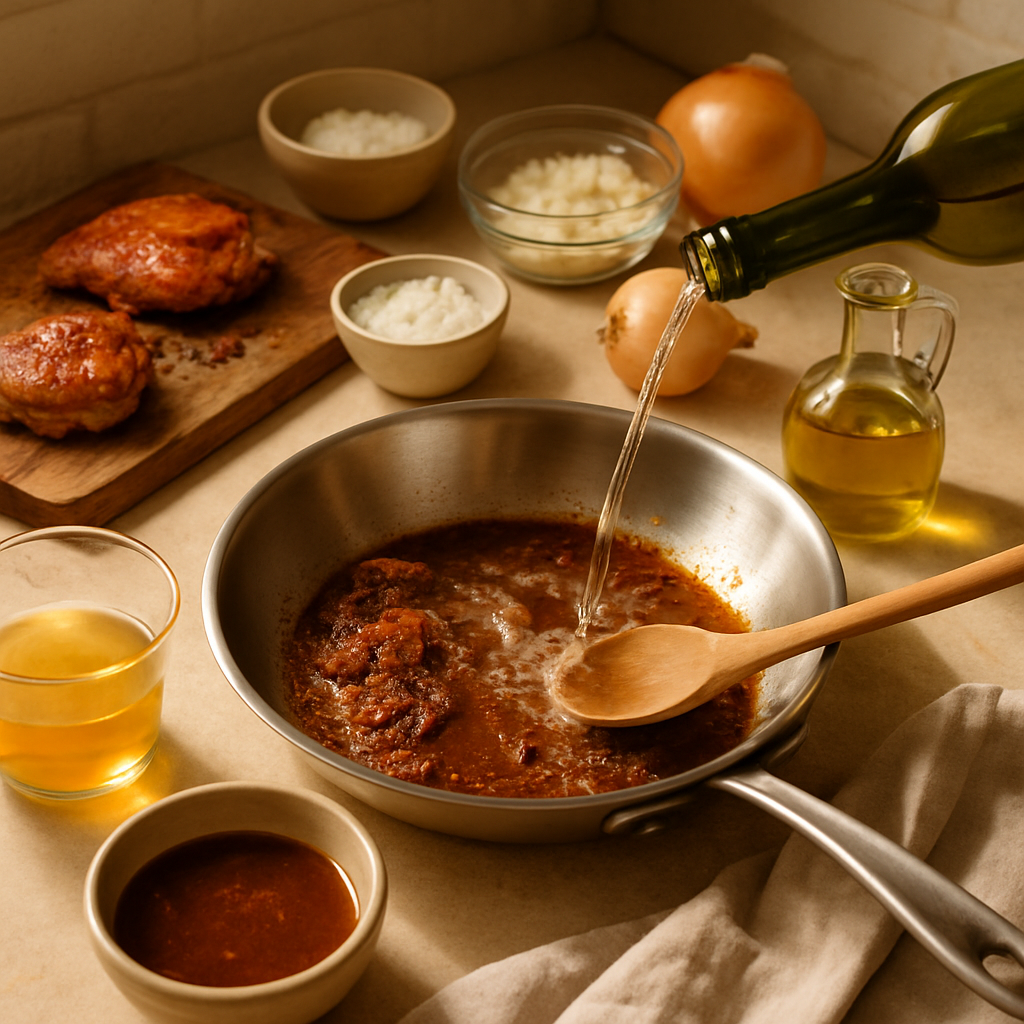
Deglazing is simply the act of adding liquid to a hot pan to lift those browned bits off the surface and dissolve them into your dish. The liquid hits the hot metal, steam erupts, the fond loosens, and suddenly you have the beginnings of a sauce, a gravy, a braise, or a deeply flavoured base for almost anything.
It takes about thirty seconds and costs nothing extra.
Why it makes such a dramatic difference
The Maillard reaction creates hundreds of different flavour compounds — aromatic molecules that don't exist in the raw ingredients. When you deglaze, you're not just preventing waste; you're actively incorporating those compounds into your dish in a way that would be impossible otherwise.
The result is depth — that quality in a dish where one flavour seems to sit behind another, where there's something going on that you can't quite identify but would absolutely notice if it were missing. It's the difference between a pan sauce that tastes like stock and one that tastes like it's been cooking for hours.
This is why restaurant food often tastes more complex than the same dish made at home with identical ingredients. The technique is doing the heavy lifting, not some secret ingredient.
What liquids work best
Almost any liquid can deglaze a pan, which is part of what makes this technique so versatile. The choice depends on what you're cooking and what direction you want the flavour to go.
Wine — red or white — is the classic choice and for good reason. The alcohol helps dissolve fat-soluble flavour compounds that water alone can't capture, and as it reduces, it adds acidity and complexity. You don't need anything expensive; a basic table wine works perfectly well. Red wine suits beef, lamb, and robust stews. White wine works beautifully with chicken, fish, pork, and creamy sauces.
Stock is a reliable everyday option. It adds body and a savoury backbone without the acidity of wine, making it good for braises and gravies where you want something more neutral to build on.
Cider and beer are underused and brilliant. Dry cider with pork and apple dishes creates something genuinely special. A dark ale deglazing a beef stew adds a subtle bitterness and maltiness that wine simply can't replicate.
Vinegar — particularly balsamic, sherry, or cider vinegar — works in small amounts when you want acidity and a touch of sweetness. It's especially effective with vegetables, caramelised onions, and liver.
Even water works in a pinch, though it won't add much flavour of its own. At minimum, it rescues the fond from burning and incorporates it into your dish.
The technique, step by step
The method is straightforward, but a few details make the difference between a great result and a mediocre one.
Get your pan properly hot before you add the liquid. The dramatic sizzle when the liquid hits the pan is doing actual work — it's the rapid temperature change that shocks the fond loose from the surface. If the pan isn't hot enough, the liquid just sits there.
Use enough liquid to cover the base. For a standard frying pan, that's usually around 100–200ml depending on the size. You can always reduce it down afterwards, so don't be shy.
Scrape actively. Use a wooden spoon or a silicone spatula to work the bottom of the pan as the liquid bubbles. You're physically dislodging the fond and dissolving it into the liquid. Don't just pour and walk away.
Let it reduce. Once the fond is incorporated, keep the heat on and let the liquid simmer and reduce. This concentrates the flavour and, if you've used wine or stock, gives you a proper pan sauce with some body. Add a knob of butter at the end and swirl it in off the heat for a glossy, restaurant-style finish.
Timing matters. Deglaze while the pan is still very hot — immediately after removing the meat or vegetables. If you let the pan cool down, the fond can harden and become more difficult to lift.
What the evidence shows
The science behind why deglazing works so well comes down to the chemistry of the Maillard reaction and the role of glutamates — naturally occurring compounds that contribute to what we perceive as umami, or savoury depth.
Research published in food chemistry journals has consistently shown that high-heat browning of proteins and sugars produces a complex array of volatile aromatic compounds — pyrazines, furans, and aldehydes among them — that are responsible for the characteristic "roasted" or "cooked" flavour in meat and vegetables. These compounds are concentrated in the fond.
The addition of an acidic liquid like wine or vinegar during deglazing also plays a chemical role: it helps break down some of the larger flavour molecules and makes them more bioavailable in terms of flavour perception. Acidity also brightens a dish — it lifts and sharpens the overall flavour profile in a way that salt alone doesn't achieve.
This is also why many classic French sauces — bordelaise, chasseur, pan au jus — are built almost entirely on deglazed fond. The technique isn't just traditional; it's chemically efficient.
Common mistakes and how to avoid them
The most common issue is burning the fond. There's a difference between dark brown and black — once it crosses into truly scorched territory, it becomes bitter and acrid, and no amount of deglazing will fix it. If you see smoke and the bottom of your pan looks very dark rather than rich brown, lower the heat before you deglaze or the bitterness will carry through.
Another frequent mistake is not reducing the liquid enough. A watery pan sauce with fond dissolved in it isn't bad, but it's not what you're aiming for. Give it time to concentrate — even three to four minutes of active simmering makes a significant difference.
Finally, some people add cold liquid to a very hot pan and pull back instinctively when it steams and spits. That reaction is normal and expected — just keep your face clear of the pan and keep stirring. The vigorous activity is what lifts the fond efficiently.
Practical takeaways
Here's how to start using deglazing in your cooking this week without changing anything else about how you cook:
- The next time you sear or fry anything — chicken thighs, mince, a pork chop, mushrooms — don't clean the pan. Add a splash of wine, stock, or cider and scrape.
- Build a habit of always finishing pan-cooked meat with a quick deglaze. Even 100ml of chicken stock, reduced for two minutes with a small knob of butter, becomes a simple pan sauce that transforms the dish.
- Keep a cheap bottle of dry white wine or a carton of stock in the kitchen specifically for cooking. The investment is minimal; the flavour return is significant.
- Experiment with matching the liquid to the dish: red wine with red meat, white wine or cider with poultry and pork, beer with heartier braises, a small splash of balsamic with roasted vegetables or liver.
- Taste as you go. Once the liquid has reduced, adjust for seasoning — the fond itself is flavourful but unseasoned, so salt and pepper at the end is essential.
If you want meal plans that are built around practical, flavour-forward cooking techniques like this, Macrology generates macro-perfect meal plans in seconds — https://macrology.app/signin
Want meals like this planned to your exact macros?
Macrology generates a personalised meal plan in seconds — breakfast, lunch, dinner and snacks, all hitting your daily targets.
Start your free 14-day trial