How to Rest and Slice Meat Properly for Better Results
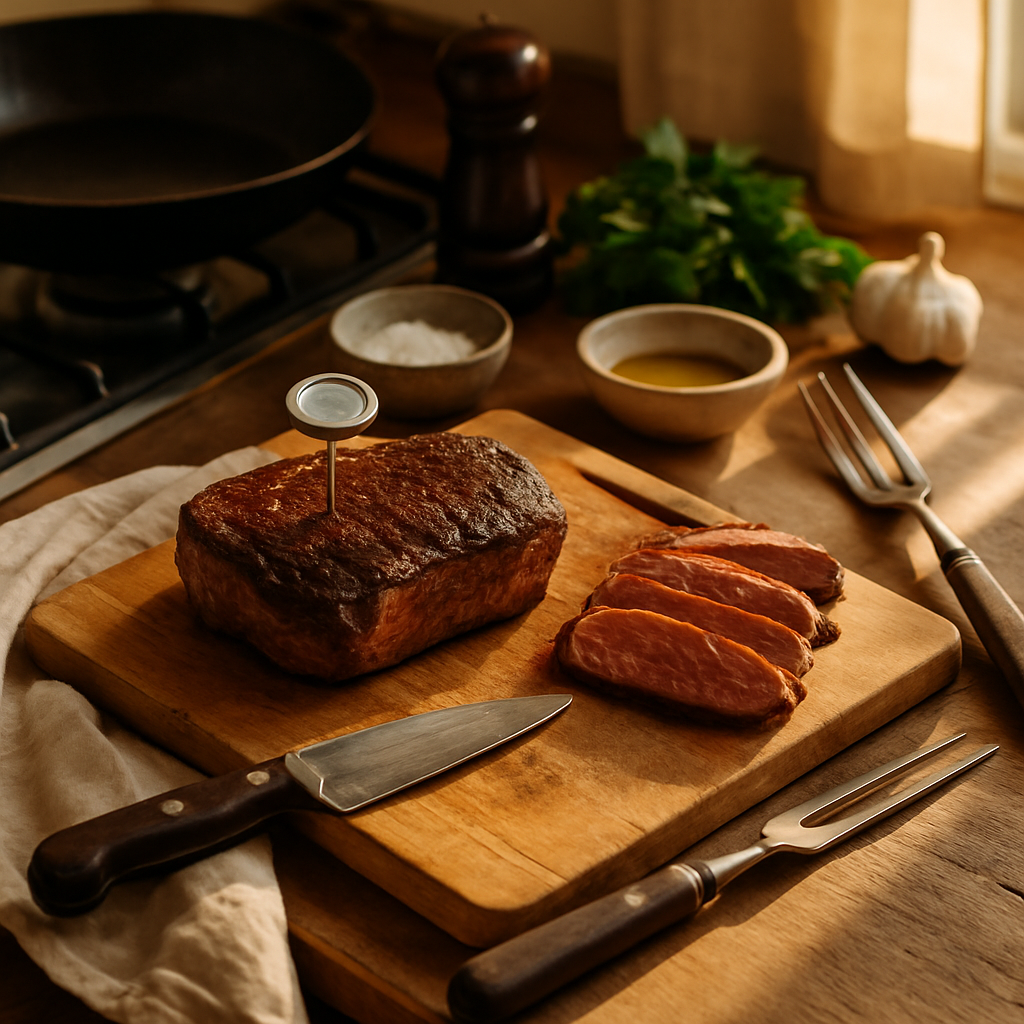
# How to Rest and Slice Meat Properly for Better Results
There's a moment every cook faces — you've nailed the timing, the crust looks perfect, and the smell is incredible. Then you cut straight into it and watch a puddle of juice spread across the chopping board. That's not bad luck. That's a resting problem.
Getting meat to the table juicy and tender isn't just about how you cook it. What happens in the minutes after it leaves the heat matters just as much — and so does the direction you slice it.
Why Resting Meat Actually Matters
When meat cooks, the heat drives moisture towards the centre. The muscle fibres contract and squeeze liquid inward, creating a pressurised core of juice. If you cut into it straight away, that pressure releases all at once and the juice runs straight out onto your board rather than staying in the meat where it belongs.
Resting gives those fibres time to relax. As the temperature equalises throughout the cut, the moisture redistributes more evenly. The result is meat that stays juicier when you slice it — not because the juice magically increases, but because it stays put when you cut.
This applies to everything — steaks, roast chicken, pork chops, lamb shoulder, even burgers. The bigger the cut, the more difference resting makes.
How Long Should You Rest Meat?
There's no single answer here, because it depends entirely on the size and density of what you've cooked. A thin chicken breast needs far less time than a two-kilogram leg of lamb.
A useful rule of thumb is to rest meat for roughly half the cooking time, up to a maximum of around 30–45 minutes for very large roasts. For quick cuts like steaks and chops, five to ten minutes is usually enough. A whole roast chicken benefits from 15–20 minutes. A large beef joint or lamb shoulder can comfortably rest for 30 minutes, which is often perfect timing while you finish your sides.
One thing worth knowing: meat doesn't cool down nearly as fast as people fear during resting. A large roast will still be piping hot after 30 minutes, especially if you tent it loosely with foil. The foil isn't essential — and it can soften a crust you've worked hard to build — but it does help retain heat if your kitchen is cold.
The Carryover Cooking Effect
Resting isn't just about juices — it also affects the final internal temperature of your meat. This is called carryover cooking, and it means meat continues to cook after it leaves the heat source.
The larger and denser the cut, the more the temperature will rise. A thick ribeye pulled off the grill at 52°C might reach 57°C by the time it finishes resting — a meaningful difference if you're aiming for medium-rare. A large beef roast can rise by as much as 5–8°C after coming out of the oven.
This is why experienced cooks pull their meat off the heat a little earlier than the target temperature. If you're aiming for 60°C for a medium steak, pulling it at 55–57°C and letting carryover do the rest will get you there more reliably than cooking it all the way to 60°C on the heat. A decent meat thermometer is one of the most useful tools you can own — remove the guesswork entirely.
The Science of Slicing Against the Grain
Once your meat has rested, how you slice it is the second major factor in how tender it feels to eat. This is where the grain comes in.
Muscle fibres run in a particular direction through any cut of meat. When you slice with the grain — parallel to those fibres — you end up with long, intact strands of muscle in each piece, which are tough and chewy. When you slice against the grain — perpendicular to those fibres — you cut those long fibres into short segments, and the meat suddenly feels far more tender.
This matters most with tougher, more fibrous cuts: skirt steak, flank steak, brisket, bavette, and hanger steak are all examples where slicing direction makes an enormous difference. A bavette sliced with the grain is borderline inedible. Sliced against it, the same piece of meat is tender and satisfying.
With naturally tender cuts — fillet, sirloin, rack of lamb — the difference is less dramatic, but it's still worth doing correctly.
How to Find and Slice Against the Grain
Look at the surface of your rested meat before you cut. You'll usually be able to see fine lines running in one direction — those are the muscle fibres. Your knife should go across those lines at 90 degrees, not along them.
For most steaks and chops, a single cut perpendicular to the grain is straightforward. For larger roasts or irregularly shaped cuts, the grain direction can change as you work through the joint, so it's worth pausing and reassessing as you go.
Thickness matters too. Thinner slices are more tender than thick ones, for the same reason — you're cutting more fibres per slice. With strongly grained cuts like brisket or flank, slicing thinly on a slight angle (rather than straight down) increases the surface area you're cutting across, which makes each slice even more tender.
A sharp knife is non-negotiable here. A dull blade tears and compresses rather than cuts cleanly, and it squeezes juice out of the meat as you work through it. If you don't have a knife sharpener, it's worth adding one to your kitchen kit.
What the Evidence Shows
The science behind resting is well established in food research. Studies on muscle tissue confirm that heat causes protein denaturation and fibre contraction, which forces intramuscular fluid toward the centre of the cut. Research published in food science literature consistently shows that resting periods of at least five minutes significantly reduce moisture loss on cutting, with longer resting times showing greater benefit for larger joints.
The carryover effect is equally well documented. The USDA's own cooking guidelines account for it — their recommended safe internal temperatures are intended to be reached after resting, not at the point the meat leaves the heat.
As for slicing direction, the evidence is straightforward anatomy: muscle fibres are long and strong, and cutting across them shortens what your teeth have to break. This is why traditional butchery has always taken grain direction into account when portioning tougher cuts.
Practical Takeaways
Here's what to take away and use straight away:
- Always rest meat before slicing — even five minutes for a thin steak makes a difference
- Use half the cooking time as a rough resting guide, up to 30–45 minutes for large joints
- Pull meat off the heat slightly early to account for carryover cooking — a thermometer makes this easy
- Look at the grain before you cut — find the lines of muscle fibre and slice across them at 90 degrees
- For tough, fibrous cuts (brisket, flank, bavette, skirt), slice thinly and against the grain — the improvement is dramatic
- Keep your knife sharp — a clean cut preserves juice and texture far better than a sawing motion
These aren't complicated techniques. They're small habits that compound into noticeably better results every time you cook meat, without changing anything about the recipe itself.
---
If you want meal plans built around the cuts and cooking methods you actually enjoy, Macrology generates macro-perfect meal plans in seconds — https://macrology.app/signin
Want meals like this planned to your exact macros?
Macrology generates a personalised meal plan in seconds — breakfast, lunch, dinner and snacks, all hitting your daily targets.
Start your free 14-day trial