How to Layer Textures in a Meal to Make Healthy Food More Satisfying
# How to Layer Textures in a Meal to Make Healthy Food More Satisfying
There's a reason you can eat a whole bag of crisps but feel completely done after a handful of mixed nuts — and it's got very little to do with calories. Texture plays a profound role in how satisfying food feels, how long we stay full, and whether we actually enjoy what we're eating. Get it right, and nutritious food stops feeling like a compromise.
Why Texture Matters More Than You Think
Most people focus on flavour when they're trying to make healthy food more enjoyable. Seasoning, sauces, herbs — all important. But texture is the thing that makes a meal feel complete in the mouth. When food has contrast — something crunchy alongside something soft, something chewy next to something smooth — it engages more of your senses at once and creates what food scientists call orosensory complexity.
Research from Wageningen University has shown that meals with higher textural variety are rated as more satisfying and are associated with slower eating, which itself gives appetite-regulating hormones more time to do their job. Put simply: a bowl of food that makes you work a little — chew a little more, pause between bites — tends to leave you feeling more content than the same ingredients blended into a uniform mush.
This isn't about making cooking complicated. It's about understanding a simple principle and applying it deliberately.
The Four Texture Groups Worth Knowing
Think of textures in four broad categories, and aim to hit at least three of them in any main meal:
Crunchy or crispy — roasted chickpeas, toasted seeds, raw vegetables, croutons, nuts, puffed grains
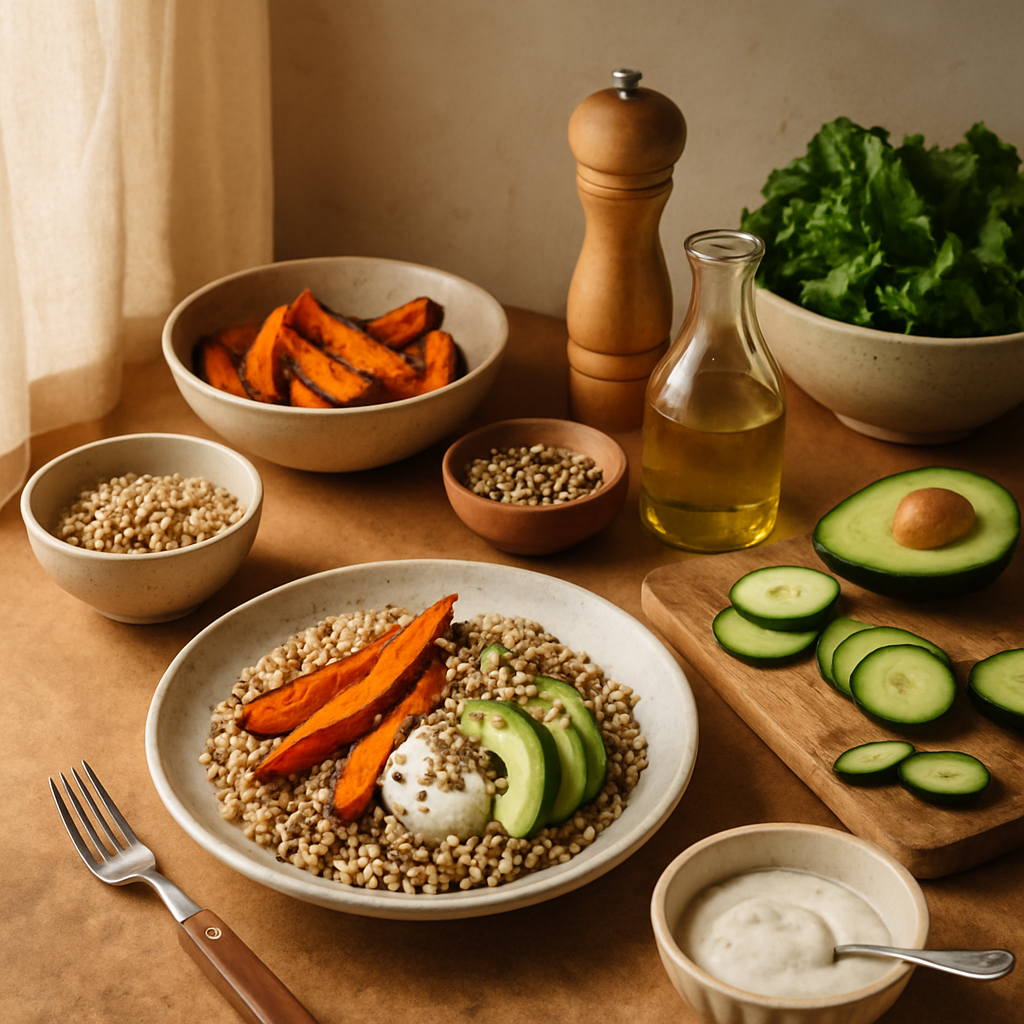
Chewy or dense — wholegrains like farro or barley, legumes, roasted sweet potato, grilled meat or tofu, dried fruit
Soft or yielding — cooked pulses, steamed fish, avocado, hummus, ricotta, soft-cooked egg
Smooth or creamy — sauces, yoghurt-based dressings, tahini, purées, nut butters
A grain bowl with brown rice, roasted vegetables, a jammy egg, a spoonful of tahini dressing, and a handful of toasted pumpkin seeds hits all four. The same bowl without the seeds and tahini? Decent, but noticeably flatter. The contrast is what makes it sing.
What the Evidence Shows
The science here is more robust than you might expect. A 2014 study published in Flavour journal found that texture contrast significantly increased meal enjoyment and the perception of satiety, even when the caloric content was held constant. Participants didn't feel they were eating more — they just felt more satisfied by what they had.
There's also compelling work around eating rate. Softer, more uniform foods are eaten faster, and faster eating is consistently linked with higher overall calorie intake and lower satiety ratings. A 2013 meta-analysis in the American Journal of Clinical Nutrition confirmed that slower eating is associated with reduced food intake — and textural variety is one of the most natural, low-effort ways to slow yourself down without thinking about it.
This doesn't mean you need to engineer every meal. It means that adding a handful of roasted seeds to a bowl of soup, or swapping silken tofu for firm tofu in a stir-fry, has a measurable impact on how satisfied you feel afterwards.
Common Mistakes That Flatten a Meal
The single most common texture mistake in home cooking is over-processing. Blending everything into a smooth soup, mashing rather than roasting, using soft white bread rather than something with a crust — these choices quietly strip texture from a meal before it's even on the table.
Another culprit is overcooking vegetables. There's a meaningful difference between a broccoli floret with a little resistance and one that's gone completely soft. Slightly underdone vegetables don't just retain more nutrients — they add a satisfying bite that signals to your brain that something substantial is being eaten.
And then there's the habit of keeping components separate. A plain chicken breast with plain rice and plain steamed greens has fine flavour if seasoned well, but it's texturally monotonous. Introduce a spoonful of something creamy, a scattering of something crunchy, and suddenly the same base ingredients feel like a proper meal.
Practical Ways to Add Texture Without Overhauling Your Cooking
You don't need to rethink your entire repertoire. Most of these additions take under five minutes:
Toast your seeds and nuts. Dry-toasting in a pan for two to three minutes transforms them — deeper flavour, more pronounced crunch. Add them at the end of cooking so they stay crisp.
Keep raw vegetables in your meals. A handful of shredded red cabbage, thinly sliced cucumber, or grated carrot on top of a cooked dish adds freshness and crunch with almost zero effort.
Roast rather than steam. Roasting concentrates flavour and creates caramelised edges that steam simply can't replicate. Cauliflower, chickpeas, cherry tomatoes, courgette — roasting transforms all of them.
Use contrasting sauces or dressings. A drizzle of tahini, a spoonful of Greek yoghurt, a smear of hummus — these creamy elements contrast beautifully with anything crunchy or chewy.
Add something crispy at the end. Croutons, fried shallots, toasted breadcrumbs (pangrattato), pomegranate seeds, puffed amaranth — even a small amount makes a noticeable difference to the overall eating experience.
Leave some chew in your grains. Cook farro, freekeh, or barley slightly al dente. The chewier the grain, the more satisfying the bite.
Applying This to Meals You Already Make
This works across virtually any cuisine. A Thai-inspired salad with vermicelli noodles becomes far more interesting with crushed peanuts and shredded raw papaya. A lentil soup that's mostly smooth gets a new dimension with a handful of croutons and a drizzle of chilli oil. A pasta dish with creamy sauce benefits from a handful of toasted pine nuts and some briefly wilted bitter greens for contrast.
Even breakfast responds well to this principle. Porridge made with just oats and milk is nutritious but texturally flat. Add a spoonful of nut butter (smooth and rich), some banana slices (soft), a sprinkle of granola (crunchy), and a few seeds (chewy-crunchy) — and it becomes something genuinely enjoyable to eat, not just functional.
The point isn't to load every meal with a dozen components. It's to be intentional about including at least one element of contrast to whatever you're already cooking.
Practical Takeaways
Here's what you can take into the kitchen today:
- Audit your next meal before you serve it. Ask: is there something crunchy, something chewy, something soft, something creamy? If two or more are missing, add one.
- Keep a small "texture toolkit" in your cupboard — toasted seeds, nuts, panko breadcrumbs, tinned chickpeas, tahini, a good yoghurt. These are your shortcut to contrast in any meal.
- Roast your chickpeas. Drain a tin, toss with olive oil and smoked paprika, roast at 200°C for 25–30 minutes until crispy. Add to salads, soups, grain bowls, or eat as a snack. They're genuinely good.
- Don't blend everything. A partly blended soup with some chunky bits is more satisfying than a fully smooth one. A rough-mashed sweet potato with some texture left in is more interesting than a silky purée.
- Cook your grains to order. Make a batch of farro or barley at the start of the week and keep it in the fridge. Add it as a chewy base to whatever you're eating.
If you want to build balanced, satisfying meals without having to think too hard about every component, Macrology generates macro-perfect meal plans in seconds — https://macrology.app/signin
The meals that stick with us — the ones we actually want to eat again — are rarely the ones with the most ingredients or the most elaborate recipes. They're the ones that feel complete. Texture is a huge part of that, and once you start noticing it, you won't be able to stop.
Want meals like this planned to your exact macros?
Macrology generates a personalised meal plan in seconds — breakfast, lunch, dinner and snacks, all hitting your daily targets.
Start your free 14-day trial