How to Get More From Your Herbs: Fresh, Dried and Frozen Explained
# How to Get More From Your Herbs: Fresh, Dried and Frozen Explained
Most of us have a sad, half-empty jar of dried oregano sitting in the back of the cupboard and a bunch of fresh coriander slowly going yellow in the fridge. Herbs are one of those ingredients that feel straightforward but are actually worth understanding properly — because getting them right can genuinely transform the flavour of your cooking.
Fresh Herbs: When They Shine (and When They Don't)
Fresh herbs are often treated as the gold standard, and for good reason. Soft herbs — think basil, coriander, parsley, mint, dill, and chives — are at their best when used raw or added at the very end of cooking. Their volatile aromatic compounds are delicate, and heat destroys them quickly.
Hardy herbs — rosemary, thyme, sage, and bay — are a different story. These can handle sustained heat and actually release their flavour more fully when cooked. Throwing a sprig of rosemary into a hot pan with lamb, or tucking thyme into a slow braise, works brilliantly because the heat does the work.
A common mistake is using soft and hardy herbs interchangeably. Adding fresh basil at the start of a tomato sauce — rather than stirring it in at the end — is a reliable way to end up with muddy, tired flavour. The rule of thumb: soft herbs finish, hardy herbs start.
Dried Herbs: More Powerful Than You Think
Dried herbs have a reputation for being a poor substitute for fresh, which is partly unfair. When dried properly, herbs lose their water content but retain — and actually concentrate — many of their flavour compounds. A teaspoon of dried thyme is considerably more potent than a teaspoon of fresh.
The standard conversion most cooks use is 1 part dried to 3 parts fresh. So if a recipe calls for a tablespoon of fresh thyme, you'd use a teaspoon of dried.
Where dried herbs genuinely struggle is with delicate soft herbs. Dried basil, dried coriander, and dried parsley tend to taste flat and slightly musty compared to their fresh counterparts. They're not worthless — dried parsley works fine in a slow-cooked dish — but they're rarely a satisfying swap in a recipe where the herb is the star.
Hardy herbs, on the other hand, often dry beautifully. Dried oregano, rosemary, bay, and thyme are pantry staples worth keeping well-stocked. They're also significantly cheaper than fresh and have a much longer shelf life.
How Long Do Dried Herbs Actually Last?
Here's where most of us go wrong. The jar in the back of your cupboard that's been there since 2019 isn't dangerous, but it's almost certainly doing nothing. Dried herbs are best used within one to three years, and their potency drops noticeably after the first year.
The easiest way to test if yours are still worth using: crush a pinch between your fingers and smell it. If there's a strong, clear aroma, you're fine. If it smells faintly of dust, it's time to replace it.
Storage matters too. Heat, light, and moisture are the enemies of dried herbs. The spot above or next to the hob looks convenient but is one of the worst places to keep them. A cool, dark cupboard will extend their life considerably.
Frozen Herbs: The Underrated Option
Frozen herbs don't get nearly enough credit. They sit in a useful middle ground — somewhere between the immediacy of fresh and the convenience of dried — and for certain uses, they're genuinely excellent.
Soft herbs like coriander, parsley, basil, and chives freeze surprisingly well. The texture changes — they go limp when thawed — so they won't work as a garnish, but for anything cooked into a dish, stirred through pasta, or blended into a sauce, you'd be hard pressed to taste the difference.
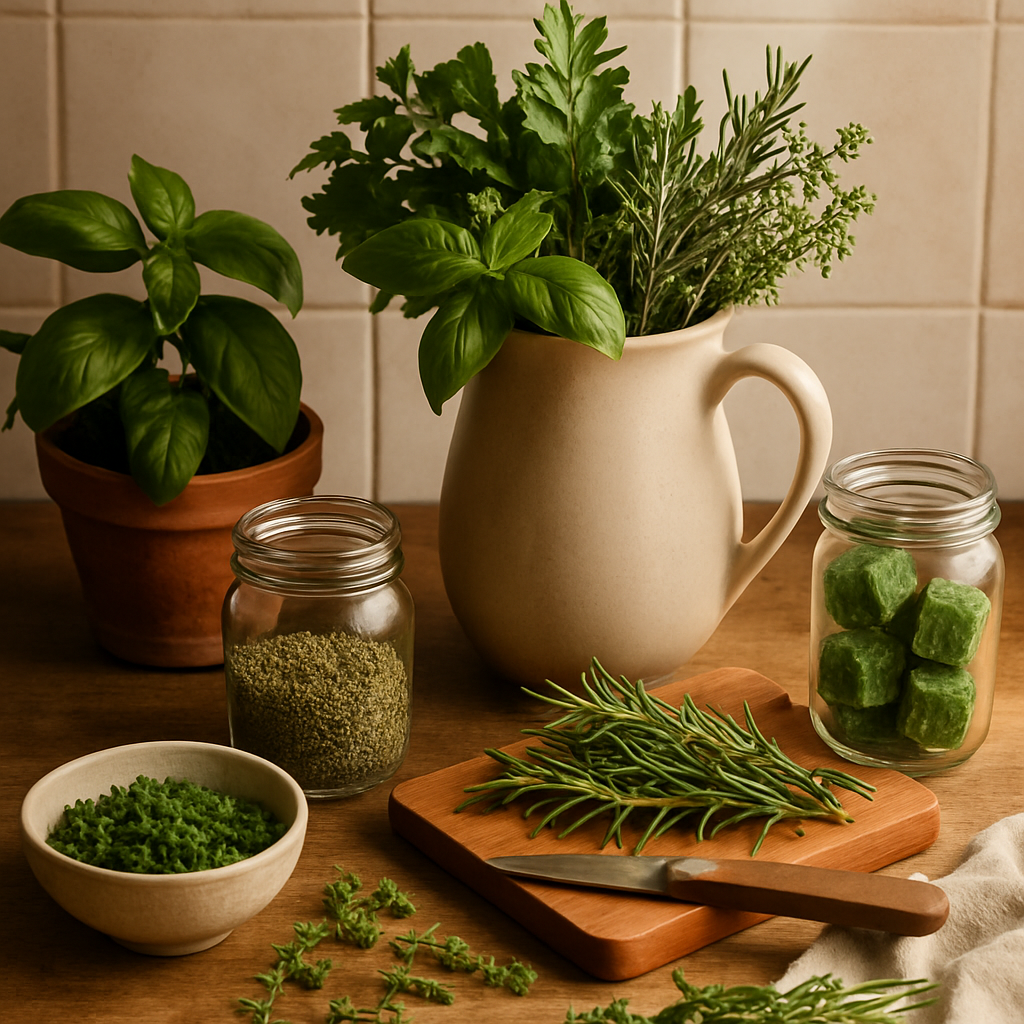
The simplest method is to freeze herbs in ice cube trays with a little water or olive oil. Once solid, transfer the cubes to a freezer bag. You then have ready-portioned herb portions you can drop straight into a pan or saucepan without any prep. It's an excellent way to use up a bunch that's on its way out.
You can also freeze whole sprigs of hardy herbs like rosemary and thyme and crumble them straight from frozen — the leaves detach from the stem easily and go directly into cooking. No thawing needed.
What the Evidence Shows
From a nutritional perspective, herbs are more interesting than their small quantities might suggest. Many contain polyphenols — plant compounds that have been linked to reduced inflammation and other health markers in research. Parsley, rosemary, oregano, and thyme are particularly rich sources.
Fresh herbs tend to retain the highest levels of these compounds, but the differences between fresh, dried, and frozen aren't always dramatic. A 2013 study published in the Journal of Food Science found that many dried herbs retained substantial antioxidant activity compared to their fresh equivalents, with some — particularly dried oregano — actually showing higher antioxidant capacity than fresh, likely due to concentration during the drying process.
Freezing is generally considered one of the most effective ways to preserve the nutritional profile of plant foods, as it slows enzymatic activity without the heat exposure of drying. For herbs specifically, this means frozen can be a nutritionally solid choice when fresh isn't available.
It's worth keeping this in perspective: herbs are used in small amounts, and chasing the "nutritionally optimal" form is much less important than simply using them more freely in your everyday cooking. More herbs — in any form — is almost always a good move for flavour and variety.
Common Misconceptions Worth Clearing Up
"Fresh herbs are always better." Not always true. Dried oregano on a pizza beats fresh in most cases — fresh oregano can taste slightly grassy and overpowering when baked at high heat, while dried becomes fragrant and deep. Context matters more than a blanket rule.
"You can swap any fresh herb for dried in equal amounts." This leads to either an underwhelming or aggressively over-seasoned dish. The 1:3 ratio (dried to fresh) exists for good reason — use it.
"Frozen herbs are just for emergencies." Genuinely not so. If you regularly cook mid-week meals and don't get through a fresh bunch before it goes off, keeping a stash of frozen herbs in the freezer is a smarter system than repeatedly buying fresh and throwing half away.
"Herbs are just for flavour, not nutrition." Research increasingly suggests that the phytochemical content of herbs — even in small culinary quantities — contributes meaningfully to dietary diversity, which is linked to gut health and broader wellbeing.
Practical Takeaways
Here's what's actually useful to take away from all of this:
Use the right herb in the right form. Soft herbs (basil, coriander, mint, dill) are almost always better fresh or frozen. Hardy herbs (thyme, rosemary, oregano, bay) work brilliantly dried and are worth keeping stocked.
Freeze before they go off. If you've bought a bunch of parsley or coriander and know you won't use it all, chop and freeze it in ice cube trays with a splash of olive oil. Takes five minutes and saves waste.
Smell-test your dried herbs regularly. If they don't smell of much, they're not adding much. Restock every year or so, especially for herbs you use often.
Add soft herbs late, hardy herbs early. This single habit will noticeably improve your cooking.
Be generous. Herbs are low in calories and high in flavour — there's rarely a reason to hold back. A dish finished with a handful of fresh parsley or a good pinch of dried oregano is almost always better than one without.
If you want meal plans that actually make use of bold, flavourful ingredients — herbs included — Macrology generates macro-perfect meal plans in seconds — https://macrology.app/signin
Whether you're cooking from a well-stocked fridge or a practically bare cupboard, understanding your herbs is one of the smallest changes that makes the biggest difference to how your food tastes. And that's the kind of cooking knowledge that sticks.
Want meals like this planned to your exact macros?
Macrology generates a personalised meal plan in seconds — breakfast, lunch, dinner and snacks, all hitting your daily targets.
Start your free 14-day trial