How to Build More Flavour When Cooking with Less Salt
# How to Build More Flavour When Cooking with Less Salt
There's a common assumption that cutting back on salt means resigning yourself to bland, joyless food. It doesn't. The truth is that most of the flavour in a well-cooked dish comes from somewhere else entirely — and once you know where to look, salt starts to feel like one tool among many rather than the only one.
Why Salt Feels So Essential in the First Place
Salt doesn't just add a salty taste. It works by suppressing bitterness and amplifying other flavours already present in your food — it essentially turns up the volume on everything else in the pan.
That's why food can taste flat without it. The issue isn't that the other flavours aren't there — it's that they're not being given a chance to come through. Understanding this changes how you approach the problem entirely.
When you reduce salt, the goal isn't to replace it with one magic ingredient. It's to build layers of flavour from the ground up, so the finished dish doesn't need as much enhancement at the end. Professional chefs do this instinctively. It's a learnable skill.
The Maillard Reaction: Your Most Underused Flavour Tool
If you want more flavour without more salt, start with heat. The Maillard reaction is the chemical process that happens when proteins and sugars in food are exposed to high heat — it's responsible for the golden crust on a seared steak, the caramelised edges on roasted vegetables, and the toasty depth in a good broth.
Food that's been properly browned tastes dramatically more complex than food that's been boiled or steamed. That complexity doesn't require salt to come through — it's baked in at a molecular level.
The practical upshot: don't crowd your pan, don't rush the heat, and let things colour properly. A pale, steamed piece of chicken and a properly seared one are almost different foods in terms of flavour, and the difference has nothing to do with seasoning.
Acids: The Sharpest Tool in the Flavour Box
One of the most effective substitutes for the "brightness" that salt provides is acid. Lemon juice, lime, vinegar (red wine, apple cider, balsamic), tamarind, and even a splash of dry wine can lift a dish in the same way salt does — by making the other flavours pop.
Acid works particularly well at the end of cooking. A squeeze of lemon over a finished soup, pasta, or roasted fish can transform something that tastes a little dull into something that tastes alive. It's not adding a citrus flavour so much as waking the whole dish up.
A useful habit: before you reach for more salt, taste your food and ask whether it tastes flat or whether it tastes dull. Flat food usually needs salt. Dull food — where the flavours are present but muted — often just needs a hit of acid.
Aromatics Do the Heavy Lifting
Garlic, onions, shallots, leeks, ginger, and celery are the backbone of flavour in most cuisines for a reason. When cooked properly — slowly, in a little fat — they release a huge amount of natural sweetness and depth that forms the base of a dish.
Most recipes underestimate how much work these ingredients do. If you cook your onions quickly on high heat, you get a sharp, slightly raw flavour. If you cook them slowly for 20–25 minutes until they're soft and golden, you get something almost jammy and caramel-like — and that becomes the flavour platform your whole dish stands on.
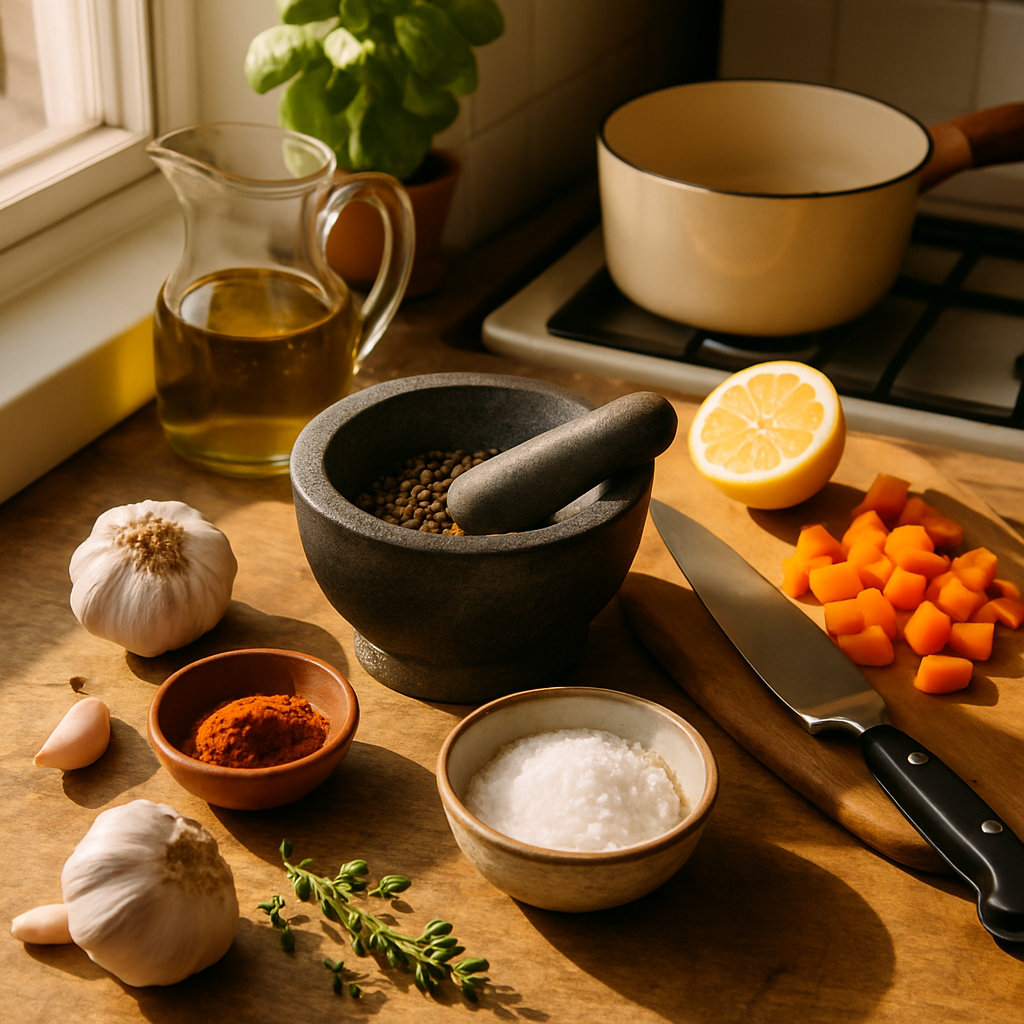
Layering aromatics matters too. Adding fresh garlic, a bay leaf, some thyme, and a pinch of black pepper at different stages of cooking builds a complexity that salt alone could never replicate. Whole spices toasted in a dry pan before grinding release oils that are genuinely aromatic in the truest sense — they fill the air and, later, the dish.
What the Evidence Shows
Research into salt reduction and flavour perception is more nuanced than the headlines suggest. A 2013 study published in the Journal of Food Science found that umami-rich compounds could significantly enhance saltiness perception, meaning that food can taste saltier than it actually is when umami is present — without any additional sodium.
Umami — the fifth basic taste, often described as savoury or moreish — is found naturally in ingredients like tomatoes, mushrooms, Parmesan, miso, soy sauce, anchovies, and nutritional yeast. The interesting thing is that many of these ingredients do contain some sodium, but in much smaller quantities than table salt, while delivering an outsized flavour impact.
Separate research has also shown that the way salt is applied matters as much as the quantity. Finishing salt — added at the table or just before serving — stimulates taste buds more directly than salt dissolved into a dish during cooking. This means you can use less overall while still getting the satisfying hit that makes food feel properly seasoned. A few flakes of Maldon on a finished plate do more than a teaspoon stirred into the pot.
Herbs, Spices, and Fermented Ingredients
Fresh herbs are wildly underused in everyday British cooking. Stirring a handful of chopped parsley, coriander, or basil into a finished dish at the last moment adds brightness, colour, and a layer of flavour that does a lot of the work salt might otherwise do.
Dried herbs and spices, used early in cooking so they have time to bloom, add warmth and complexity — smoked paprika, cumin, coriander, turmeric, and cinnamon can all transform a dish that might otherwise taste one-dimensional. The key is using enough of them. Under-spicing is as common a mistake as over-salting.
Fermented ingredients deserve a special mention. Miso paste, fish sauce, Worcestershire sauce, kimchi, and even a spoonful of quality soy sauce all carry deep, savoury flavour with relatively modest sodium content per portion when used judiciously. They add umami, complexity, and that elusive sense that a dish tastes "finished" — which is often what people are actually chasing when they reach for more salt.
Stock, Fat, and Finishing
Two more underrated contributors to full, rounded flavour: good stock and fat.
A dish made with a well-reduced chicken or vegetable stock has a depth that water simply cannot provide. Stock adds body, savouriness, and an almost silky quality to sauces, soups, and braises that makes them taste complete. If you're buying stock, look for low-sodium versions — that way you're getting the flavour benefit without inadvertently piling in sodium.
Fat carries and amplifies flavour. Olive oil, butter, and even the fat rendered from meat all help flavour compounds dissolve and spread across the palate. A finishing drizzle of good extra virgin olive oil over a bowl of soup or a plate of roasted vegetables adds richness that signals satisfaction to the brain — and a satisfied palate is less likely to feel like something is missing.
Practical Takeaways
You don't need to overhaul how you cook overnight. Start with one or two of these and build from there:
- Brown things properly. Whether it's meat, vegetables, or aromatics — colour equals flavour.
- Taste before you season, and ask what the dish actually needs. Acid (a squeeze of lemon or a splash of vinegar) fixes dullness. Salt fixes flatness.
- Cook your onions and garlic slowly. Don't rush the base of a dish — it's doing more work than you think.
- Finish with fresh herbs or a drizzle of good oil. Both add a lot for very little effort.
- Use umami-rich ingredients — mushrooms, tomato purée, a teaspoon of miso — to create the sense that a dish is savoury and complete.
- Add finishing salt rather than cooking salt where possible. A little goes much further when it hits your tongue directly.
The goal isn't to avoid salt entirely — it's to cook in a way where you need less of it because your food is already doing a lot of the work itself.
If you want meal plans built around bold, balanced flavours that hit your macro targets without sacrificing taste, Macrology generates macro-perfect meal plans in seconds — https://macrology.app/signin
Want meals like this planned to your exact macros?
Macrology generates a personalised meal plan in seconds — breakfast, lunch, dinner and snacks, all hitting your daily targets.
Start your free 14-day trial