How to Build Flavour with Compound Butters and Flavoured Oils
# How to Build Flavour with Compound Butters and Flavoured Oils
There's a reason restaurant food tastes different to home cooking — and it's not always technique. Often, it comes down to fat. Specifically, the kind of fat that's been infused, blended, or built into something far greater than the sum of its parts.
Compound butters and flavoured oils are two of the most underused tools in home cooking. Once you understand how they work, you'll find yourself reaching for them constantly.
What Are Compound Butters and Flavoured Oils?
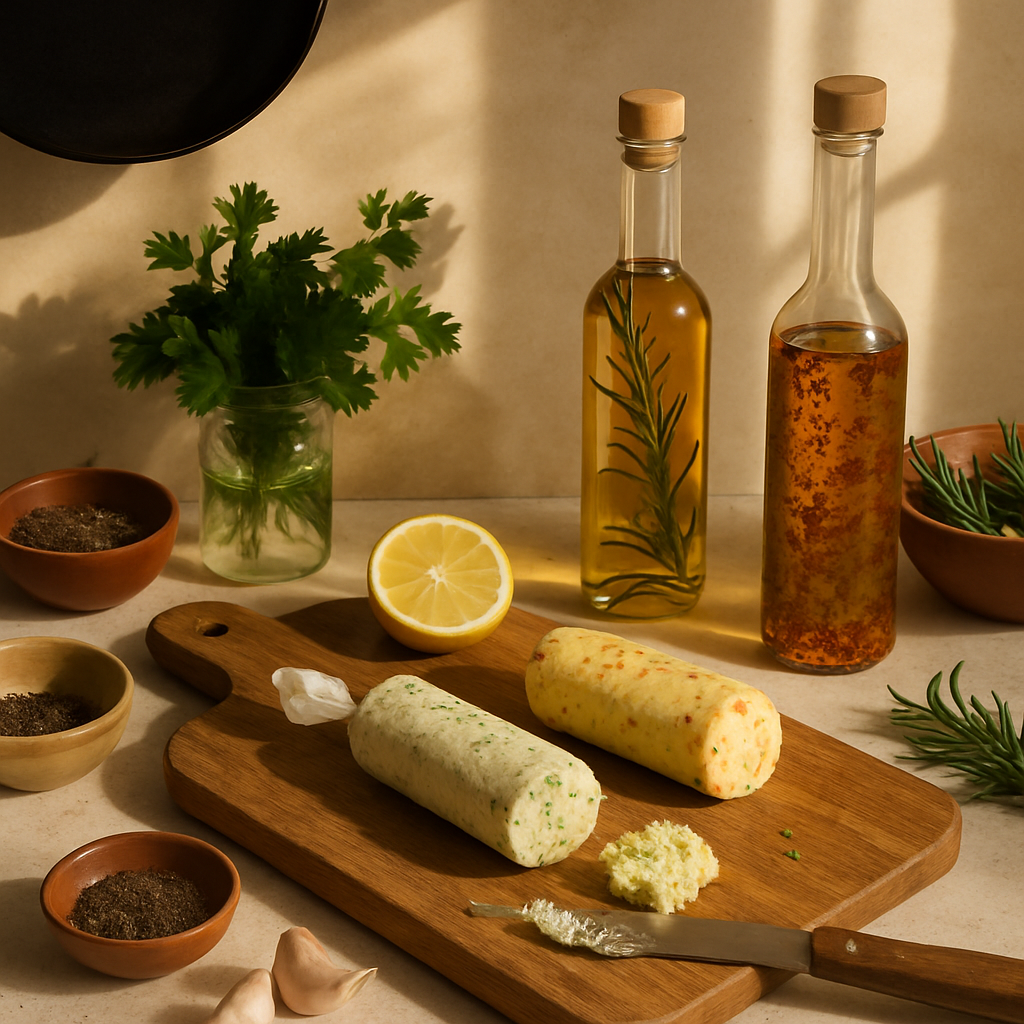
A compound butter is simply softened butter mixed with aromatics, herbs, spices, or other flavourings, then re-set into a solid. A flavoured oil is exactly what it sounds like — oil that's been infused with ingredients like garlic, chilli, or fresh herbs to carry those flavours into whatever you're cooking.
Neither requires special equipment or culinary school training. What they do require is a bit of forethought, because their real power comes from having them ready to go when you need them.
Both techniques exist because fat carries flavour. Fat-soluble compounds — the aromatic molecules responsible for most of what we taste — dissolve into fats far more effectively than they dissolve in water. When you embed those compounds into butter or oil, you create a concentrated delivery system for flavour that coats food evenly and lingers on the palate.
Why Fat Is Your Flavour Carrier
This isn't just culinary folklore. The science behind fat as a flavour carrier is well-established. Many of the volatile compounds that give herbs, spices, and aromatics their character are lipophilic — they bind to fat molecules rather than water molecules. This is why a herb oil tastes so much more vivid than herb-infused water ever could.
Butter has an additional advantage over plain oil: it contains milk solids and water alongside the fat. When you melt butter in a hot pan, those milk solids brown and develop hundreds of new flavour compounds through the Maillard reaction. A compound butter dropped onto a hot steak doesn't just melt — it actively browns and builds new flavour in the final seconds of cooking.
This is why finishing a piece of fish or a chicken breast with a knob of herb butter right at the end transforms the dish. It's not decoration. It's a final flavour-building step.
How to Make a Classic Compound Butter
The basic method is straightforward. Take softened (not melted) butter, mix in your chosen ingredients, roll it into a cylinder using cling film or baking paper, and refrigerate or freeze until needed. Slice off rounds as required.
A few combinations worth knowing:
- Garlic and parsley butter — the classic. Works on bread, steak, chicken, or tossed through pasta
- Miso and ginger butter — extraordinary on roasted vegetables, salmon, or corn
- Lemon zest, thyme, and black pepper — brilliant on grilled fish or stirred into mashed potato
- Chilli, lime, and coriander — great on sweetcorn, grilled chicken, or black beans
- Blue cheese and walnut — melt over a burger or a medium-rare steak
The ratio that works reliably is roughly 2 tablespoons of flavouring per 100g of butter, though this is flexible depending on intensity. Taste as you go. Salt matters too — unsalted butter gives you more control, but salted butter works fine for most applications.
Compound butters keep in the fridge for up to a week, and in the freezer for three months. Making a batch takes five minutes and pays dividends across multiple meals.
Building Flavoured Oils at Home
Flavoured oils require slightly more care, but offer something compound butters can't: a pourable, heat-stable flavour base that works in dressings, marinades, and finishing drizzles simultaneously.
Cold-infusion is the simplest approach. Add dried chilli flakes, whole peppercorns, dried herbs, or citrus zest to a neutral oil (such as light olive oil or sunflower oil) and leave it for 24–48 hours. The oil slowly absorbs the aromatic compounds without any heat required. This method is low-risk and produces reliably clean results.
Warm infusion is faster and more intense. Gently heat your oil to around 60–80°C — warm enough to extract flavours quickly, but not so hot that you're frying your aromatics. Pour it over fresh garlic, rosemary, or dried spices, let it cool, then strain. The result is a deeply flavoured oil ready to use within an hour.
One important note on food safety: never store raw garlic or fresh herbs in oil at room temperature. This creates an anaerobic environment that can allow Clostridium botulinum to grow — a genuine risk, not a theoretical one. Always refrigerate herb and garlic oils, use them within a week, or use commercially acidified versions. Dried ingredients in oil are considerably safer.
What the Evidence Shows
Research into flavour perception consistently supports the idea that fat doesn't just carry flavour — it shapes the experience of eating in ways that go beyond simple taste. A 2015 study published in Chemical Senses identified fat as a potential sixth basic taste (sometimes called "oleogustus"), suggesting our tongues may have dedicated receptors for fat compounds.
Separately, work from the Monell Chemical Senses Center has demonstrated that aroma molecules are released more slowly from fat than from water, meaning flavour lingers longer when fat is involved. This explains why a dish finished with flavoured butter or a drizzle of good infused oil feels more satisfying and complete — the flavour genuinely does last longer on your palate.
From a nutritional standpoint, both butter and oil are calorie-dense, so portion awareness matters if you're tracking macros. But the quantities used in these techniques are typically small — a 10g knob of compound butter on a piece of grilled salmon adds around 70–75 calories while dramatically improving the eating experience. That's a reasonable trade-off for most people.
Where to Use Them (Beyond the Obvious)
Most people know herb butter goes on steak. Fewer people think to use these techniques in less obvious places — which is where the real gains are.
Compound butters work brilliantly: - Stirred into risotto at the end of cooking (this is the mantecatura technique used in Italian restaurants) - Tossed through cooked pasta instead of sauce - Melted over steamed greens — transforms broccoli or green beans completely - Spread inside a chicken before roasting, under the skin - Whisked into scrambled eggs just before serving
Flavoured oils extend further: - As the base fat for roasting vegetables — rosemary and garlic oil under potatoes is a revelation - Drizzled over hummus, soups, or grain bowls just before serving - As a marinade base for meat or fish - Used in salad dressings in place of plain oil - Brushed onto flatbreads before grilling or toasting
The principle in each case is the same: you're depositing concentrated flavour compounds directly onto or into the food, with fat as the vehicle.
Practical Takeaways
Getting started with compound butters and flavoured oils doesn't need to be a big project. Here's how to build the habit:
Start with one compound butter this week. Garlic and parsley is the obvious entry point — it takes five minutes, keeps in the freezer, and improves almost everything savoury it touches. Make a 200g batch, wrap it in cling film, and slice from it for the next few weeks.
Make a chilli oil on your next day off. Add a teaspoon of dried chilli flakes and a few peppercorns to 150ml of light olive oil, warm gently for two minutes, cool, and bottle it. Use it on eggs, pizza, noodles, or anything that needs a lift.
Think in layers. Cook your protein in plain oil or butter, then finish with a flavoured version. The flavours build rather than compete.
Taste before you serve. A drizzle of herb oil or a melting knob of compound butter right before food hits the table is often the difference between "that was nice" and "how did you make this?"
If you want to plan meals that actually make the most of techniques like these — meals that hit your macro targets without sacrificing flavour — Macrology generates macro-perfect meal plans in seconds — https://macrology.app/signin
The gap between home cooking and restaurant cooking is smaller than most people think. A few jars and rolls of the right stuff in your fridge is a good place to start closing it.
Want meals like this planned to your exact macros?
Macrology generates a personalised meal plan in seconds — breakfast, lunch, dinner and snacks, all hitting your daily targets.
Start your free 14-day trial