How to Build Depth of Flavour When Cooking Without Meat
# How to Build Depth of Flavour When Cooking Without Meat
There's a common assumption that meat is what makes food taste interesting — that without it, you're left with something worthy but a bit flat. If you've ever made a vegetable soup that tasted like hot water with bits in it, you'll know exactly what that assumption is built on.
But the problem was never the absence of meat. It was the absence of technique.
Meat carries flavour partly because of what it contains — fat, protein, connective tissue — and partly because of what happens to it when you apply heat. Once you understand what's actually going on, you can recreate those same effects with plant-based ingredients. Here's how.
---
What Makes Food Taste "Deep" in the First Place?
Before getting into techniques, it helps to understand what depth of flavour actually means. It's the difference between tasting one thing and tasting several things at once — richness, savoriness, a little bitterness, some sweetness, a long finish on the palate.
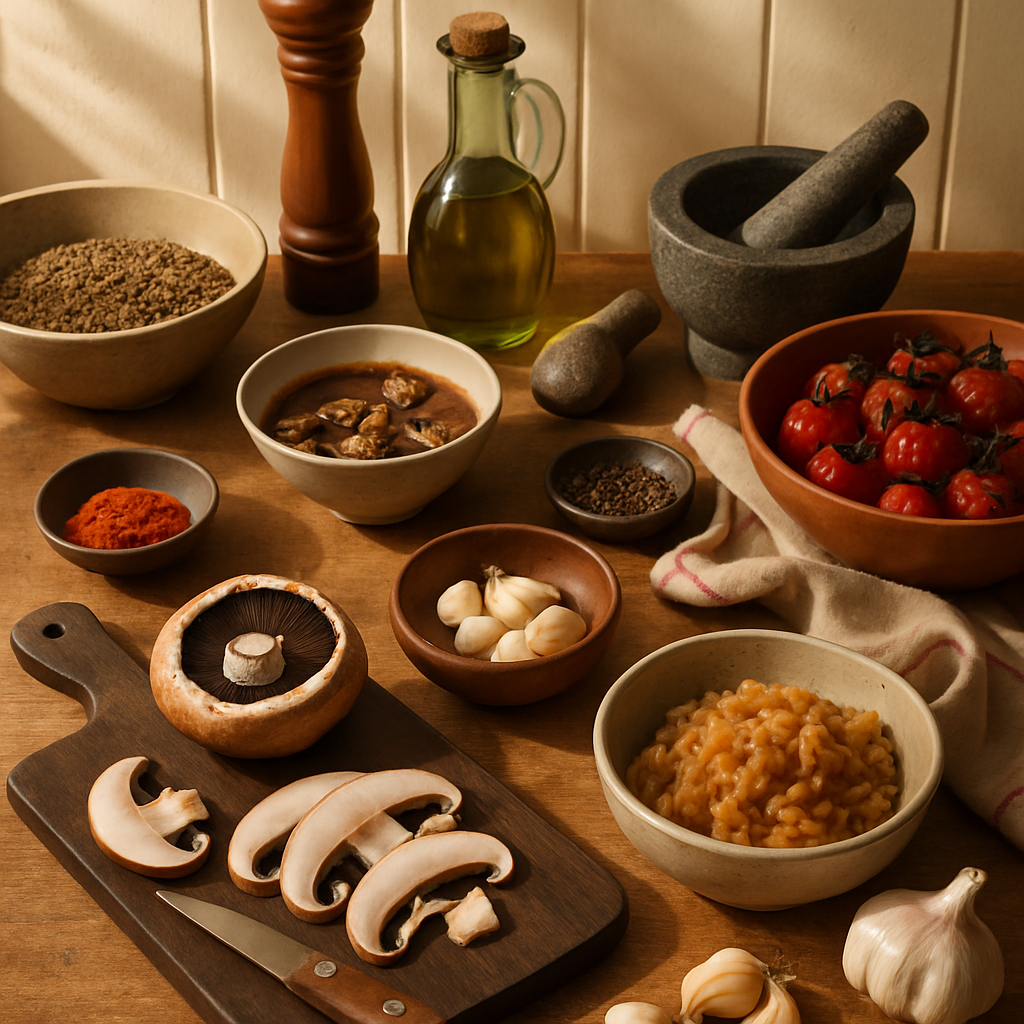
Umami is a big part of this. Often described as the fifth taste alongside sweet, sour, salty, and bitter, umami is that satisfying, almost meaty savouriness associated with glutamates — naturally occurring compounds found in a wide range of foods. Parmesan, soy sauce, miso, tomatoes, and mushrooms are all glutamate-rich, which is why they feature so heavily in plant-forward cooking.
Fat plays a role too. It carries flavour compounds and coats your palate in a way that gives food a sense of richness and roundness. And browning — specifically the Maillard reaction, which occurs when proteins and sugars are exposed to high heat — creates hundreds of new flavour compounds that simply don't exist in the raw ingredient.
The good news: none of these require meat.
---
Get Serious About Browning
This is probably the single most impactful change you can make. Vegetables, tofu, legumes, and grains can all be browned to develop complex, nutty, almost caramelised flavours — but most people don't take it far enough.
The rule is simple: don't crowd the pan. When you pile too many vegetables into a pan at once, they steam rather than fry. The moisture has nowhere to go, the temperature drops, and you end up with soft, pale, slightly sad results. Work in batches if you need to, use a wide pan, and leave things alone long enough to actually develop colour.
Onions are a prime example. A properly caramelised onion takes 30–45 minutes over a low-to-medium heat with a pinch of salt and a little oil. What you end up with is deeply sweet, golden, and sticky — a completely different ingredient to the raw version, and one that adds enormous complexity to anything you add it to.
The same principle applies to roasting vegetables at high heat (200°C+), getting a proper crust on halloumi or tofu, or letting tinned tomatoes cook down in a pan until they darken and stick slightly to the bottom.
---
Build in Layers, Not All at Once
One of the mistakes people make when cooking without meat is adding everything to the pot simultaneously and hoping for the best. Layering flavour means building complexity at different stages of cooking.
Start with your aromatics — onion, garlic, celery, carrot — and cook them low and slow until soft and fragrant before you add anything else. Then add any spices and toast them briefly in the oil before they hit any liquid. This blooming step is transformative: fat-soluble flavour compounds in spices release more fully when heated in oil than when added directly to water or sauce.
Add acidic ingredients like tomatoes or wine after the aromatics are cooked, not before — acid slows the softening of vegetables and can make onions stay unpleasantly sharp if you rush the process.
Finish with fresh herbs, a squeeze of lemon, or a small amount of vinegar just before serving. This brightening step lifts the whole dish and stops it tasting muddy.
---
Learn Your Umami-Rich Ingredients
Knowing which plant-based ingredients are naturally high in glutamates — and how to use them — will change your cooking significantly.
Mushrooms, particularly dried varieties like porcini and shiitake, are amongst the most umami-dense ingredients available. The drying process concentrates their glutamates dramatically. Rehydrating dried mushrooms also gives you a deeply flavoured liquid that works brilliantly as a stock base.
Miso paste is fermented soybean paste with an intense, complex savouriness. A tablespoon stirred into a soup, stew, or dressing at the end of cooking adds a rounded depth that's hard to pinpoint but immediately noticeable. Don't boil it after adding — heat above about 60°C begins to break down the beneficial compounds and dulls the flavour.
Soy sauce and tamari are similarly powerful. A small amount added during cooking rather than just at the table works better — it integrates into the dish rather than sitting on top.
Tomato paste is more glutamate-rich than fresh tomatoes and works best when fried briefly in oil before any liquid is added, turning it from raw and slightly sharp to rich and almost jammy.
Nutritional yeast (often called "nooch") has a cheesy, nutty flavour and works well stirred into sauces, soups, and grain dishes. It's also a useful source of B vitamins, particularly for those not eating meat regularly.
---
What the Evidence Shows
The science behind plant-forward flavour development is well-established. Research published in journals including Food Chemistry has confirmed that the Maillard reaction produces a comparable range of flavour compounds whether it occurs in meat or plant proteins — the mechanism is identical.
Studies on umami perception have shown that combining multiple glutamate sources creates a synergistic effect, meaning the perceived umami is greater than the sum of its parts. This is why a dish made with both miso and dried mushrooms tastes richer than one made with either alone — a principle sometimes called "umami stacking" in culinary literature.
There's also solid evidence that fat significantly enhances flavour perception. A 2015 study in the journal Chemical Senses found that fat increases the persistence of volatile flavour compounds on the palate, which is part of why a dish finished with olive oil or a knob of butter tastes more satisfying than the same dish without.
None of this is complicated, but it does matter — the evidence supports what experienced cooks have known intuitively for generations.
---
Use Stock Properly
A good stock is essentially liquid flavour, and it makes an enormous difference to the finished dish. Many people use water where they should use stock, and it shows.
Vegetable stocks vary enormously in quality. The best are made from roasted vegetables — particularly onion, carrot, celery, leek, and tomato — with aromatics like bay, peppercorns, and thyme. Roasting before simmering adds that critical browning-derived depth.
If you're short on time, a good-quality shop-bought stock or stock paste (Marigold Bouillon is widely recommended in UK kitchens) is a perfectly reasonable shortcut. What matters most is that you're using something with actual flavour.
Kombu — a type of dried seaweed used in Japanese cooking — is also worth knowing about. A small piece simmered in water produces a stock (dashi base) that is extraordinarily rich in glutamates and almost flavourless on its own but transforms anything it's added to.
---
Practical Takeaways
Here's what to put into practice the next time you're cooking without meat:
- Brown everything properly. Dry your tofu, mushrooms, and vegetables before they go in the pan. Work in batches. Take the colour further than feels comfortable.
- Start with low-and-slow aromatics. Give your onions, garlic, and celery proper time to soften and sweeten before adding anything else.
- Stack your umami. Use at least two umami-rich ingredients in any savoury dish — miso and mushrooms, tomato paste and soy sauce, parmesan and dried tomatoes.
- Bloom your spices in fat. Add ground spices to hot oil for 30–60 seconds before adding liquid. The difference is immediate.
- Finish with acid and freshness. A squeeze of lemon, a splash of sherry vinegar, or a handful of fresh herbs just before serving lifts and sharpens everything underneath.
- Use good stock. Replace water with a proper stock or stock paste wherever the recipe allows.
These aren't advanced techniques. They're small adjustments that compound — each one adds a layer, and together they produce food that genuinely satisfies.
---
If you want meal plans built around flavour-forward, macro-balanced cooking, Macrology generates macro-perfect meal plans in seconds — https://macrology.app/signin
Want meals like this planned to your exact macros?
Macrology generates a personalised meal plan in seconds — breakfast, lunch, dinner and snacks, all hitting your daily targets.
Start your free 14-day trial