How to Build a Flavourful Pan Sauce in Under Five Minutes
# How to Build a Flavourful Pan Sauce in Under Five Minutes
There's a moment after you've cooked a steak, a chicken breast, or a pork chop when most people do something that makes professional cooks wince: they tip away the sticky, golden-brown residue left in the pan. That residue is where all the flavour lives. Five minutes and a handful of ingredients are all you need to turn it into something genuinely restaurant-worthy.
What Is a Pan Sauce, Actually?
A pan sauce is built directly in the pan you've just cooked in, using the browned bits stuck to the bottom as its flavour base. Those bits have a name — fond — and they're the result of the Maillard reaction, the same chemical process that gives seared meat, toasted bread, and roasted coffee their depth and complexity.
The logic is simple: you've already done the hard work of creating flavour. A pan sauce is just the process of dissolving that flavour into a liquid and building it into something cohesive. No long simmering times, no specialist equipment, no culinary school required.
The Basic Formula
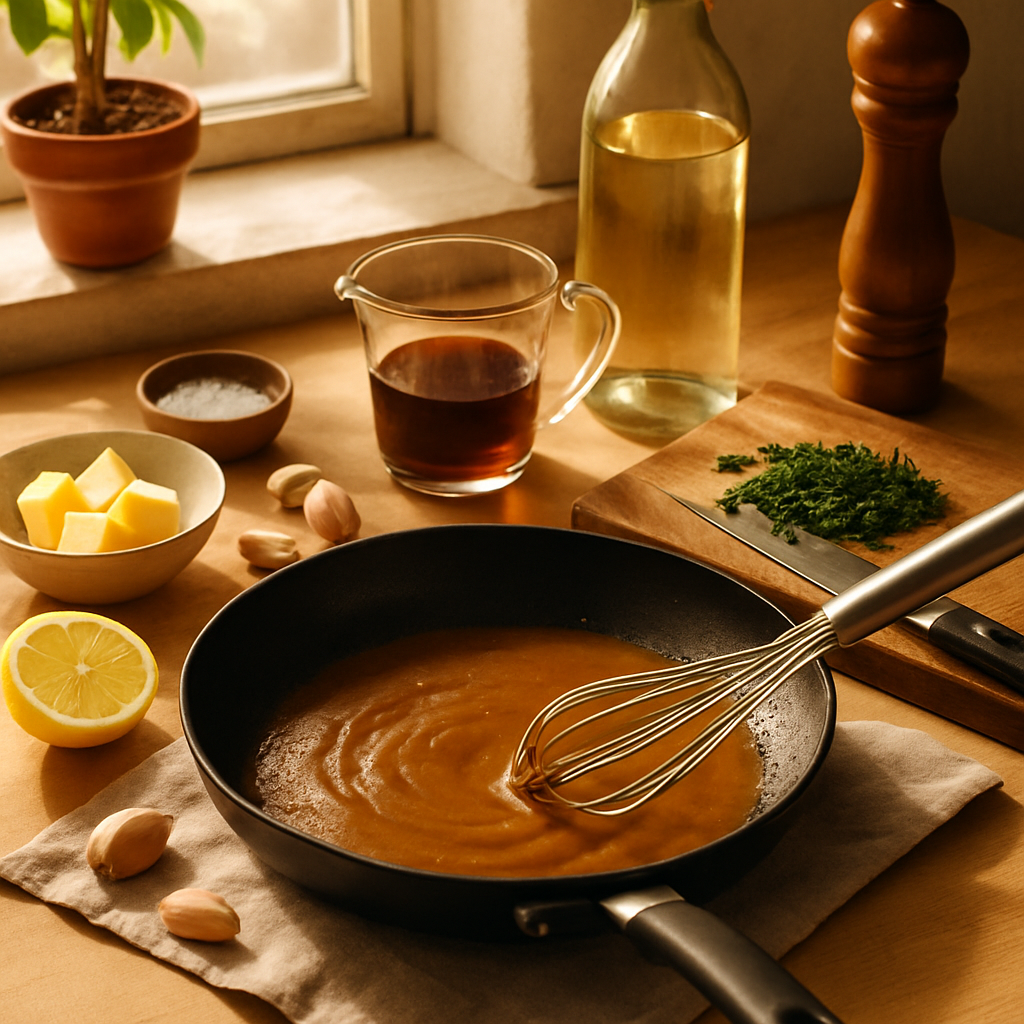
Every pan sauce follows the same structure, and once you know it, you can improvise endlessly. There are four core components.
An aromatic. Something to build a base — shallots, garlic, or a combination of both. These go in first, straight into the residual fat in the pan, and cook for about sixty seconds.
A liquid to deglaze. Wine (red or white depending on what you cooked), stock, cider, or even a splash of something like vermouth or Madeira. This goes in next, and as it hits the hot pan, it loosens the fond from the bottom. Use a wooden spoon or spatula to scrape everything up — that's where the flavour is.
A secondary liquid. Usually stock, if you didn't use it to deglaze. This adds volume and body.
Fat to finish. Cold butter, whisked in at the very end, gives the sauce its gloss and silky texture. This technique is called monter au beurre, and it's what separates a flat, thin sauce from one that coats a spoon beautifully.
The Step-by-Step Process
Remove your cooked protein from the pan and let it rest. Don't clean the pan — that residue is the point.
Set the heat to medium. Add a finely diced shallot (one small one is enough for two portions) and let it soften for about sixty seconds in whatever fat is already in the pan. If the pan looks dry, add a small knob of butter.
Pour in roughly 100ml of wine or another deglazing liquid. It will sizzle aggressively — that's fine. Scrape the bottom of the pan firmly as it bubbles, dissolving all the fond into the liquid. Let it reduce by about half.
Add around 150ml of good stock — chicken stock works with almost everything, beef stock suits red meat, vegetable stock is a solid all-rounder. Let this reduce until the sauce looks slightly thickened and coats the back of a spoon.
Take the pan off the heat entirely. Add 20–30g of cold butter, cut into small cubes, and whisk or swirl the pan constantly until it melts into the sauce. Season with salt and a little black pepper. Taste it. Adjust. Done.
Common Mistakes and How to Avoid Them
Adding butter on the heat. This is the most frequent error. If the pan is too hot when you add the butter, it splits — the fat separates from the liquid and you end up with something greasy rather than glossy. Take the pan off the heat completely before the butter goes in, and keep moving it.
Not reducing enough. A good pan sauce should have some body to it. If it's watery, let it reduce further before you add the butter. You're looking for a consistency that clings lightly to a spoon — not gravy-thick, but not broth-thin either.
Using a non-stick pan. Non-stick pans don't develop fond the same way stainless steel or cast iron do. If you've cooked in a non-stick and there's nothing stuck to the bottom, you don't have much to work with. Stainless steel is ideal for this technique.
Over-salting too early. Stock can vary a lot in its salt content, and as it reduces, the seasoning concentrates. Always taste at the end, after reducing, before you decide how much salt to add.
What the Evidence Shows
The science behind why pan sauces taste so good is well-established. The Maillard reaction, first described by French chemist Louis-Camille Maillard in the early 20th century, produces hundreds of new flavour compounds when amino acids and sugars are exposed to high heat. These compounds — which include furans, pyrazines, and aldehydes — are responsible for the complex, savoury, slightly caramelised flavours we associate with well-cooked meat.
When you deglaze with an acidic liquid like wine, you're not just dissolving fond — you're also brightening the flavour of the sauce. Acidity plays a crucial role in how we perceive taste, making other flavours more distinct and preventing a sauce from tasting flat or one-dimensional. Research into flavour perception consistently shows that a small amount of acid (whether from wine, citrus, or vinegar) can enhance the overall complexity of a dish in a way that's disproportionate to the quantity used.
The fat from the butter finish also serves a functional purpose beyond texture. Fat carries fat-soluble flavour compounds and slows down how quickly you perceive them, which is why buttery sauces taste more lingering and rounded than lean ones.
Variations Worth Trying
Once you're comfortable with the base formula, the variations are genuinely endless.
Creamy mushroom: Deglaze with white wine, add sautéed mushrooms and a splash of double cream instead of extra stock. Works brilliantly with chicken or pork.
Dijon and tarragon: Deglaze with white wine and chicken stock, whisk in a teaspoon of Dijon mustard with the butter, and add fresh tarragon at the very end. Classic with chicken.
Red wine and thyme: Use beef stock, deglaze with a full-bodied red wine, add a sprig of fresh thyme, and reduce well before buttering. Made for steak.
Cider and apple: Deglaze with dry cider, add chicken or vegetable stock, finish with butter and a few thin slices of apple softened separately in butter. Pairs beautifully with pork.
The key in each case is the same — build on the fond, reduce, and finish with cold butter off the heat.
Practical Takeaways
Here's what to take into the kitchen with you.
Keep a bottle of dry white and dry red wine in the kitchen, not for drinking necessarily, but for cooking. Even a cheap bottle used for deglazing transforms a sauce.
Always rest your meat before making the sauce. This gives you time to work without rushing, and the resting juices can be added back into the sauce at the end for extra depth.
Use a light hand with salt until the very end. Reduce first, taste second, season third.
Don't be afraid of reduction. New cooks often panic when a sauce looks too small in the pan. As long as you have enough to coat the protein, that concentration of flavour is exactly what you want.
Cold butter, off the heat, always. Write it on a Post-it note if that helps.
If you want to plan meals that actually make the most of techniques like this — not just what to eat, but how to cook it well — Macrology generates macro-perfect meal plans in seconds — https://macrology.app/signin
Want meals like this planned to your exact macros?
Macrology generates a personalised meal plan in seconds — breakfast, lunch, dinner and snacks, all hitting your daily targets.
Start your free 14-day trial