How to Build a Flavourful Crust on Fish Without Deep-Frying
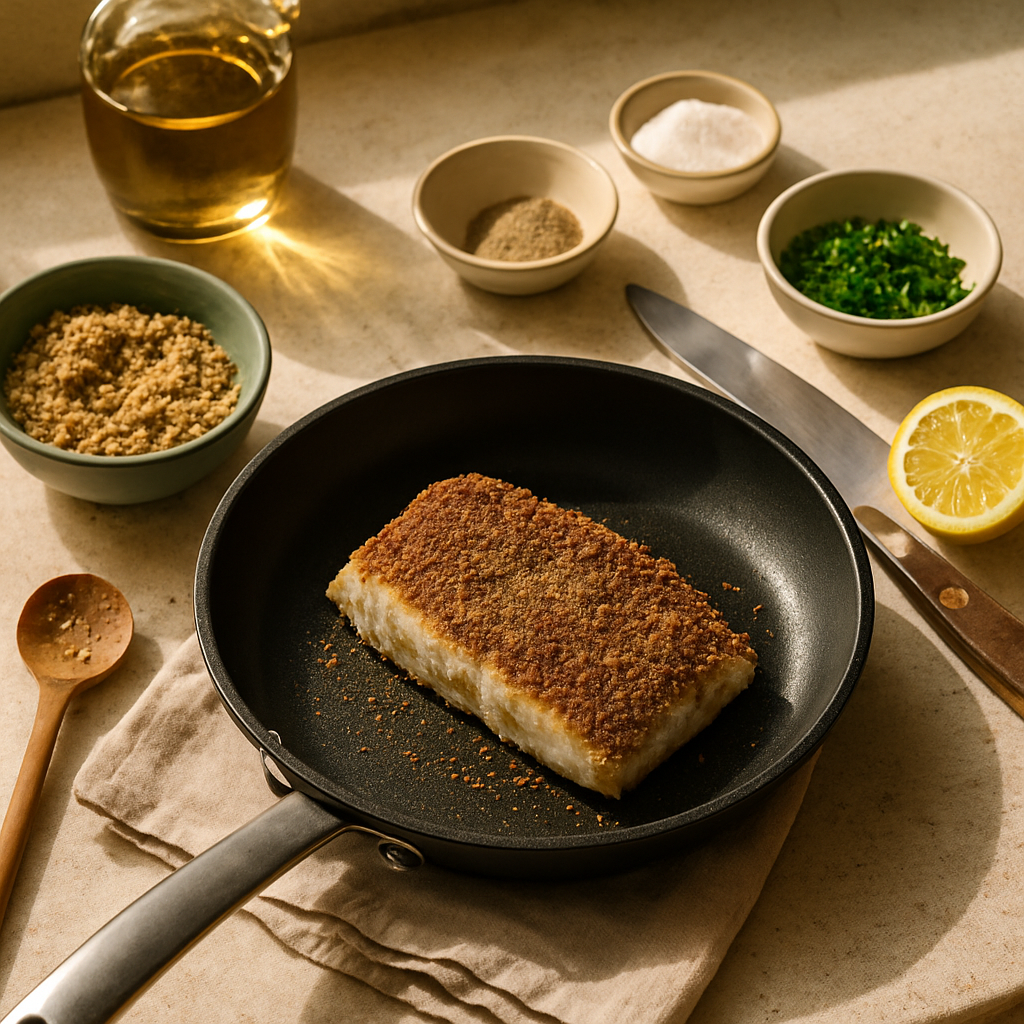
# How to Build a Flavourful Crust on Fish Without Deep-Frying
There's something deeply satisfying about biting through a crisp, golden crust on a piece of fish — that contrast of textures, the burst of flavour. The assumption is that you need a deep fryer and a litre of oil to get there, but that's not quite right.
Whether you're working with a simple cod fillet or something a bit more interesting like sea bass or salmon, there are techniques that deliver a genuinely impressive crust without submerging anything in fat. Here's what actually works, and why.
Why Crust Matters (Beyond the Obvious)
A good crust isn't just about texture. It acts as a protective barrier during cooking, trapping moisture inside the fish so it doesn't dry out. This is why well-crusted fish tends to stay flakier and more tender than a bare fillet thrown straight into a pan.
It also gives you a vehicle for flavour. Herbs, spices, citrus zest, and other aromatics bind into a crust in a way they simply can't when scattered loosely over fish. The surface area, the heat, the slight crunch — it all concentrates the flavour in a way that's hard to achieve otherwise.
Understanding this changes how you approach the whole process. You're not just adding a coating; you're building a flavour layer that serves the fish.
The Role of the Binding Agent
Before anything sticks to your fish, you need something to stick it with. This is where most home cooks go wrong — they skip the binding step entirely and wonder why their herb crust falls off halfway through cooking.
The most common binding agents are egg wash, mustard, and mayonnaise. Each brings something slightly different. Egg wash gives a neutral base that crisps well under heat. Mustard adds sharpness and pairs particularly well with salmon or mackerel. Mayonnaise — a less obvious choice — actually works brilliantly because the fat content helps the crust brown evenly and the emulsion clings to the fish beautifully.
For a lighter approach, a thin smear of olive oil works on lean white fish, though it won't grip quite as firmly. The key is to apply your binding agent in a thin, even layer rather than piling it on.
Choosing Your Crust Ingredients
This is where things get genuinely interesting. The base of most pan or oven crusts is a dry, fine-textured ingredient that will toast and crisp up under heat. Here are the main options:
Breadcrumbs are the classic choice. Panko breadcrumbs are worth seeking out — they're lighter and crispier than standard breadcrumbs because of their larger, flakier structure. Toasting your panko lightly in a dry pan before pressing it onto the fish gives you a head start on colour and crunch.
Ground nuts — almonds, pistachios, or hazelnuts — create a denser, richer crust that works well with meatier fish like tuna or swordfish. Blitz them to a coarse crumb rather than a fine powder so you get some textural variation.
Seeds such as sesame or nigella can either form the sole crust or be mixed into a breadcrumb base. Sesame-crusted salmon is a well-established combination for good reason — the nuttiness of the seeds complements the fattiness of the fish perfectly.
Polenta or cornmeal gives a particularly robust, slightly grainy crust that holds up well in a hot pan. It's a good option if you want something more substantial without going to the effort of deep-frying.
Add your flavourings — dried herbs, smoked paprika, lemon zest, garlic granules, finely grated Parmesan — directly into the dry mix and combine before pressing onto the fish.
What the Evidence Shows
From a nutritional standpoint, cooking fish with a pan-crust or oven-baked method rather than deep-frying makes a meaningful difference to the overall fat content of the dish — not because fat is something to fear, but because it gives you more control over what you're eating.
Research consistently shows that regular fish consumption is associated with better cardiovascular outcomes, largely due to the omega-3 fatty acids found in oily fish like salmon, mackerel, and sardines. The NHS recommends at least two portions of fish per week, one of which should be oily.
The way you cook fish can affect its omega-3 content. A 2014 study published in Food Chemistry found that grilling and baking preserved omega-3 fatty acids better than deep-frying, which caused greater degradation of these fats. Pan-searing with a crust sits in a similar territory to grilling — relatively high heat, but short cooking time, which limits nutrient loss.
The practical upshot: a well-made pan crust lets you get the textural satisfaction of fried fish while keeping the nutritional profile of the fish itself largely intact.
Pan Crust vs. Oven Bake — Which is Better?
Both methods work, and the best choice depends on the fish and the result you're after.
Pan crusting (pressing the coated fish into a hot, lightly oiled pan) gives you more direct control over colour and crispness. The direct contact with the pan creates the Maillard reaction — the same browning process responsible for the crust on a good steak. This is where you get deep golden colour and that toasty, complex flavour. The catch is that it works best for fillets under 2cm thick; anything thicker risks an overcooked exterior before the centre is done.
Oven baking is more forgiving and better suited to thicker fillets, whole fish, or when you're cooking for more than two people and can't realistically manage multiple pans. The crust won't be quite as dramatically crunchy, but a hot oven (200–220°C) and a preheated baking tray can get you surprisingly close. For an extra boost, finish under the grill for the final two minutes.
A combination method — sear the crust side in a pan for two minutes, then transfer to the oven to finish — gives you the best of both. It's what many restaurant kitchens do.
Common Mistakes That Ruin the Crust
Even with the right ingredients, a few easily avoidable errors can derail the whole thing.
Wet fish is the biggest culprit. If your fillet has surface moisture, the crust steams rather than crisps. Pat every fillet thoroughly dry with kitchen paper before you do anything else. This single step makes a disproportionate difference.
Not pressing the crust firmly enough. The coating needs actual contact with the binding agent to adhere. Press the fish gently but firmly into the crust mixture — don't just sprinkle it on top.
Moving the fish too soon in the pan. Once the fillet goes into the pan crust-side down, leave it alone for at least two to three minutes. If you try to move it before the crust has set, it'll stick and tear. When it's ready, it will release naturally.
Overcrowding the pan drops the temperature and causes steaming, which is the enemy of crispness. Cook in batches if necessary, or use your largest pan.
Practical Takeaways
Here's a straightforward method you can use tonight:
1. Dry your fillets thoroughly with kitchen paper. Season with salt and leave uncovered for five minutes if you have time — this draws out a little more surface moisture.
2. Choose your binding agent — a thin smear of Dijon mustard for salmon, mayonnaise for white fish, or egg wash for a neutral base.
3. Make your crust mix in a shallow bowl: panko breadcrumbs as your base, then add a teaspoon of smoked paprika, some finely grated lemon zest, a pinch of garlic granules, and a tablespoon of grated Parmesan. Season with black pepper.
4. Press the top of each fillet firmly into the crust mix until well coated.
5. Heat a non-stick or cast iron pan over medium-high heat with a thin layer of oil. Place the fish crust-side down and don't touch it for two to three minutes until golden. Flip carefully and finish cooking on the other side (or in the oven at 200°C for four to five minutes for thicker fillets).
6. Rest for a minute before serving — the crust firms up slightly as it cools.
The approach scales easily to whatever fish you have available, and the crust mix can be made in advance and kept in a jar.
---
If you want meal plans that make the most of high-protein, flavourful cooking like this, Macrology generates macro-perfect meal plans in seconds — https://macrology.app/signin
Macrology tip: Add your crusted fish dish to the Macrology app to get an accurate breakdown of protein, fats, and carbohydrates — useful if you're keeping an eye on your intake without the faff of manual calculations.
Want meals like this planned to your exact macros?
Macrology generates a personalised meal plan in seconds — breakfast, lunch, dinner and snacks, all hitting your daily targets.
Start your free 14-day trial