How to Use Blooming Spices in Oil or Butter to Get More Flavour from Your Cooking
# How to Use Blooming Spices in Oil or Butter to Get More Flavour from Your Cooking
Ever wondered why a restaurant curry tastes so much more complex than the same recipe made at home, even when you've followed every step? The answer is often happening in the first 60 seconds of cooking — before anything else even hits the pan.
Blooming spices is one of those techniques that quietly transforms a dish. It takes almost no extra time, costs nothing extra, and the difference in flavour is genuinely remarkable. Here's everything you need to know to use it well.
What Does "Blooming" Actually Mean?
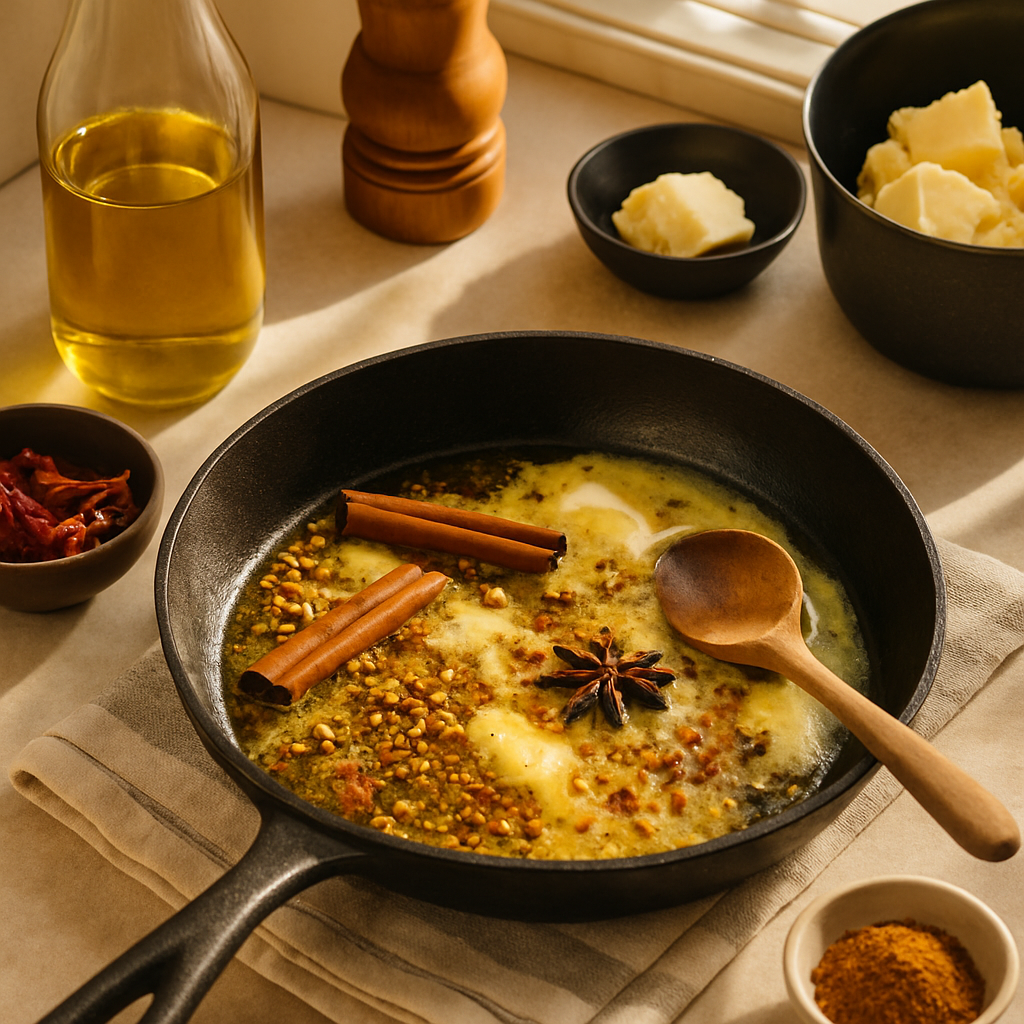
Blooming — sometimes called tempering or toasting in fat — is the process of heating whole or ground spices in oil or butter before adding other ingredients. The heat and fat work together to extract the aromatic compounds from the spices, releasing them into the cooking medium where they can then coat everything else in the pan.
It's a technique found across South Asian, Mexican, Middle Eastern, and West African cuisines — essentially anywhere that spices are central to the cooking tradition. The fact that it shows up independently in so many food cultures is a fairly strong signal that it works.
The result isn't just "more spice flavour." It's a deeper, rounder, more integrated flavour that tastes like the spice belongs in the dish rather than sitting on top of it.
The Science Behind Why It Works
Spices get their flavour and aroma from volatile organic compounds — molecules like terpenes, aldehydes, and esters that are responsible for the characteristic smell of cumin, coriander, or cardamom. Many of these compounds are fat-soluble, meaning they dissolve in fat far more readily than they dissolve in water.
When you add spices directly to a water-based dish — a soup, a stew, a sauce — you're getting some flavour extraction, but nowhere near the full picture. The fat-soluble aroma compounds stay largely locked in. When you bloom spices in oil or butter first, those compounds are drawn out efficiently and distributed throughout the fat, which then carries them through the entire dish.
Heat also plays its own role. Toasting drives off moisture and triggers Maillard reactions in spices — the same chemical process responsible for browning in meat or bread — which develops new flavour compounds that simply don't exist in the raw spice.
Oil or Butter — Does It Matter?
Both work, and which you choose depends mostly on the dish you're making and what flavour profile you're after.
Oil (vegetable, rapeseed, coconut, olive) is the default for most applications. It has a higher smoke point than butter, which gives you a bit more leeway on heat — useful when you're blooming whole spices that need a minute or two to open up fully. Neutral oils let the spice flavour come through cleanly; coconut oil adds its own character, which works brilliantly in South Asian and Caribbean cooking.
Butter adds richness and a nuttiness that complements warmer spices — think cumin with butter in a daal, or smoked paprika bloomed in butter for scrambled eggs. The milk solids in butter can burn more easily though, so keep the heat moderate and keep your eye on it. Ghee — clarified butter with the milk solids removed — gives you the best of both worlds: that rich, toasty butter flavour with a higher smoke point.
The key is matching the fat to the dish. A Keralan fish curry wants coconut oil. A spiced Bolognese wants olive oil. A warming lentil soup could go either way.
Whole Spices vs Ground Spices — Different Rules Apply
This is where a lot of home cooks go slightly wrong, and it's worth getting right.
Whole spices — cumin seeds, mustard seeds, cardamom pods, cinnamon sticks, dried chillies — need more time and slightly higher heat to bloom properly. You're waiting for them to become fragrant and, in the case of seeds, to start popping or just beginning to colour. This usually takes 60–90 seconds over a medium heat. The visual and auditory cues are your guide here: mustard seeds will pop, cumin seeds will darken slightly and smell toasty.
Ground spices are more volatile and far easier to burn. They bloom in as little as 20–30 seconds and need lower heat. The moment you smell them — that immediate, intense hit of aroma — they're done. Add your next ingredient (onion, garlic, liquid) straight away to stop the cooking. A burnt ground spice is bitter and difficult to rescue, so it's better to be too cautious than too confident here.
A useful approach is to layer your blooming: start with whole spices in the oil first, then add your aromatics (onion, ginger, garlic), cook those down, and add ground spices later when the temperature drops slightly. This is the foundation of most South Asian cooking and produces a richly layered result.
What the Evidence Shows
The science here is well-established in food chemistry. Research published in food science journals has consistently shown that fat-based extraction of volatile aroma compounds is significantly more efficient than water-based extraction for the fat-soluble flavour molecules that dominate many spice profiles.
A 2011 study in the Journal of Agricultural and Food Chemistry found that heat treatment substantially increased the concentration of key aroma compounds in cumin — including compounds like cuminaldehyde — compared to unheated samples. Similar findings have been replicated across spices including coriander, fenugreek, and black pepper.
There's also evidence that bioavailability of certain spice compounds improves when consumed with fat. Curcumin — the active compound in turmeric — is famously poorly absorbed on its own, but fat significantly increases how much your body can actually use. Piperine in black pepper has a similar relationship with fat. So blooming isn't just a flavour decision; it may also influence how much benefit you get from spices nutritionally.
None of this means you need to be adding spices in oil for health reasons — food doesn't need to be medicinal to be worth eating. But it's a nice illustration of why fat and spice have been cooked together across cultures for thousands of years. It makes sense biologically and culinarily.
Common Mistakes and How to Avoid Them
The pan isn't hot enough. If the oil isn't shimmering before your spices go in, they'll sit in lukewarm fat and absorb it rather than bloom in it. Let the oil heat up first.
Too much oil. You only need a thin layer — enough to coat the spices. A tablespoon or two is usually sufficient for a dish serving four. Excess oil doesn't improve the blooming and can make the final dish greasy.
Walking away. Blooming spices is a 30–90 second process that requires your full attention. Have your next ingredient ready to go before you add the spices — it needs to land in the pan the moment the spices are done.
Using old spices. Ground spices start to lose their volatile aroma compounds as soon as the jar is opened. If your cumin smells of very little when you open the jar, it's going to taste of very little in the pan. Check your spices every six months, and replace anything that's lost its scent.
Practical Takeaways
Here's how to put this into practice straight away:
- Heat your oil or fat until it's shimmering before any spices go in
- Add whole spices first and wait for them to pop or turn fragrant (60–90 seconds)
- Add ground spices later, at a slightly lower temperature, and move quickly (20–30 seconds maximum)
- Have your next ingredient ready before you start blooming — don't leave the spices alone
- Match your fat to the dish: neutral oil for clean spice flavour, butter or ghee for richness, coconut oil for tropical or South Asian dishes
- Replace ground spices that have lost their smell — they're not doing much in the pan
Start with something simple: next time you make scrambled eggs, bloom a pinch of cumin or smoked paprika in a little butter before the eggs go in. It takes 20 seconds and the difference is immediately obvious.
If you want your everyday meals to taste like they've had genuine care and thought put into them, Macrology generates macro-perfect meal plans in seconds — [https://macrology.app/signin](https://macrology.app/signin)
Want meals like this planned to your exact macros?
Macrology generates a personalised meal plan in seconds — breakfast, lunch, dinner and snacks, all hitting your daily targets.
Start your free 14-day trial