The Role of Potassium in Muscle Function and Where to Find It in Everyday UK Foods
# The Role of Potassium in Muscle Function and Where to Find It in Everyday UK Foods
Most people can name iron or calcium when asked about important minerals — but potassium tends to get overlooked, despite being one of the most critical nutrients for how your body actually moves. If you've ever experienced a muscle cramp mid-run or woken up with a calf seizing in the night, potassium is likely part of the story.
Why Potassium Matters More Than You Might Think
Potassium is an electrolyte — an electrically charged mineral that your body uses to transmit signals between cells. It works in close partnership with sodium, and together they regulate the fluid balance inside and outside your cells, which is fundamental to how muscles contract and relax.
Every time a muscle fibre fires — whether you're lifting something heavy, going for a walk, or your heart is beating — potassium ions move across cell membranes to trigger and then reset that contraction. Without adequate potassium, this electrical signalling becomes unreliable. Muscles can cramp, feel weak, or fatigue much faster than they otherwise would.
Beyond muscle function, potassium also plays a role in maintaining healthy blood pressure. A well-established body of research shows that higher potassium intake is associated with lower blood pressure, partly because it helps your kidneys excrete excess sodium more efficiently.
What the Evidence Shows
The relationship between potassium and muscle function is well-supported in physiology and clinical research. A 2019 review published in Nutrients confirmed that inadequate potassium intake impairs neuromuscular function — the communication system between your nerves and muscles — and that this effect is measurable even before clinical deficiency (hypokalaemia) is diagnosed.
Hypokalaemia — when blood potassium drops significantly — can cause profound muscle weakness and, in serious cases, disruption to heart rhythm. But the more common, everyday story is suboptimal intake: not technically deficient, but not eating enough potassium to support optimal muscle recovery and performance.
The UK government's National Diet and Nutrition Survey has consistently found that many adults fall below the recommended 3,500mg of potassium per day. Women tend to have lower intakes than men, largely due to lower overall calorie consumption. Athletes and people who sweat heavily have even higher needs, since potassium is lost through sweat alongside sodium.
One important nuance: cramps have multiple causes. Dehydration, magnesium deficiency, and simply doing more exercise than your body is conditioned for can all trigger cramps independently of potassium. So while correcting low potassium intake is worthwhile, it isn't always the sole fix.
The Sodium-Potassium Balance
Modern diets, particularly in the UK, tend to be high in sodium and lower in potassium than our physiology is designed for. Processed foods — ready meals, crisps, bread, cured meats — are the primary source of dietary sodium for most people. Meanwhile, the potassium-rich foods that counterbalance this (fruits, vegetables, legumes) often make up a smaller portion of what people actually eat day to day.
This imbalance matters because sodium and potassium compete at the cellular level. High sodium intake can deplete the effectiveness of potassium, and low potassium intake amplifies the blood-pressure-raising effect of sodium. Getting more potassium into your diet doesn't require dramatic dietary overhaul — but it does benefit from a bit of awareness.
Where to Find Potassium in Everyday UK Foods
The good news is that potassium is found in a wide range of foods that are readily available and affordable across the UK. You don't need specialist shops or expensive supplements.
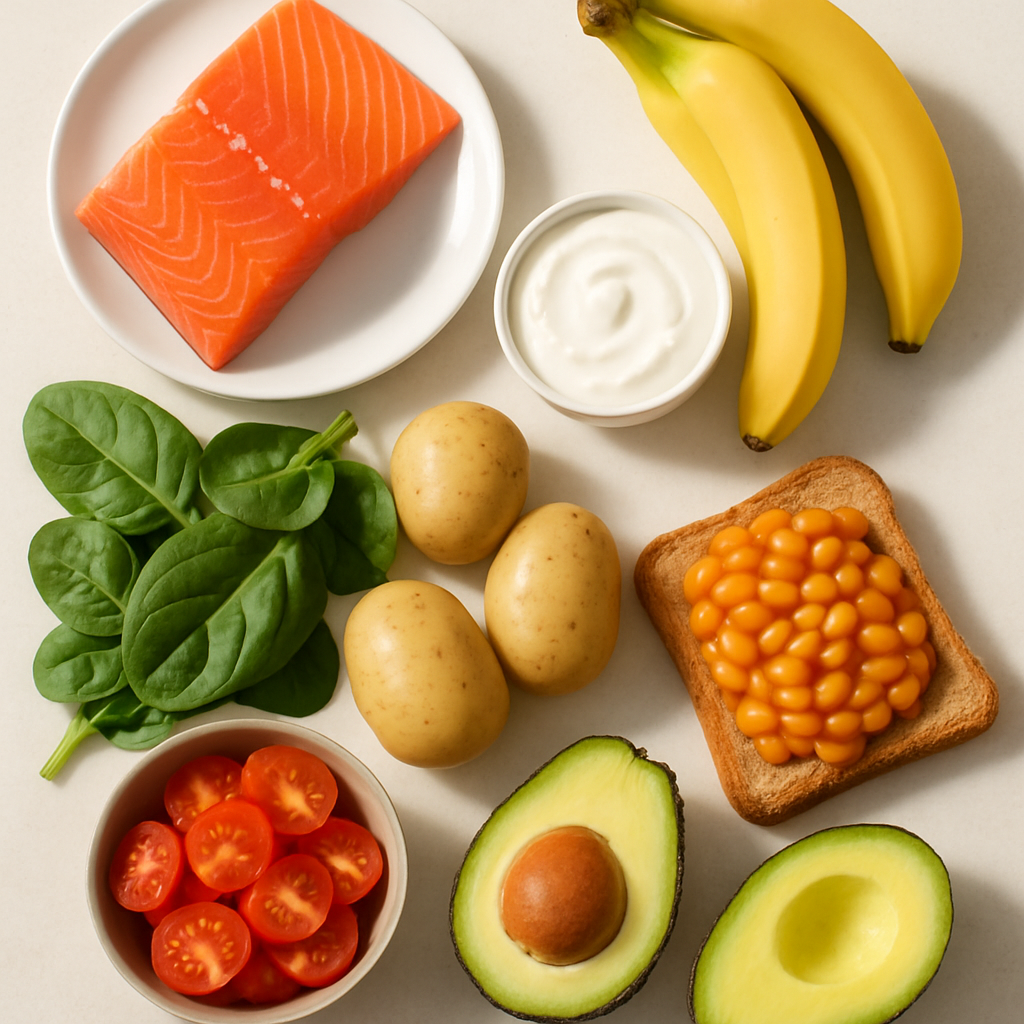
Potatoes are one of the best and most underrated sources. A medium baked potato with the skin on contains around 900mg of potassium — more than a quarter of your daily target in one sitting. Boiling potatoes causes some potassium to leach into the water, so baking, roasting, or steaming retains more.
Bananas are the food most commonly associated with potassium, and fairly — a medium banana contains around 420mg. They're convenient, cheap, and widely available. That said, they're not uniquely special compared to other fruits; they've simply become the cultural symbol for the mineral.
Avocados are an excellent source, with half an avocado providing roughly 485mg. Tinned tomatoes, which are a staple in many UK kitchens, are also a solid contributor — a 400g tin contains around 800–1,000mg of potassium depending on the brand.
Legumes — lentils, chickpeas, kidney beans — are particularly potassium-dense. A portion of cooked lentils (around 200g) delivers roughly 700mg, alongside a substantial amount of protein and fibre. Tinned versions are just as nutritious as dried, making them a genuinely convenient option.
Dark leafy greens such as spinach and kale are worth a mention, though the quantities you'd need to eat to hit your targets are larger than with the foods above. Spinach wilts significantly when cooked, which makes getting a meaningful portion easier than eating it raw by volume.
Dairy and fish also contribute. A pot of plain yoghurt contains around 350–450mg, and a fillet of salmon provides approximately 400–600mg depending on size. Whole milk is a reasonable source too, at around 375mg per 250ml serving.
A Common Misconception: Do You Need to Supplement?
Potassium supplements exist, but they're worth approaching with caution. In the UK, over-the-counter supplements are typically limited to low doses (around 99mg per tablet) because high-dose potassium supplementation can be dangerous — particularly for people with kidney disease or those taking certain blood pressure medications, where potassium can accumulate to harmful levels.
For the vast majority of healthy people, food is the most effective and safest way to increase potassium intake. Whole food sources come packaged with other nutrients — fibre, magnesium, vitamin C — that support how potassium is absorbed and used. A supplement simply can't replicate that.
If you have a medical condition, take ACE inhibitors, ARBs, or potassium-sparing diuretics, or have any reason to believe your potassium levels are abnormal, a conversation with your GP before changing anything is sensible.
How Exercise Changes Your Potassium Needs
During exercise, potassium is released from muscle cells into the bloodstream, then lost through sweat. For most people doing moderate activity, this is easily offset by eating a varied diet. For those training intensively — multiple sessions per week, long-distance running, cycling, or team sports — potassium needs are meaningfully higher.
Sports nutrition research suggests that recovery meals and snacks are a particularly good time to prioritise potassium-rich foods. After training, your muscles are primed to absorb nutrients, and replenishing potassium alongside carbohydrates and protein supports both recovery and the resetting of normal muscle cell function.
A practical post-training combination that many people already gravitate towards: a banana with yoghurt, or a jacket potato with beans. Both tick the boxes for potassium, carbohydrate, and protein without needing to overthink it.
Practical Takeaways
Here are some straightforward ways to increase potassium intake without turning your diet upside down:
- Swap boiled potatoes for baked or roasted — you'll retain significantly more potassium, and they tend to taste better anyway
- Keep a tin of lentils or chickpeas in the cupboard — they can be added to soups, curries, and salads with very little effort and give a potassium boost alongside protein and fibre
- Use tinned tomatoes as a base — most UK households already do this, so leaning into it more is an easy win
- Add a portion of yoghurt to breakfast — it's a convenient way to hit a few hundred milligrams before the day really starts
- Don't skip the potato skin — it holds a disproportionate amount of the potassium and fibre, and the texture is usually better for it
- Eat a varied range of vegetables — rather than chasing individual "superfoods", variety across the week adds up across many minerals including potassium
If you want to hit your potassium targets consistently without having to track everything manually, Macrology generates macro-perfect meal plans in seconds — [https://macrology.app/signin](https://macrology.app/signin)
Potassium won't make headlines the way protein or omega-3s tend to, but it's doing quiet, essential work every time your muscles move. Getting enough of it from everyday UK foods is genuinely achievable — and the foods that happen to be rich in it are largely the ones that make meals more satisfying anyway.
Want meals like this planned to your exact macros?
Macrology generates a personalised meal plan in seconds — breakfast, lunch, dinner and snacks, all hitting your daily targets.
Start your free 14-day trial