How to cut the cost of your food bill without compromising on quality
# How to Cut the Cost of Your Food Bill Without Compromising on Quality
Most of us have felt the pinch at the checkout in recent years. Food prices in the UK rose by over 19% between 2022 and 2024, and for many households, the weekly shop has become one of the most stressful budget decisions of the week.
The good news is that eating well on less money is genuinely achievable — and it doesn't mean surviving on plain rice and sadness. With a bit of strategy, you can actually end up eating better than before.
Why "eating healthy is expensive" is only half the story
This idea gets repeated a lot, and there's some truth to it — yes, a bag of almonds costs more than a bag of crisps. But the framing misses something important.
The real cost driver isn't healthy versus unhealthy food — it's planning versus not planning. Unplanned shopping leads to impulse buys, wasted produce, and expensive convenience meals when you can't figure out what to cook with the random ingredients you've got.
Research from WRAP (the Waste and Resources Action Programme) found that UK households throw away around 9.5 million tonnes of food every year, worth approximately £14 billion. The average family wastes nearly £60 worth of food every month. That's money going straight in the bin.
Fix the planning problem, and the cost of eating well drops considerably.
What the evidence shows
Studies consistently find that the most cost-effective diets share a few features: they're built around whole grains, legumes, vegetables, and eggs, with smaller amounts of meat and fish. This lines up almost perfectly with what nutrition research recommends for health anyway.
A 2021 analysis published in PLOS ONE looked at diet quality scores against food costs across multiple countries and found that the least expensive healthy diets were heavily plant-forward — not because plants are inherently virtuous, but because they tend to deliver a lot of protein, fibre, and micronutrients per pound spent.
Tinned and frozen foods are often nutritionally comparable to fresh. A 2017 review in the Journal of the Science of Food and Agriculture found that frozen vegetables frequently retain more vitamins than their fresh counterparts, particularly vitamin C, because they're frozen shortly after harvest rather than spending days in transit and on shelves.
Frozen spinach, tinned tomatoes, canned chickpeas — these aren't budget compromises. They're genuinely good food.
The planning habit that makes everything easier
Meal planning has a reputation for being time-consuming and restrictive, but it doesn't have to work that way. You're not committing to a rigid schedule — you're just giving yourself a rough map for the week so you're not standing in front of the fridge at 7pm with no idea what to cook.
The single most valuable thing you can do is plan around what you already have. Before you write a shopping list, check your cupboards, fridge, and freezer. Build at least two or three meals around what's already there, then fill the gaps.
This approach — sometimes called "use it up" cooking — drastically reduces waste and means you're not constantly buying duplicates of things you already own.
Batch cooking sits alongside this naturally. If you're making a lentil soup or a tray of roasted vegetables, it costs almost nothing extra in time or energy to make double the quantity. That's lunch sorted for two more days without any additional shopping.
Where to spend and where to save
Not all food categories are equal when it comes to quality versus cost trade-offs. Knowing where it's worth spending a bit more — and where own-brand or frozen is just as good — can make a meaningful difference over the course of a month.
Worth spending more on:
- Good olive oil (used sparingly, it lasts a while and makes a real difference to flavour)
- Spices and dried herbs (a well-stocked spice rack transforms cheap base ingredients)
- A decent cut of meat occasionally rather than cheap meat frequently
Where own-brand or budget options are genuinely just as good:
- Tinned fish (sardines, mackerel, tuna — nutritionally excellent, and supermarket own-brand is fine)
- Frozen vegetables and fruit
- Dried pasta, rice, lentils, and pulses
- Tinned tomatoes (often better quality than cheap fresh tomatoes out of season)
- Eggs
The broader principle: invest in flavour-builders and save on bulk ingredients. A packet of cumin costs very little and will make a pot of cheap lentils taste like something you'd happily serve to guests.
Smart shopping habits that actually help
Beyond planning, a few practical shopping habits can quietly reduce your bill without feeling like deprivation.
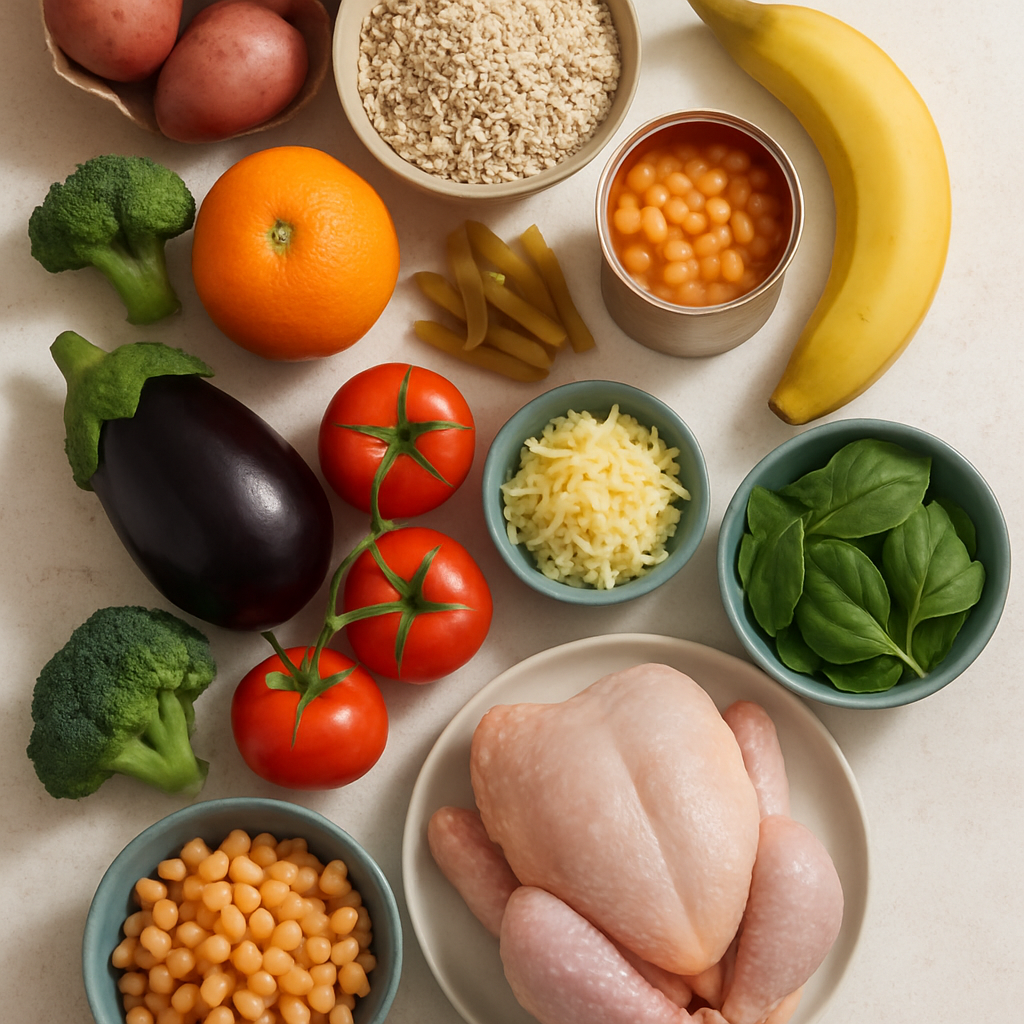
Buy whole rather than pre-prepped. A block of cheese costs less per gram than pre-grated. A whole chicken is significantly cheaper per kilo than buying separate portions. A head of broccoli costs less than broccoli florets in a bag. You're paying for convenience when you buy pre-prepped — which is fine sometimes, but worth being conscious of.
Lean into seasonal produce. In the UK, this means root vegetables and brassicas through autumn and winter (carrots, parsnips, cabbage, leeks), and softer vegetables and salads through spring and summer. Seasonal produce is cheaper because it's abundant and doesn't need to be imported. It also tends to taste better, which is its own reward.
Don't overlook cheaper protein sources. Chicken thighs cost less than breasts and are arguably more flavourful. Tinned sardines are one of the most nutritionally dense foods you can buy and cost around 80p a tin. Eggs remain exceptional value. Lentils and tinned beans are cheap, filling, and high in both protein and fibre — and they go with almost everything.
Shop the reduced section. Most supermarkets mark down food approaching its use-by date, usually in the morning and again in the evening. If you're cooking that day or can freeze it, this can mean significant savings on meat, fish, bread, and dairy.
Making it work with a busy life
The honest challenge here isn't knowledge — most people know that cooking from scratch is cheaper than buying ready meals. The challenge is time, energy, and the mental load of figuring out what to cook every day.
This is where a bit of structure pays off. A flexible weekly template — something like: one batch-cooked soup or stew, one egg-based meal, two or three simple weeknight dinners, one "use it up" meal on Friday — gives you a framework without being prescriptive.
It also helps to keep a short list of go-to meals you can make cheaply and quickly without having to think too hard. Tinned tomatoes and chickpeas with spices over rice. Eggs scrambled with leftover vegetables. A bowl of soup from whatever's in the fridge. These become your safety net when life gets busy and you'd otherwise reach for a takeaway.
Practical takeaways
Here's what you can act on this week, without overhauling anything dramatically:
- Check your cupboards before you write your shopping list — build at least two meals from what you already have
- Swap fresh for frozen on vegetables you use regularly (peas, spinach, sweetcorn, edamame) without any nutritional downside
- Double your next batch cook — soup, stew, grain salad, whatever you're making anyway
- Add one cheap protein staple you don't use much — a bag of red lentils or a tin of sardines — and find one recipe built around it
- Buy whole rather than pre-prepped where you can: block cheese, whole chicken, uncut vegetables
- Invest in two or three spices you don't currently have — smoked paprika, cumin, and dried chilli will transform cheap base ingredients
None of this requires a dramatic lifestyle change. It's a collection of small shifts that compound over a month into a noticeably lower food bill — and often a noticeably better diet.
If you want to take the guesswork out of planning nutritious, budget-friendly meals, Macrology generates macro-perfect meal plans in seconds — [https://macrology.app/signin](https://macrology.app/signin)
Want meals like this planned to your exact macros?
Macrology generates a personalised meal plan in seconds — breakfast, lunch, dinner and snacks, all hitting your daily targets.
Start your free 14-day trial