Why Fat-Soluble Vitamins Behave Differently — and Why It Matters for Your Diet
# Why Fat-Soluble Vitamins Behave Differently — and Why It Matters for Your Diet
You can eat a perfectly "healthy" diet and still end up deficient in some of the most important vitamins your body needs. Not because you're not trying hard enough, but because of a quirk in how certain vitamins are absorbed — one that most nutrition advice quietly ignores.
Fat-soluble vitamins play by different rules. Understanding those rules can genuinely change how you eat.
What Makes a Vitamin Fat-Soluble?
Vitamins are broadly split into two camps: water-soluble and fat-soluble. The water-soluble ones — vitamin C and the B vitamins — dissolve in water, get absorbed fairly easily, and any excess is flushed out in your urine. Your body doesn't store much of them, so you need a regular supply.
Fat-soluble vitamins work very differently. Vitamins A, D, E, and K need dietary fat present in order to be absorbed at all. Once they're in your system, they're transported through the lymphatic system, packaged into lipoproteins, and stored in your liver and fatty tissues rather than excreted.
This has two important consequences. First, if you eat these vitamins without any fat, a significant proportion passes straight through you. Second, because your body stores them, both deficiency and excess are possible in ways that don't apply to water-soluble vitamins.
The Absorption Problem Nobody Talks About
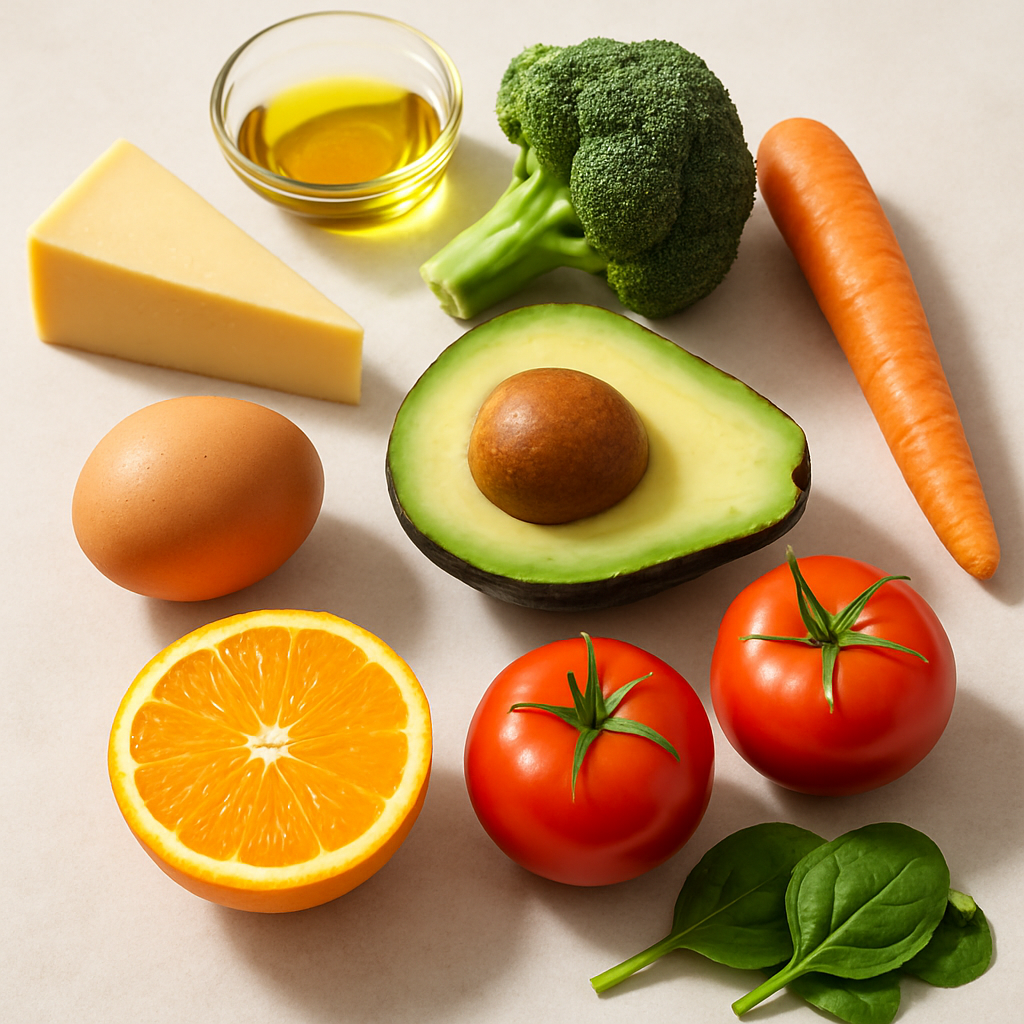
Here's where things get interesting. Many of the foods richest in fat-soluble vitamins are plant-based — think leafy greens for vitamin K, carrots and sweet potato for beta-carotene (which converts to vitamin A), and nuts and seeds for vitamin E.
The catch? These foods are often low in fat themselves. A salad packed with spinach, peppers, and grated carrot is genuinely nutritious, but if it's dressed with nothing but lemon juice, you're leaving a substantial portion of those vitamins on the table — literally.
Research published in the American Journal of Clinical Nutrition found that adding fat to a meal containing carotenoids (the compounds that convert to vitamin A) significantly increased absorption. One study found that eating salad with a full-fat dressing led to dramatically higher absorption of fat-soluble nutrients compared to a fat-free dressing. The difference wasn't marginal — it was several-fold in some cases.
This isn't an argument for drowning everything in oil. It's a reminder that context matters enormously in nutrition — pairing is just as important as the food itself.
What the Evidence Shows
Each of the four fat-soluble vitamins has its own distinct absorption profile, and the evidence on each is worth understanding.
Vitamin D is the most widely discussed. The UK's NHS recommends that everyone considers a supplement during autumn and winter, because sunlight exposure — the primary source — is insufficient for much of the year. Vitamin D is found in oily fish, egg yolks, and fortified foods. Its absorption is enhanced by fat in the same meal, which is one reason supplements taken with a meal containing some fat show better uptake than those taken on an empty stomach. A 2015 study in the Journal of the Academy of Nutrition and Dietetics found that taking vitamin D with the largest meal of the day — typically the one with the most fat — increased blood levels by about 50% compared to taking it on an empty stomach.
Vitamin K exists in two main forms: K1 (phylloquinone), found in leafy greens, and K2 (menaquinone), found in fermented foods and some animal products. K1 has relatively modest absorption — somewhere around 10–20% from plant foods — and this improves noticeably with fat. K2 is absorbed more efficiently and sticks around in the body longer, which may explain why some researchers believe it plays a more significant role in bone and cardiovascular health, though this area is still actively studied.
Vitamin E is an antioxidant found in nuts, seeds, and plant oils. Because it's found alongside fat in many of its food sources, absorption is often naturally supported — though it's still worth knowing that very low-fat diets can impair intake.
Vitamin A comes from two sources: preformed vitamin A (retinol) from animal foods like liver and dairy, and provitamin A carotenoids from plants. The conversion of beta-carotene to active vitamin A is less efficient than many people assume — it can vary enormously depending on genetics, gut health, and the food matrix. Eating beta-carotene with fat improves conversion, but some people are genetically poor converters regardless.
The Toxicity Side of the Equation
Because fat-soluble vitamins are stored rather than excreted, they can accumulate to harmful levels — something that's essentially impossible with water-soluble vitamins consumed through food.
Vitamin A toxicity (hypervitaminosis A) is the most well-documented. Consuming very high doses of preformed vitamin A — typically through high-dose supplements or eating large amounts of liver very frequently — can cause symptoms ranging from nausea and headaches to more serious effects over time. Liver is extremely rich in retinol; it's nutrient-dense and worth eating occasionally, but the NHS advises pregnant women to avoid it entirely because of the risk to the foetus.
Vitamin D toxicity is possible but rare from food alone. It's almost always the result of taking very high-dose supplements over extended periods without monitoring. This isn't a reason to avoid vitamin D, which is genuinely important and widely under-consumed — it's a reason to be thoughtful about supplementation rather than assuming more is always better.
Vitamins E and K have much lower toxicity risk, though very high-dose vitamin E supplements have been associated with increased bleeding risk, and high-dose vitamin K can interfere with anticoagulant medications.
The practical upshot: supplements for fat-soluble vitamins deserve more care than supplements for water-soluble ones.
Common Situations Where This Goes Wrong
A few scenarios where fat-soluble vitamin absorption quietly breaks down.
Very low-fat diets — whether by choice or habit — can meaningfully reduce absorption of all four vitamins. This doesn't mean dietary fat needs to be high, but it does mean that going extremely low has real nutritional trade-offs.
Fat malabsorption conditions, including coeliac disease, Crohn's disease, cystic fibrosis, and certain bowel surgeries, can significantly impair fat-soluble vitamin absorption. If you have one of these conditions, it's worth discussing vitamin status with your GP or dietitian.
Eating fat-soluble vitamin-rich foods consistently at low-fat meals — a dry salad at lunch every day, steamed vegetables with no added fat at dinner — can compound over time. It doesn't cause immediate deficiency, but it's an inefficiency worth knowing about.
Practical Takeaways
None of this needs to be complicated. A few straightforward shifts cover most of what matters.
Add a fat source to vegetable-heavy meals. This doesn't need to be much — a drizzle of olive oil on roasted vegetables, some avocado in a salad, a handful of nuts alongside. The fat doesn't even need to be in the same dish, just in the same meal.
Take vitamin D supplements with your main meal. If you're taking vitamin D (which is sensible for most people in the UK, particularly from October to March), take it with food that contains some fat for better absorption.
Don't rely entirely on plant sources for vitamin A if you're a poor converter. If you eat no animal products, it's worth being aware that beta-carotene conversion varies a lot between individuals. Some people convert it well; others don't. Getting blood levels checked periodically is a sensible step.
Be cautious with fat-soluble supplements at high doses. Unlike vitamin C, where excess is simply excreted, taking large amounts of vitamins A and D regularly without medical supervision isn't risk-free.
Eat liver occasionally, not daily. It's one of the most nutrient-dense foods available, but moderation applies.
If you want to build meals that naturally support your vitamin and mineral intake alongside your macro goals, Macrology generates macro-perfect meal plans in seconds — https://macrology.app/signin
The bigger picture here is that nutrition isn't just about what you eat — it's about what your body can actually absorb. Getting that right doesn't require obsessing over every detail, but understanding a few key mechanisms makes a real difference.
Want meals like this planned to your exact macros?
Macrology generates a personalised meal plan in seconds — breakfast, lunch, dinner and snacks, all hitting your daily targets.
Start your free 14-day trial