The Role of Collagen in Joint and Skin Health: What the Evidence Actually Shows
# The Role of Collagen in Joint and Skin Health: What the Evidence Actually Shows
Walk into any health food shop or scroll through your social media feed and you'll find collagen powders, capsules, and drinks promising younger-looking skin and pain-free joints. But with supplements, the marketing almost always runs ahead of the science — so what does the evidence actually say?
What Is Collagen and Why Does It Matter?
Collagen is the most abundant protein in the human body. It forms the structural scaffold of your skin, tendons, ligaments, cartilage, and bones — essentially the connective tissue that holds everything together.
There are at least 28 known types of collagen, but the ones you'll hear about most are Type I (found in skin, tendons, and bone), Type II (the main structural protein in cartilage), and Type III (found in skin and blood vessels). Each plays a slightly different role, which matters when we start talking about supplements.
Your body produces collagen naturally by combining amino acids — primarily glycine, proline, and hydroxyproline — alongside vitamin C, zinc, and copper. The problem is that production slows from your mid-twenties onwards, accelerating with age, sun exposure, and smoking. This decline is what drives much of the interest in whether supplementing collagen can compensate.
The Big Question: Does Oral Collagen Actually Work?
Here's where it gets interesting. For years, the prevailing scepticism was that any collagen you eat simply gets broken down into amino acids during digestion — just like any other protein — and there's no reason it would specifically end up rebuilding your joints or skin.
That view has been partially challenged by more recent research. Studies have found that collagen peptides (hydrolysed collagen that's been broken into smaller fragments) don't fully disappear during digestion. Some specific peptides, particularly Pro-Hyp and Hyp-Gly, appear to survive digestion and enter the bloodstream intact, where they may signal fibroblasts — the cells responsible for producing collagen — to ramp up their own production.
This is a plausible mechanism, but it's worth being clear: it doesn't confirm that supplements reliably rebuild ageing joints or reverse skin changes. The mechanism exists; whether it's strong enough to make a meaningful clinical difference in real people is a separate question.
What the Evidence Shows
Let's look at the research on both fronts — joints and skin — because the picture is somewhat different for each.
For joints and cartilage, one of the more cited studies is a 2008 randomised controlled trial published in Current Medical Research and Opinion, which found that athletes taking 10g of hydrolysed collagen daily for 24 weeks reported significant reductions in joint pain compared to a placebo group. A 2021 systematic review in the British Journal of Sports Medicine also concluded that collagen supplementation showed promise for reducing joint pain, though it called for more large-scale, high-quality trials.
For people with osteoarthritis, a 2016 meta-analysis found that collagen hydrolysate modestly reduced pain and improved function compared to placebo, though the authors noted considerable variation across studies. The European Food Safety Authority has not approved a health claim for collagen and joint health, partly because the evidence base, while encouraging, isn't yet considered robust enough.
For skin, the evidence is somewhat stronger. A 2019 systematic review in the Journal of Drugs in Dermatology examined 11 randomised controlled trials and found that collagen supplementation improved skin elasticity, hydration, and dermal collagen density. Most studies used doses of 2.5–10g per day over periods of 4–12 weeks. A 2021 review in the International Journal of Dermatology reached similar conclusions, noting improvements in skin moisture and a reduction in fine lines, while acknowledging that many studies were industry-funded — a limitation worth keeping in mind.
The honest summary: skin evidence is more consistent; joint evidence is promising but needs more rigorous investigation. Neither is definitive enough to make sweeping claims.
Common Misconceptions Worth Clearing Up
A few things regularly get muddled in conversations about collagen.
"Collagen cream will boost your collagen." Topical collagen is largely ineffective at increasing collagen in the dermis because collagen molecules are simply too large to penetrate the skin barrier. Skincare products that stimulate the skin's own collagen production — like retinoids and certain peptides — have a much stronger evidence base than applying collagen directly.
"Bone broth is a great collagen source." Bone broth does contain collagen and gelatin, but the concentration is highly variable depending on how it's made. It's a perfectly fine food, but it's not a reliable or measurable way to hit a therapeutic dose.
"Any protein will do the same job." Collagen is unusual in its amino acid profile — it's extremely rich in glycine, which most other dietary proteins contain in much lower amounts. There's some argument that this specific composition, rather than just protein in general, matters for the proposed mechanisms. That said, eating adequate total protein still supports your body's baseline collagen synthesis.
What Influences Your Body's Natural Collagen Production?
Before reaching for a supplement, it's worth noting how much everyday factors influence collagen synthesis.
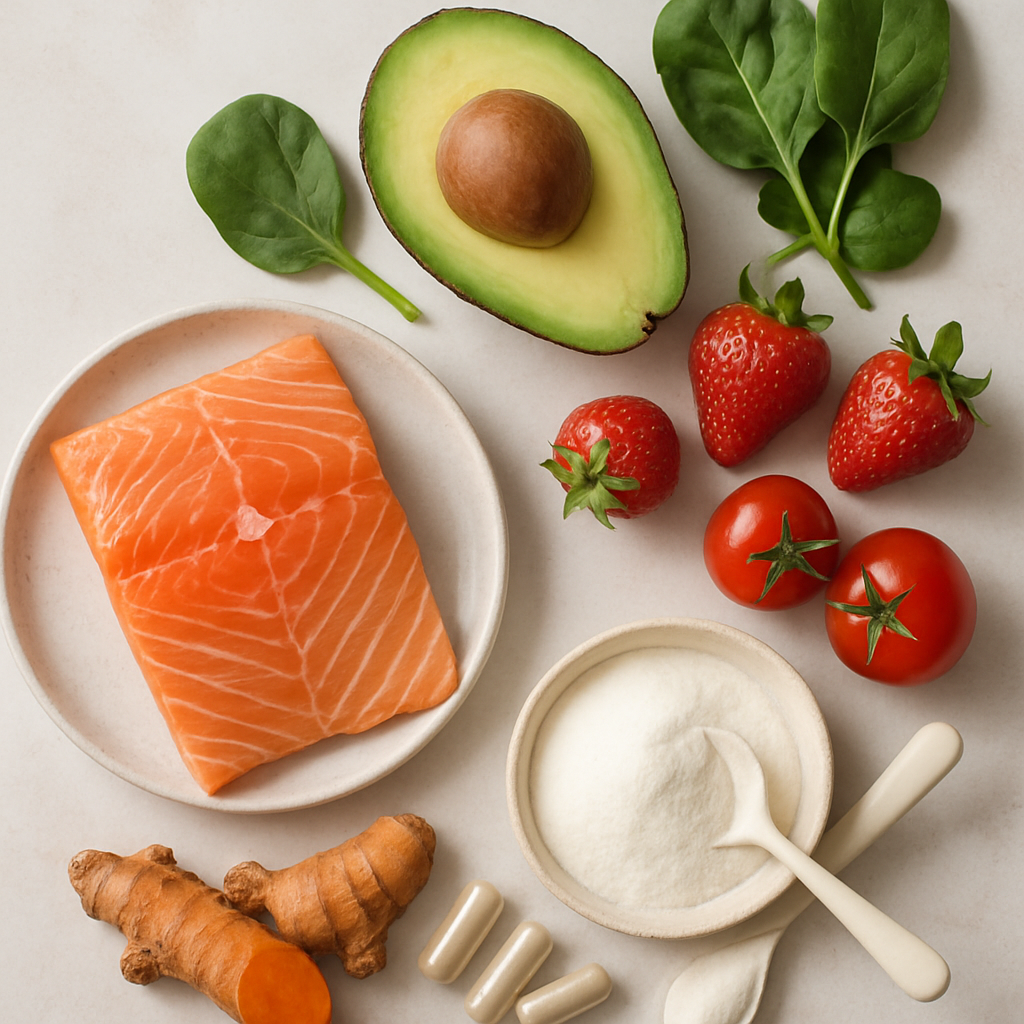
Vitamin C is non-negotiable — it's an essential cofactor in collagen synthesis. Without enough of it, your body simply cannot build collagen properly. Citrus fruit, peppers, broccoli, and strawberries are all excellent sources, and most people in the UK eat enough, though not everyone does.
Zinc and copper, found in foods like meat, shellfish, legumes, and nuts, also play roles in collagen formation and cross-linking. Chronic sleep deprivation impairs skin repair. UV exposure degrades existing collagen and is one of the most significant accelerants of skin ageing. And smoking is one of the most potent inhibitors of collagen synthesis — it reduces skin collagen content measurably.
Eating enough total protein matters too. If your diet is low in protein overall, you're limiting the raw materials your body has to work with, regardless of anything else.
Should You Try Collagen Supplements?
There's no evidence that collagen supplements are harmful for most people — they're essentially a protein source with a specific amino acid profile. The question is really whether they're worth adding to your routine.
If joint discomfort is your concern, the evidence suggests there may be a modest benefit, particularly for exercise-related joint pain, and a dose of around 10g per day is what most studies have used. It's not a quick fix, and the effects take weeks to months to become apparent.
For skin, the evidence is a little more encouraging, particularly around hydration and elasticity. Again, 2.5–10g daily appears to be the effective range in research settings.
That said, if your diet is already high in protein, well-varied, and rich in the nutrients that support collagen synthesis — vitamin C, zinc, copper — the additional benefit from a supplement may be relatively modest. Supplements are unlikely to outperform a poor diet, but they may complement a decent one.
Practical Takeaways
Here's what you can actually do with all of this:
- Prioritise vitamin C daily — it's the most evidence-backed way to support your body's own collagen production. A red pepper, a handful of strawberries, or some broccoli will do it.
- Eat enough protein overall — aim for a varied intake that includes meat, fish, eggs, legumes, or dairy, depending on your preferences.
- If you want to try a collagen supplement, look for hydrolysed collagen (also called collagen peptides) rather than unprocessed gelatin, as the hydrolysed form is what most studies have used. Marine and bovine collagen are the most common types.
- Be patient and realistic — research timelines are typically 8–12 weeks, and effects are moderate, not dramatic.
- Don't ignore sun protection — no supplement can undo the collagen degradation from unprotected UV exposure. SPF is arguably the most effective anti-ageing tool available.
- Skip the collagen creams — topical application has weak evidence; spend your money elsewhere.
If you want to build a diet that genuinely supports your skin, joints, and overall health without the guesswork, Macrology generates macro-perfect meal plans in seconds — [https://macrology.app/signin](https://macrology.app/signin)
Want meals like this planned to your exact macros?
Macrology generates a personalised meal plan in seconds — breakfast, lunch, dinner and snacks, all hitting your daily targets.
Start your free 14-day trial