Taiwanese Braised Pork Rice with Soft-Boiled Egg and Pickled Mustard Greens
# Taiwanese Braised Pork Rice with Soft-Boiled Egg and Pickled Mustard Greens
There's a dish that Taiwanese people grow up eating for breakfast, lunch, and dinner — and once you've tried it, the loyalty makes complete sense. Lu rou fan is slow-braised pork belly over rice, and it is one of the most satisfying things you can make in a home kitchen.
What Is Lu Rou Fan?
Lu rou fan (滷肉飯) translates roughly as "braised pork rice," and it's been a staple of Taiwanese street food and home cooking for generations. At its core, it's pork belly — skin on — braised low and slow in a fragrant mix of soy sauce, rice wine, and spices until the fat renders down into something almost silky.
The resulting sauce, called the "master stock" or lu, is deeply savoury with a faint sweetness and the kind of complexity you'd normally associate with something that took days to make. The good news is that it doesn't. A couple of hours on the hob and you're there.
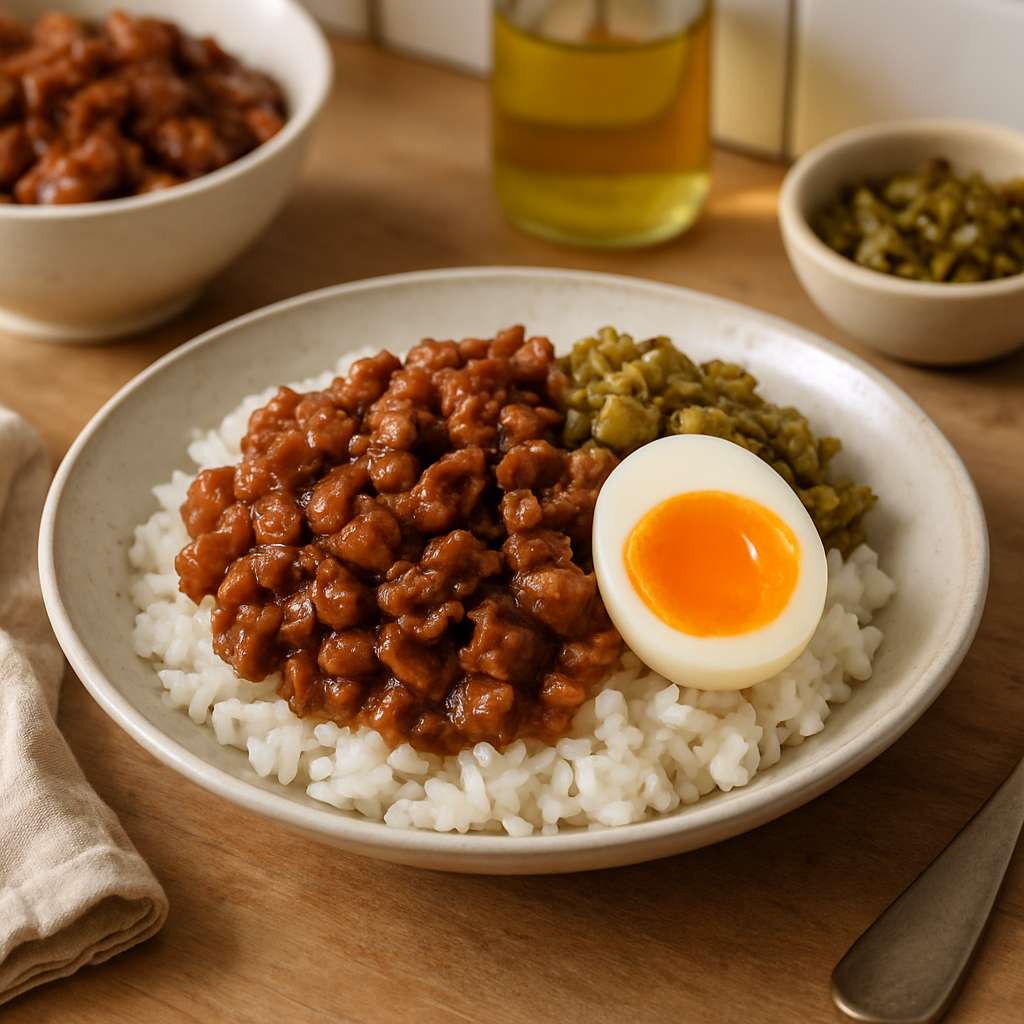
Served over jasmine rice with a soy-marinated soft-boiled egg and a spoonful of pickled mustard greens on the side, this is a bowl that covers every base — rich, bright, sharp, warming.
The Ingredients and Why Each One Matters
Pork belly is non-negotiable here. The high fat content isn't incidental — it's the whole point. As the belly braises, the collagen in the skin breaks down into gelatin, giving the sauce that glossy, clinging quality that makes lu rou fan so distinctive. Lean pork simply won't do the same job.
Soy sauce forms the backbone of the braise. Traditional recipes often use a combination of regular soy and dark soy — the latter for colour and a hint of molasses depth. If you can find a light Chinese soy sauce rather than a Japanese one, it'll be closer to the original flavour profile, though either works well.
Shaoxing rice wine adds a gentle fermented warmth. If you'd rather not use alcohol, you can substitute with a light chicken stock, though you'll lose a little of that background complexity.
Five-spice powder — a blend of star anise, cloves, Chinese cinnamon, Sichuan pepper, and fennel seeds — does a lot of work in a small quantity. Just half a teaspoon brings a fragrant, almost floral warmth that's entirely different from European spice blends.
Fried shallots are perhaps the most underrated ingredient on the list. They melt into the braise over time, adding a sweetness and body that's hard to replicate with anything else. You can fry your own from thinly sliced shallots, or buy them pre-fried from an Asian supermarket, which is a perfectly good shortcut.
Pickled mustard greens (酸菜, suān cài) serve as the counterpoint to all that richness. Their sharp, tangy bite cuts through the pork fat and resets the palate between bites. Look for them in jars or vacuum packs at Chinese or Taiwanese grocery stores. A quick rinse before serving helps moderate the saltiness.
The Method
Start with the pork. Cut your pork belly into roughly 1cm dice — skin on. You want pieces small enough to eat in one bite but large enough to hold some texture after a long braise. Blanch them briefly in boiling water for two minutes, then drain and rinse. This removes impurities and keeps the braising liquid clean and glossy rather than murky.
Build the flavour base. In a wok or heavy-bottomed pan, warm a little neutral oil and fry the fried shallots briefly — just 30 seconds or so — then add the pork and let it colour lightly. Add the Shaoxing wine and let it bubble up, then add the soy sauces, five-spice, a small amount of sugar, and enough water to just cover the pork.
Braise low and slow. Bring to a gentle simmer, cover, and cook for at least 90 minutes — two hours if you have time. The pork should be completely tender and the sauce glossy and reduced. Taste and adjust with a little more soy or sugar at the end.
Prepare the eggs. For the classic lu dan (soy eggs), soft-boil your eggs for exactly six and a half minutes, then transfer immediately to ice-cold water. Peel them and let them sit in a mixture of soy sauce, water, and a little sugar for at least 30 minutes — ideally an hour. They'll turn a beautiful caramel colour and absorb a gentle savoury sweetness throughout.
Serve it properly. Steamed jasmine rice, a generous ladle of pork and sauce, one halved marinated egg, and a small pile of rinsed pickled mustard greens. That's it. Don't overthink it.
What Makes This Work Nutritionally
Lu rou fan is often described as comfort food, which sometimes gets used as a way of saying "don't look too closely at the numbers." But there's actually quite a lot going on here that's worth understanding.
Pork belly is energy-dense, primarily from fat, but that fat is doing real structural and flavour work in this dish. The collagen breakdown during braising produces gelatin, which some early research suggests may support joint health, though the evidence is still developing. More practically, the fat slows digestion and contributes to satiety — this is a bowl that keeps you full.
The eggs add a significant protein boost. A single large egg delivers around 6g of complete protein, and the marinating process doesn't change that meaningfully. Paired with the pork, this dish is a reasonable protein source per serving.
Pickled mustard greens are a fermented food, meaning they contain live cultures that may contribute to gut microbiome diversity. The evidence base for fermented foods and gut health is growing, with a 2021 study in Cell finding that a diet high in fermented foods increased microbiome diversity more than a high-fibre diet alone.
Jasmine rice is the carbohydrate foundation — fast-digesting and excellent at absorbing the braising liquid. If you want to moderate the glycaemic load slightly, mixing in some cooked cauliflower rice or serving a slightly smaller portion of rice with more sauce works well without changing the character of the dish.
A single serving of this dish (roughly 150g cooked rice, 100g pork, one egg) comes in at approximately 550–650 kcal depending on your portion sizes, with a reasonable macro split of around 30–35g protein, 50–55g carbohydrate, and 20–25g fat.
Common Mistakes to Avoid
Skipping the blanching step. It seems fussy, but it makes a real difference to the clarity and cleanliness of the final sauce. Two minutes in boiling water is worth it.
Rushing the braise. This dish genuinely needs time. At 60 minutes, the pork will be cooked but the fat won't have fully rendered and the sauce won't have the right body. Give it the full two hours if you can.
Over-salting early. Soy sauce is salty, and the sauce reduces significantly as it cooks. Season lightly at the start and taste carefully at the end. It's much easier to add salt than to rescue an over-seasoned braise.
Using the wrong cut. Shoulder or loin won't give you the same result. The skin-on belly is what makes lu rou fan what it is.
Practical Takeaways
- Dice the pork belly small — roughly 1cm — so every piece gets coated in sauce
- Blanch before braising for a cleaner, glossier result
- Fry the shallots first to build a proper flavour base before adding liquids
- Braise for a minimum of 90 minutes, two hours if you have time
- Marinate the eggs for at least 30 minutes after peeling — longer is better
- Rinse the pickled mustard greens before serving to take the edge off the salt
- This dish freezes exceptionally well — make a double batch and freeze the braised pork in portions without the rice or eggs
If you want to hit your protein or calorie targets without spending ages calculating portions, Macrology generates macro-perfect meal plans in seconds — https://macrology.app/signin
---
> Macrology tip: Lu rou fan is a great example of a dish where the macros look intimidating on paper but the satiety per calorie is genuinely high. Log it once, portion it right, and it fits into almost any macro target. Macrology can build it into your weekly plan automatically — https://macrology.app/signin
Want meals like this planned to your exact macros?
Macrology generates a personalised meal plan in seconds — breakfast, lunch, dinner and snacks, all hitting your daily targets.
Start your free 14-day trial