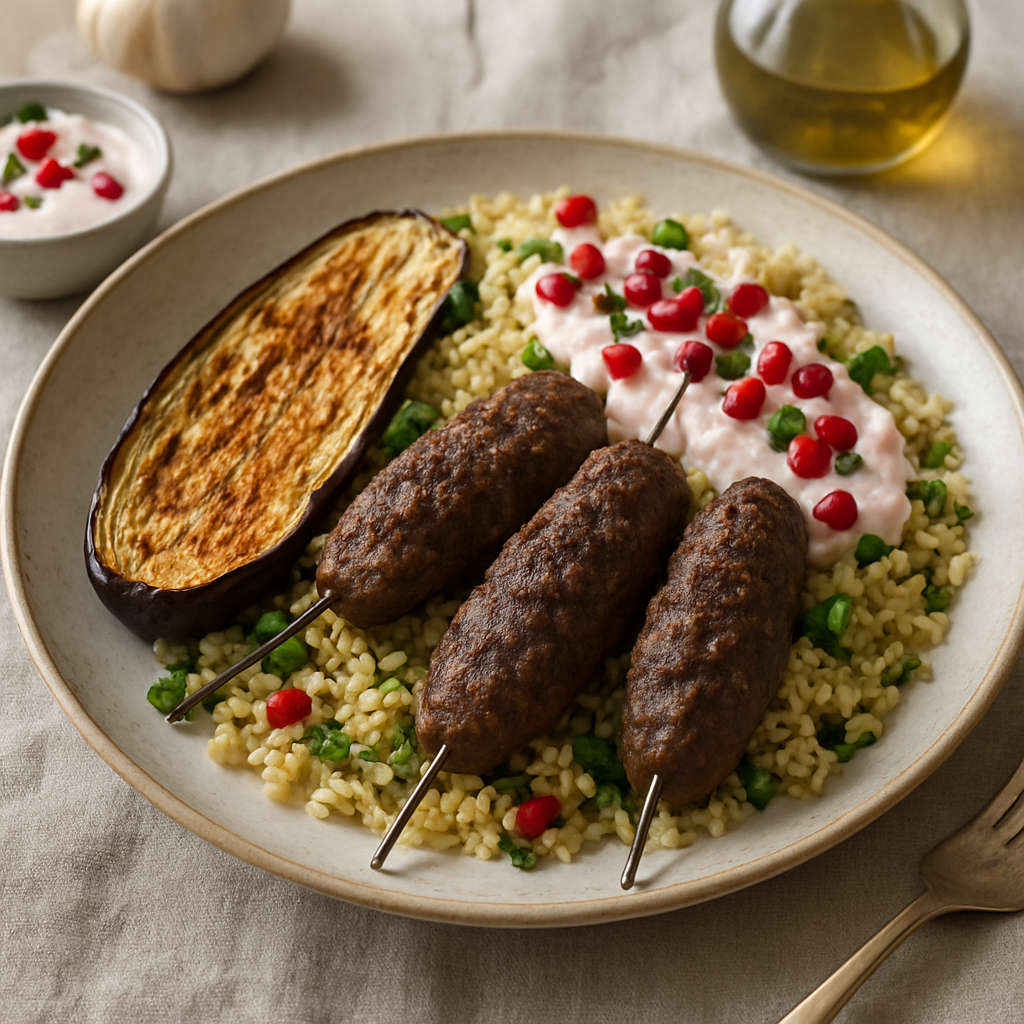
Spiced Beef Kofta with Roasted Aubergine, Bulgur and Pomegranate Yoghurt
# Spiced Beef Kofta with Roasted Aubergine, Bulgur and Pomegranate Yoghurt
There's something about kofta that feels simultaneously effortless and impressive — a handful of spiced mince, shaped by hand, cooked in minutes, and somehow tasting like it took all afternoon. This version leans into the bold, warm spices of the Middle East and pairs the beef with smoky roasted aubergine, nutty bulgur wheat, and a sharp, jewelled pomegranate yoghurt that cuts right through the richness.
It's a genuinely satisfying weeknight meal that happens to hit a solid macronutrient balance — protein from the beef and yoghurt, complex carbs from the bulgur, and plenty of flavour layered throughout.
---
What you'll need (serves 2)
For the kofta:
- 400g lean beef mince (10–15% fat works well)
- 2 garlic cloves, finely grated
- 1 small onion, finely grated
- 1 tsp ground cumin
- 1 tsp ground coriander
- ½ tsp smoked paprika
- ½ tsp cinnamon
- ¼ tsp chilli flakes (optional)
- Small handful of fresh flat-leaf parsley, finely chopped
- Salt and black pepper
For the roasted aubergine:
- 1 large aubergine, cut into 2cm chunks
- 1 tbsp olive oil
- ½ tsp cumin
- Salt and pepper
For the bulgur:
- 150g bulgur wheat
- 300ml hot chicken or vegetable stock
- Juice of ½ lemon
- Small handful of fresh mint, roughly chopped
For the pomegranate yoghurt:
- 150g Greek yoghurt (full-fat or low-fat, your call)
- 3 tbsp pomegranate seeds
- 1 tsp pomegranate molasses (optional but worth it)
- Small pinch of salt
---
How to make it
Start with the aubergine. Preheat your oven to 200°C (fan 180°C). Toss the aubergine chunks with olive oil, cumin, salt, and pepper on a baking tray, then spread them out in a single layer. Roast for 25–30 minutes until golden and slightly collapsing at the edges. Don't crowd the tray — aubergine steams rather than roasts if it's packed in too tightly, and you want a bit of colour on it.
Make the kofta mixture. Combine the beef mince, grated garlic, grated onion, spices, and parsley in a bowl. Mix thoroughly with your hands — yes, get in there — until everything is evenly distributed. Divide the mixture into 8 portions and shape each one around a skewer (or simply into a short cylinder if you're not using skewers). Press firmly so they hold together during cooking.
Cook the bulgur. Place the bulgur in a bowl or saucepan, pour over the hot stock, cover, and leave for 15 minutes. It'll absorb the liquid and cook through with no further effort. Once done, fluff with a fork, squeeze over the lemon juice, and stir through the mint. Season to taste.
Cook the kofta. Heat a griddle pan or large frying pan over a high heat. Cook the kofta for 10–12 minutes, turning every few minutes, until cooked through with a good caramelised crust on the outside. If you're using a grill, 12–15 minutes under a medium-high heat works just as well. Don't rush this — the Maillard reaction happening on the outside is where a lot of the flavour lives.
Assemble the yoghurt. Stir the pomegranate seeds and molasses through the Greek yoghurt. Season with a pinch of salt. That's genuinely it.
To serve, spoon the bulgur into bowls, add the roasted aubergine, lay the kofta alongside, and add a generous dollop of the pomegranate yoghurt. A few extra pomegranate seeds and a drizzle of olive oil on top makes it look the part.
---
What makes this work nutritionally
This dish is built around protein and complex carbohydrates, with fat coming primarily from the beef and olive oil rather than anything gratuitous. Here's what's going on under the bonnet:
Beef mince is one of the more practical high-protein ingredients in a home kitchen. At around 26g of protein per 100g for lean mince, it contributes meaningfully to muscle protein synthesis — relevant whether you're training or simply trying to stay fuller for longer. The iron content is also notable; haem iron from red meat is absorbed more efficiently than the non-haem iron found in plant foods, which makes it a useful inclusion if iron intake is something you're mindful of.
Bulgur wheat is often overlooked in favour of rice or pasta, but it punches above its weight. It has a lower glycaemic index than white rice and provides a decent amount of dietary fibre — around 4–5g per 100g dry weight — which supports satiety and gut health. It also cooks faster than almost any other grain, which is a practical bonus.
Aubergine is low in calories but high in volume, which helps create a satisfying portion without adding a significant caloric load. It also contains nasunin, an anthocyanin antioxidant found in the skin, though the overall antioxidant contribution in a single meal shouldn't be overstated.
Greek yoghurt adds a secondary protein hit alongside calcium and live cultures that support gut microbiome diversity. Using it as a sauce base rather than a dollop on the side means it actually integrates into the dish rather than sitting as an afterthought.
The spice profile — cumin, coriander, cinnamon, smoked paprika — does more than flavour the meat. Cinnamon in particular has been explored in research for its potential role in blood glucose regulation, though the amounts used in cooking are modest and shouldn't be treated as a therapeutic dose. What the spices undeniably do is make lean mince taste considerably more interesting than it might otherwise.
---
What the evidence shows
Research on high-protein diets and satiety consistently points to protein's role in reducing appetite hormones like ghrelin while increasing satiety hormones like peptide YY. A meal containing upwards of 30–35g of protein — which this dish comfortably reaches — tends to keep people fuller for longer compared with lower-protein equivalents matched for total calories.
The inclusion of fermented dairy (Greek yoghurt) alongside fibre from the bulgur and aubergine creates what researchers sometimes call a "gut-friendly" eating pattern — though the evidence on any single meal making a significant microbiome difference is nuanced. What does seem fairly well established is that consistently eating dietary fibre and fermented foods supports microbial diversity over time.
There's also reasonable evidence supporting pomegranate for cardiovascular health, particularly around its polyphenol content. The amounts in a yoghurt garnish are modest, but pomegranate molasses is a concentrated source, and it's worth noting that the traditional diets from which this dish draws inspiration tend to be characterised by exactly this kind of ingredient diversity.
---
A few things worth knowing before you cook
Grating the onion rather than chopping it is the difference between kofta that holds together and kofta that falls apart on the grill. Grated onion distributes moisture evenly and integrates into the mince; chopped onion creates weak points.
Chilling the shaped kofta for 20–30 minutes before cooking also helps them hold their shape. If you've got the time, it's worth doing.
Pomegranate molasses can be found in most larger supermarkets and Middle Eastern grocers. It's intensely sour-sweet and a little goes a long way. If you can't find it, a squeeze of lemon into the yoghurt and a small drizzle of honey does a reasonable job as a substitute.
---
Practical takeaways
- Grate your onion, not chop it — it makes the texture of the kofta noticeably better
- Spread the aubergine on the tray with space between pieces or it'll steam rather than roast
- Bulgur is one of the fastest-cooking grains available — it's worth keeping a bag in the cupboard
- The pomegranate yoghurt doubles as a sauce for wraps, grilled chicken, or falafel — make extra
- This dish works well prepped ahead: cook everything, store separately, reheat the kofta and aubergine before serving
---
If you want meal plans that balance protein, carbs, and fat without the spreadsheet headache, Macrology generates macro-perfect meal plans in seconds — https://macrology.app/signin
---
> Macrology tip: Add this recipe to your Macrology meal plan and the app will automatically adjust your remaining daily targets around it — so you can see exactly where you stand for the rest of the day without any manual number-crunching.
Want meals like this planned to your exact macros?
Macrology generates a personalised meal plan in seconds — breakfast, lunch, dinner and snacks, all hitting your daily targets.
Start your free 14-day trial