Slow-Roasted Tomato and Ricotta Galette with Fresh Basil and Toasted Pine Nuts
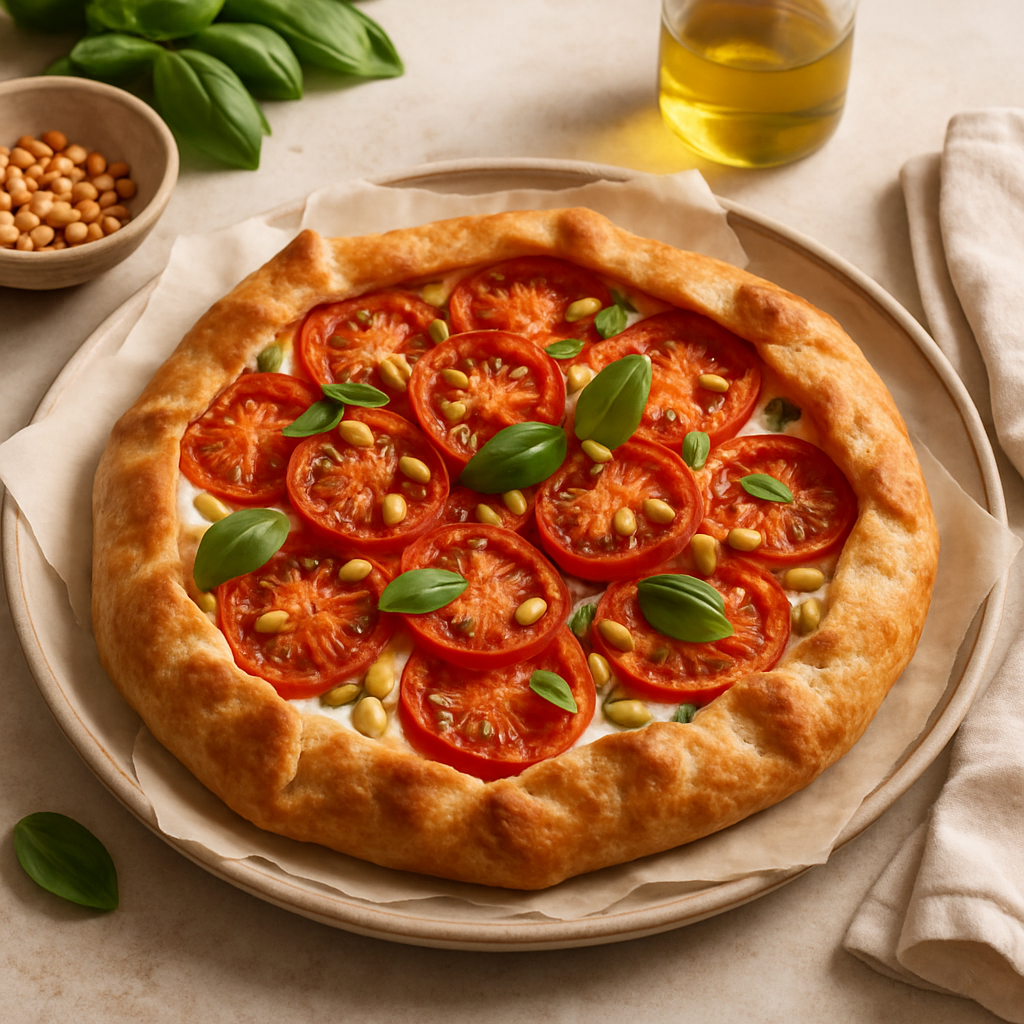
# Slow-Roasted Tomato and Ricotta Galette with Fresh Basil and Toasted Pine Nuts
There's something quietly impressive about a galette — it looks like it took hours of effort, but it's essentially a free-form tart that forgives every imperfection. This one layers jammy, slow-roasted tomatoes over a herbed ricotta base, finished with torn basil and golden pine nuts on a buttery, flaky crust.
What Is a Galette, Exactly?
A galette is a French free-form pastry — no tart tin, no blind baking, no fuss. You roll the pastry out on a baking sheet, pile on your filling, and fold the edges up and over. The rough, rustic edges are the point.
Unlike a traditional tart, a galette doesn't need to be perfect. The pastry will crack a little, the edges will be uneven, and that's entirely fine. What you get in return is a genuinely impressive dish that takes far less faff than it looks.
This version leans savoury — ripe tomatoes roasted low and slow until they concentrate into something almost sweet, set against the cool creaminess of seasoned ricotta and the richness of toasted pine nuts.
Why Slow-Roast the Tomatoes?
This is the step that makes the whole dish. Fresh tomatoes dropped straight onto pastry will make it soggy and taste watery. Slow-roasting changes everything.
At a low temperature over 60–90 minutes, tomatoes lose most of their water content, and their natural sugars caramelise. The result is deeply flavoured, slightly jammy tomatoes with an almost meaty intensity — nothing like the flavour of a raw or quickly cooked tomato.
The process is largely hands-off. You're not doing anything; the oven is doing the work. It just requires a little planning ahead, which is why this recipe works brilliantly for a weekend lunch or a dinner party starter where you want to do the heavy lifting in advance.
The Ingredients
For the pastry:
- 200g plain flour
- 125g cold unsalted butter, cubed
- ½ tsp fine sea salt
- 1 tsp dried thyme or herbes de Provence
- 3–4 tbsp ice-cold water
For the slow-roasted tomatoes:
- 500g mixed tomatoes (a mix of cherry and larger vine tomatoes works well)
- 2 tbsp olive oil
- 1 tsp caster sugar
- Salt and black pepper
- 2 garlic cloves, thinly sliced
For the ricotta filling:
- 250g full-fat ricotta
- 30g Parmesan, finely grated
- Zest of half a lemon
- 1 egg yolk
- Salt, black pepper, and a pinch of chilli flakes
To finish:
- 30g pine nuts
- A small bunch of fresh basil
- 1 egg, beaten (for egg wash)
- Extra virgin olive oil, to drizzle
How to Make It
Step 1: Slow-roast the tomatoes
Preheat your oven to 150°C (130°C fan). Halve any larger tomatoes and leave cherry tomatoes whole or halved. Arrange on a baking tray, scatter over the garlic slices, drizzle with olive oil, sprinkle with the sugar, and season well. Roast for 60–90 minutes until the tomatoes are collapsed, slightly caramelised at the edges, and most of the liquid has evaporated. Set aside to cool.
Step 2: Make the pastry
Increase the oven temperature to 200°C (180°C fan). In a large bowl, rub the cold butter into the flour and salt with your fingertips until the mixture resembles coarse breadcrumbs — a few larger bits of butter are fine and actually desirable. Stir in the dried herbs, then add the cold water one tablespoon at a time, mixing with a fork until the dough just comes together. Flatten into a disc, wrap in beeswax wrap or cling film, and chill for 30 minutes.
Step 3: Make the ricotta filling
Beat the ricotta with the Parmesan, lemon zest, egg yolk, and seasoning until smooth. Taste and adjust — it should be well-seasoned and have a little brightness from the lemon.
Step 4: Assemble the galette
On a lightly floured surface, roll the pastry into a rough circle about 30cm in diameter and 3–4mm thick. Transfer to a lined baking sheet. Spread the ricotta mixture over the pastry, leaving a 5cm border all the way around. Arrange the slow-roasted tomatoes over the ricotta. Fold the pastry edges up and over the filling, pressing gently to seal and pleating as you go. Brush the pastry with beaten egg.
Step 5: Bake and finish
Bake for 30–35 minutes until the pastry is deep golden and cooked through on the base. While it bakes, toast the pine nuts in a dry pan over a medium heat for 2–3 minutes until golden — watch them closely, they catch quickly. Once the galette comes out of the oven, scatter over the toasted pine nuts, tear over the fresh basil, and finish with a drizzle of extra virgin olive oil.
Serve warm or at room temperature.
What Makes This Work Nutritionally
Ricotta is often underestimated as a protein source. A 250g portion across this recipe provides roughly 18–20g of protein, plus calcium and a moderate fat content that keeps the filling satisfying without being heavy.
Tomatoes are rich in lycopene, a carotenoid antioxidant that becomes more bioavailable when cooked, particularly with fat present — so the olive oil in the roasting process actually helps your body absorb more of it. Slow-roasting also concentrates the vitamin C content relative to volume, though some is lost to heat.
Pine nuts are calorie-dense but contribute healthy monounsaturated fats, magnesium, and zinc. A small amount goes a long way in terms of flavour and nutritional contribution.
The pastry, made with butter and plain flour, is exactly what it is — a vehicle for the filling, and a very good one. The lemon zest in the ricotta isn't just for flavour; it adds a small amount of vitamin C, which can help with iron absorption from the pine nuts.
What the Evidence Shows
The Mediterranean dietary pattern — which this dish broadly reflects, with its olive oil, tomatoes, fresh herbs, and nuts — is one of the most consistently well-studied eating patterns in nutritional research.
A 2013 landmark trial (the PREDIMED study) found that people following a Mediterranean diet supplemented with olive oil or nuts had significantly reduced rates of major cardiovascular events compared to those following a low-fat diet. While no single dish makes or breaks a diet, the ingredients in this galette align well with that pattern.
Lycopene from cooked tomatoes has also been associated with reduced markers of oxidative stress and inflammation in several observational studies, though researchers are careful to note that it's difficult to isolate a single compound's effect in the context of a whole diet.
The takeaway isn't that this galette is a health food in some grand sense — it's that the ingredients are genuinely good ones, combined in a way that tastes excellent.
Practical Takeaways
Make the tomatoes the day before. Slow-roasted tomatoes keep well in the fridge for 3–4 days and are also excellent on toast, stirred through pasta, or added to a grain bowl.
Keep the butter cold. Cold fat is the secret to flaky pastry. If your kitchen is warm, pop the cubed butter in the freezer for 10 minutes before you start.
Don't skip the resting time. Chilling the pastry for 30 minutes before rolling prevents shrinkage and makes it easier to handle.
Serve at room temperature. This galette is arguably better once it's had 20 minutes to settle — the filling firms up slightly, and the flavours come through more clearly.
Swap freely. Goat's cheese works beautifully in place of ricotta. Walnuts can stand in for pine nuts. A handful of olives or some thinly sliced courgette can go in alongside the tomatoes.
---
If you want meal plans built around genuinely satisfying, macro-balanced recipes like this one, Macrology generates macro-perfect meal plans in seconds — https://macrology.app/signin
---
> Macrology tip: Log this galette in Macrology to see how it fits your daily macros. One generous slice provides a solid balance of protein from the ricotta and Parmesan, healthy fats from the pastry and pine nuts, and carbohydrates from the crust — making it a more balanced plate than it might first appear.
Want meals like this planned to your exact macros?
Macrology generates a personalised meal plan in seconds — breakfast, lunch, dinner and snacks, all hitting your daily targets.
Start your free 14-day trial