Slow-Cooked Beef Cheek with Creamy Polenta and Salsa Verde
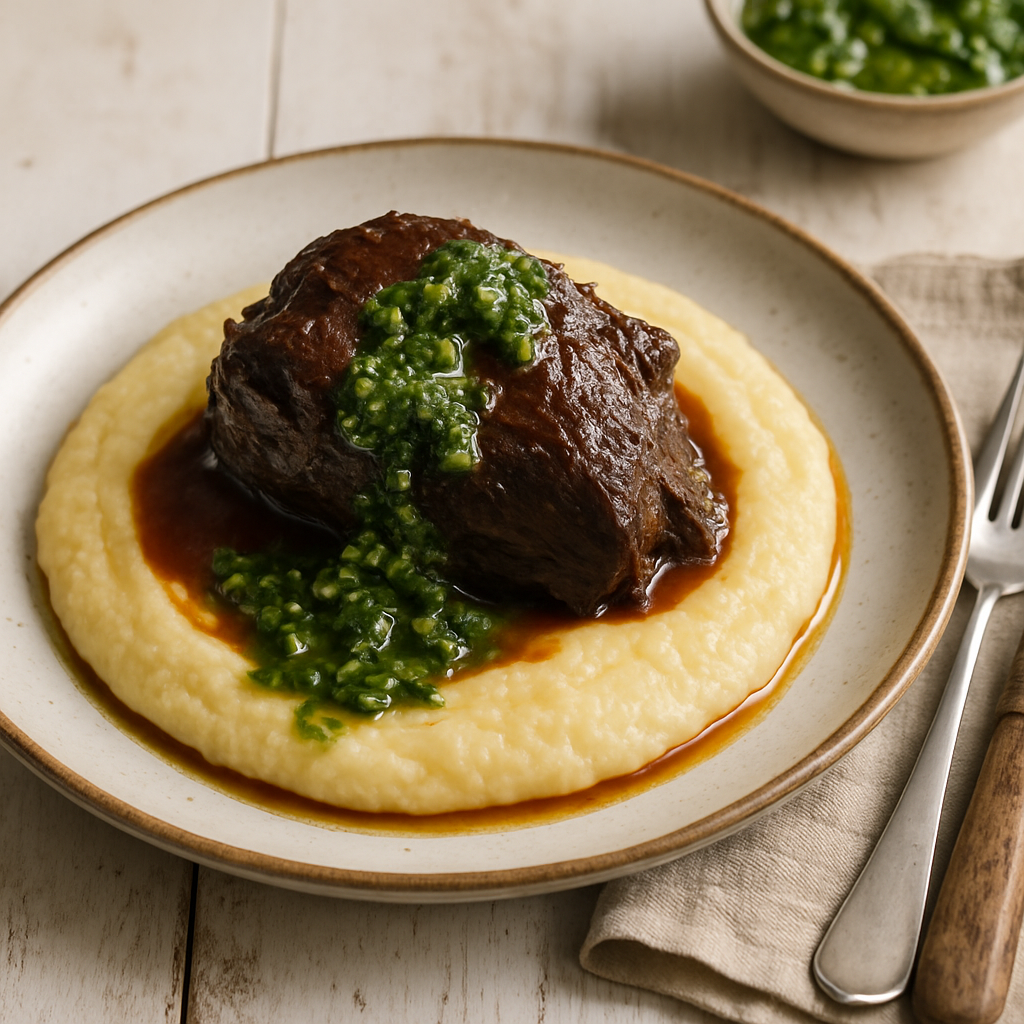
# Slow-Cooked Beef Cheek with Creamy Polenta and Salsa Verde
There's something deeply satisfying about a cut of meat that rewards patience. Beef cheek — often overlooked in favour of more familiar braising cuts — transforms after hours in the pot into something genuinely extraordinary: fork-tender, richly flavoured, and falling apart at the gentlest touch.
What Is Beef Cheek, and Why Should You Care?
Beef cheek is exactly what it sounds like — the facial muscle of the cow. Because this muscle works constantly throughout the animal's life, it's incredibly dense with connective tissue and collagen. That might sound off-putting at first, but it's precisely what makes it such a rewarding braising cut.
When cooked low and slow, all that collagen breaks down into gelatin, which gives the braising liquid an almost glossy, luxurious quality — and the meat itself a melt-in-the-mouth texture that you simply cannot achieve with a leaner cut. It's the same science that makes oxtail and short rib so compelling.
Beef cheek is also excellent value. It tends to sit well below the price of premium cuts like ribeye or bavette, yet when cooked correctly, it produces results that genuinely rival a restaurant main course.
Building Flavour: The Braise
The backbone of this dish is the braise. You'll need patience, but very little active cooking time — most of the work happens in the oven while you get on with your evening.
Ingredients (serves 4):
- 4 beef cheeks (approximately 200–250g each), trimmed of excess fat
- 2 tbsp olive oil
- 1 large onion, roughly chopped
- 2 carrots, roughly chopped
- 3 celery sticks, roughly chopped
- 4 garlic cloves, crushed
- 2 tbsp tomato purée
- 500ml red wine (something robust — a Rioja or Côtes du Rhône works well)
- 500ml good-quality beef stock
- 2 sprigs of fresh thyme
- 2 bay leaves
- Salt and black pepper
Method:
Preheat your oven to 160°C (fan 140°C). Pat the beef cheeks dry with kitchen paper and season generously with salt and pepper. Heat the olive oil in a large, heavy-based casserole dish over a high heat and sear the cheeks for 3–4 minutes on each side until deeply browned. Don't rush this step — proper caramelisation here builds the foundation of the dish's flavour.
Remove the meat and set aside. Lower the heat to medium and add the onion, carrot, and celery to the same pan, cooking for 5–6 minutes until softened. Add the garlic and tomato purée, stir for another minute, then pour in the red wine. Let it bubble and reduce by half — around 5 minutes — then add the stock, thyme, and bay leaves.
Return the beef cheeks to the pot, ensuring they're mostly submerged. Bring to a gentle simmer, then cover and transfer to the oven. Cook for 3 to 3.5 hours, turning the cheeks halfway through, until the meat is completely tender and yielding.
Once cooked, remove the cheeks and strain the braising liquid into a saucepan. Simmer it over medium-high heat until it reduces to a glossy, sauce-like consistency — this usually takes 10–15 minutes. Taste and adjust seasoning.
Creamy Polenta: Getting It Right
Polenta has a reputation for being either bland or lumpy, but neither needs to be true. The key is using enough liquid, cooking it properly, and finishing it generously.
Ingredients:
- 200g coarse or medium-ground polenta (not instant)
- 900ml whole milk
- 300ml water
- 50g unsalted butter
- 60g Parmesan, finely grated
- Salt and white pepper
Method:
Bring the milk and water to a gentle simmer in a large, heavy-bottomed saucepan with a good pinch of salt. Pour in the polenta in a slow, steady stream while whisking constantly — this prevents lumps from forming. Reduce the heat to low and cook, stirring frequently with a wooden spoon, for 35–40 minutes. It should pull away from the sides of the pan and have a thick, porridge-like consistency.
Remove from the heat and stir in the butter and Parmesan. Taste and season with salt and white pepper. It should be rich, savoury, and just loose enough to spread on the plate. If it firms up while you're plating, add a splash of warm milk and stir through.
The Salsa Verde: Brightness to Balance
A good braise is rich and deep, and that's exactly why it needs something sharp and herby to cut through it. Salsa verde does that job beautifully — it's punchy, bright, and takes about five minutes to put together.
Ingredients:
- Large handful of flat-leaf parsley
- Small handful of fresh mint leaves
- 1 tbsp capers, drained
- 2 anchovy fillets
- 1 small garlic clove
- 1 tsp Dijon mustard
- 2 tbsp red wine vinegar
- 6–8 tbsp extra virgin olive oil
- Salt and black pepper
Method:
Finely chop the parsley, mint, capers, anchovies, and garlic together on a board — or pulse briefly in a small food processor if you prefer a smoother result. Transfer to a bowl and stir in the mustard and vinegar. Add the olive oil gradually until you reach a spoonable, loose consistency. Season to taste.
The anchovies aren't there to make it taste fishy — they dissolve into the sauce and add a deep, savoury backbone that lifts the whole thing. Even people who avoid anchovies in other contexts often can't identify them here.
What Makes This Work Nutritionally
This dish is a genuinely well-balanced plate when you look at the macronutrient breakdown.
Beef cheek is an excellent source of protein — a 200g portion provides roughly 36–40g of protein — as well as iron, zinc, and B vitamins, particularly B12, which plays a crucial role in nerve function and red blood cell production. The collagen content also provides glycine, an amino acid that supports joint and gut health, though the evidence on supplemental collagen is still developing.
Polenta provides a moderate amount of carbohydrate from maize, and unlike some refined carb sources, coarse polenta has a slightly lower glycaemic index than white rice or mashed potato. It's also naturally gluten-free, which makes this dish suitable for those avoiding gluten — just check your stock and other ingredients.
Salsa verde adds a nutritional punch in its own right. Flat-leaf parsley is surprisingly rich in vitamin K and vitamin C, while the olive oil contributes heart-healthy monounsaturated fats. The capers and anchovies bring in flavour with minimal calorie impact.
A typical portion of this dish — one beef cheek, a generous serve of polenta, a drizzle of salsa verde, and the reduced sauce — comes in at roughly 550–650 kcal, with around 40–45g of protein, 35–40g of carbohydrate, and 20–25g of fat. Exact figures will vary depending on portion sizes and the fat content of your beef cheeks.
What the Evidence Shows
Slow cooking and braising aren't just about texture — they can also influence the bioavailability of certain nutrients. Research suggests that prolonged, moist heat cooking can make iron and zinc in red meat more bioavailable, as the breakdown of connective tissue and muscle fibre makes nutrients more accessible during digestion.
Red meat has had something of a complicated relationship with nutrition headlines, but the current evidence suggests that lean-to-moderate red meat consumption — within the context of a varied diet — doesn't carry the risks that earlier observational studies implied. Beef cheek, once trimmed, is actually a relatively lean braising cut compared to short rib or brisket, given that much of its richness comes from collagen rather than intramuscular fat.
The Mediterranean-style elements here — olive oil, fresh herbs, vinegar, garlic — are consistently associated with positive health outcomes across a wide body of research, including reduced cardiovascular risk and improved inflammatory markers.
Practical Takeaways
- Beef cheeks benefit from an overnight marinade in red wine with aromatics before cooking — it deepens the flavour further and is worth the planning if you have time.
- Make the polenta just before serving — it firms up quickly and doesn't reheat as well as the beef.
- The braised cheeks and reduced sauce actually improve the next day, making this an ideal dish to cook ahead for a dinner party.
- Salsa verde keeps in the fridge for up to three days with a layer of olive oil on top — make a double batch and use it with grilled fish, roasted vegetables, or stirred through scrambled eggs.
- If you can't find beef cheeks, ox cheeks are the same cut and often easier to source from a good butcher.
If you want meal plans built around high-protein, satisfying recipes like this one, Macrology generates macro-perfect meal plans in seconds — https://macrology.app/signin
---
Macrology tip: Log this recipe once and Macrology will track your macros automatically, so you can enjoy a dish like this and know exactly how it fits your day — no guesswork needed.
Want meals like this planned to your exact macros?
Macrology generates a personalised meal plan in seconds — breakfast, lunch, dinner and snacks, all hitting your daily targets.
Start your free 14-day trial