Roasted Squash and Blue Cheese Risotto with Toasted Walnuts and Sage
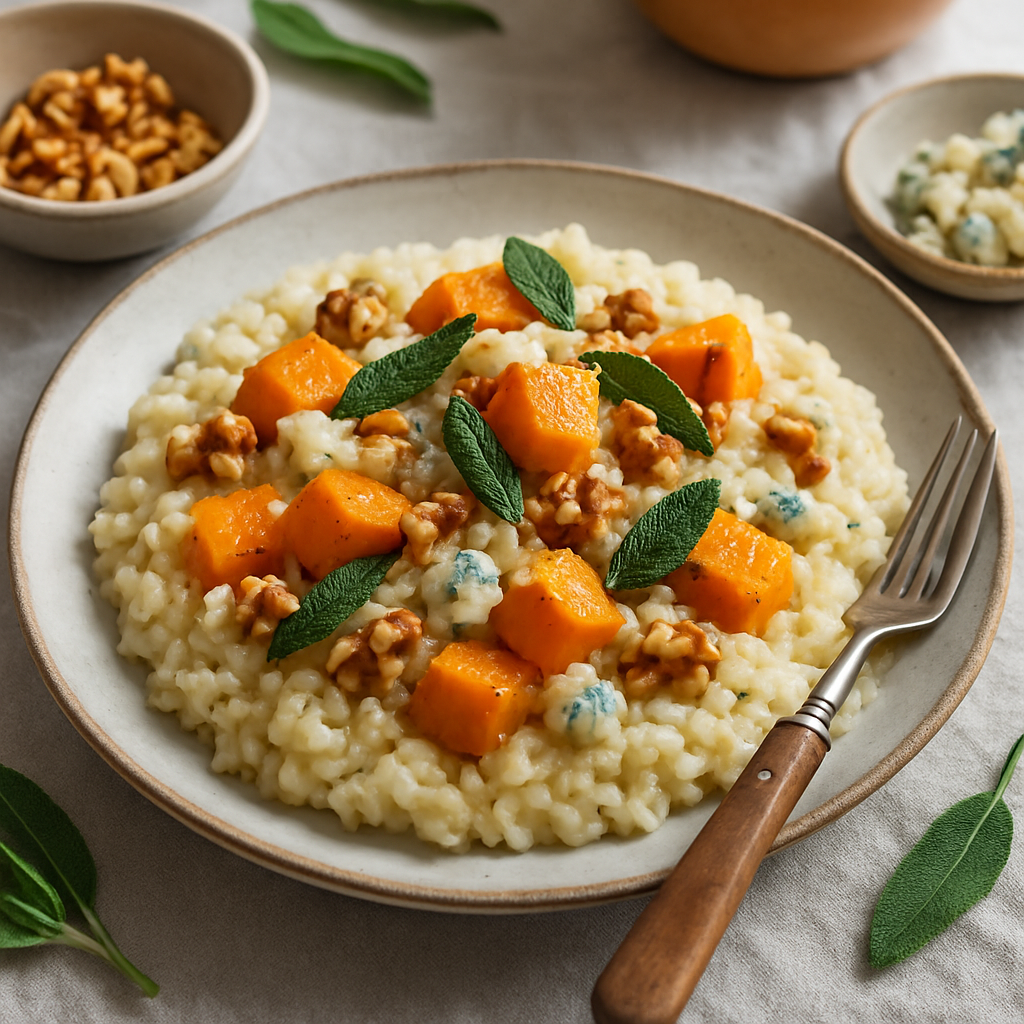
# Roasted Squash and Blue Cheese Risotto with Toasted Walnuts and Sage
There's a particular kind of satisfaction that comes from a bowl of risotto — the kind that makes you slow down without even realising it. This version layers roasted butternut squash, bold blue cheese, crunchy walnuts, and crispy sage into something that feels genuinely special, yet uses ingredients most people already have kicking around in autumn.
Why This Combination Works
Risotto has a reputation for being fussy, but the real secret is that it rewards patience rather than skill. The base is forgiving — it's the toppings and flavourings that transform it from pleasant to memorable.
Here, the sweetness of roasted squash does the heavy lifting against the sharp, salty punch of blue cheese. Contrasting flavours are what make a dish feel complex, and this pairing is a textbook example: caramelised and earthy meets tangy and funky. The walnuts add texture where everything else is soft, and the sage — fried briefly in butter until crisp — cuts through the richness with a faintly bitter, aromatic edge.
It's a combination that's been used in Italian and British cooking for good reason. It simply works.
Ingredients (Serves 4)
For the roasted squash: - 1 medium butternut squash, peeled and cut into 2cm cubes - 2 tbsp olive oil - Salt and black pepper - ½ tsp smoked paprika (optional, but good)
For the risotto: - 300g arborio or carnaroli rice - 1 medium onion, finely diced - 2 garlic cloves, minced - 150ml dry white wine - 1–1.2 litres hot vegetable or chicken stock - 30g unsalted butter - 80g Gorgonzola, Dolcelatte, or Stilton, crumbled - 2 tbsp olive oil - Salt and black pepper to taste
For the topping: - 60g walnuts, roughly broken - A small handful of fresh sage leaves (around 12–15) - 20g unsalted butter - Extra blue cheese to finish (optional)
Method
Step 1 — Roast the squash
Preheat your oven to 200°C (fan 180°C). Toss the squash cubes in olive oil, season generously, add the paprika if using, and spread onto a baking tray in a single layer. Roast for 25–30 minutes, turning once, until golden and caramelised at the edges. Set aside.
Step 2 — Toast the walnuts
In a dry frying pan over a medium heat, toast the walnuts for 3–4 minutes, tossing regularly, until they smell nutty and have taken on a little colour. Tip onto a plate and set aside. Don't walk away — they catch quickly.
Step 3 — Fry the sage
In the same pan, melt the 20g of butter over a medium-high heat until it just starts to foam. Add the sage leaves and fry for 30–60 seconds until crisp. Remove with a slotted spoon onto kitchen paper. Reserve the brown butter — you'll add it to the risotto later.
Step 4 — Build the risotto
In a large, heavy-bottomed pan, warm the olive oil over a medium heat. Add the onion and cook gently for 8–10 minutes until soft and translucent — don't rush this. Add the garlic and cook for another minute.
Add the rice and stir for 1–2 minutes until the grains are lightly toasted and beginning to look translucent at the edges. Pour in the wine and stir until it's mostly absorbed.
Step 5 — Add the stock gradually
Add the hot stock one ladleful at a time, stirring frequently and allowing each addition to absorb before adding the next. This process takes around 18–22 minutes. The risotto is ready when the rice is just tender with a slight bite and the mixture moves in slow, lazy waves when you shake the pan.
Step 6 — Finish and serve
Remove from the heat. Stir in the butter, the reserved sage-infused brown butter, and the blue cheese. Let it melt through. Fold in roughly two-thirds of the roasted squash, crushing a few pieces slightly so they meld into the rice.
Season to taste, then serve immediately in warm bowls. Top with the remaining squash, toasted walnuts, crispy sage leaves, and an extra crumble of blue cheese if you like.
What Makes This Work Nutritionally
This dish is more nutritionally interesting than it might look at first glance.
Butternut squash is an excellent source of beta-carotene, which the body converts to vitamin A — important for immune function and skin health. It also provides vitamin C, potassium, and a reasonable amount of fibre, particularly when roasted rather than puréed, since you retain more of the physical structure of the food.
Walnuts are one of the better plant sources of omega-3 fatty acids (specifically alpha-linolenic acid), and contribute protein, magnesium, and polyphenols. Research published in Nutrients has linked regular walnut consumption to improvements in cardiovascular markers and cognitive function. A 60g portion across four servings is modest, but it adds genuine nutritional value rather than just crunch.
Arborio rice is a refined carbohydrate, which some people instinctively avoid. But in the context of a balanced meal with fibre from squash, fat from cheese and walnuts, and protein from cheese and butter, the glycaemic response is significantly blunted compared to eating white rice alone. Context matters more than individual ingredients when it comes to how food affects your body.
Blue cheese tends to be higher in sodium than other cheeses, so if you're keeping an eye on salt intake, a lighter hand here goes a long way — the flavour is potent enough that a little does a lot.
Per serving (approximate): 520–580 kcal | 18–22g protein | 55–60g carbohydrates | 24–28g fat
Macros will vary based on specific ingredients and portion sizes.
Common Risotto Mistakes (and How to Sidestep Them)
Using cold stock is probably the most common issue. Cold stock shocks the rice and slows cooking unevenly. Keep your stock in a separate pan on a low heat throughout.
Stirring constantly is actually less important than risotto's reputation suggests. Frequent stirring is helpful, but you don't need to stand motionless over the pan. A stir every 30–45 seconds is plenty — it gives you time to prep your toppings while it cooks.
Adding all the stock at once is tempting when you're hungry, but it skips the slow hydration process that creates risotto's characteristic creaminess. The starch needs time to release gradually.
Over-salting early is easy to do when blue cheese is going in at the end. Season lightly during cooking and adjust once the cheese is incorporated.
Swaps and Variations
This recipe is quite flexible once you've got the core method down.
If blue cheese isn't your thing, goat's cheese or a good aged Parmesan work well — you'll lose the sharpness but gain a milder creaminess. Pecans or hazelnuts make a fine substitution for walnuts. Rosemary can stand in for sage if that's what you have.
For a vegan version, use a plant-based butter, omit the cheese and finish with a generous amount of nutritional yeast and a squeeze of lemon for brightness. The squash and walnut combination is strong enough to carry the dish.
Leftovers don't reheat brilliantly as risotto — the texture tightens up. Instead, press cold leftover risotto into patties and fry in a little oil for arancini-style rice cakes. They're excellent with a simple salad alongside.
Practical Takeaways
- Roast the squash ahead — it keeps in the fridge for 3 days and makes the dish faster to pull together on a weeknight
- Keep stock hot throughout cooking; cold stock is the single biggest risotto saboteur
- Fry sage leaves until properly crisp — floppy sage is bitter and unpleasant
- Add blue cheese off the heat so it melts gently rather than splitting
- Taste before serving, especially for salt, once the cheese is in
- Serve immediately — risotto waits for no one
---
If you want meal plans built around recipes like this — with macros already calculated — Macrology generates macro-perfect meal plans in seconds — https://macrology.app/signin
---
> Macrology tip: Add this recipe to your weekly plan and Macrology will automatically balance the rest of your day's meals around it — so a rich, satisfying dinner like this fits without any second-guessing.
Want meals like this planned to your exact macros?
Macrology generates a personalised meal plan in seconds — breakfast, lunch, dinner and snacks, all hitting your daily targets.
Start your free 14-day trial