Roasted Beetroot and Lentil Salad with Goat's Cheese and Walnut Dressing
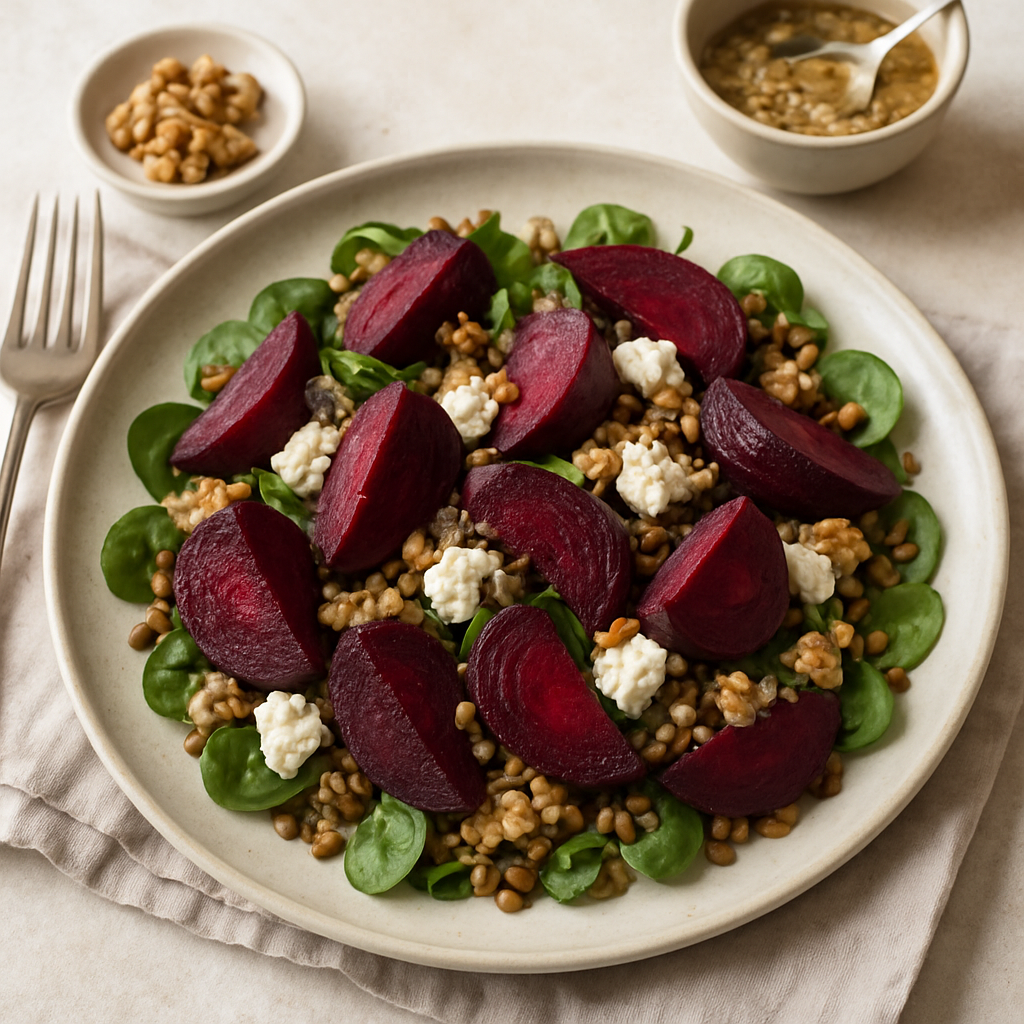
# Roasted Beetroot and Lentil Salad with Goat's Cheese and Walnut Dressing
There's a certain kind of salad that feels like a proper meal — the kind that keeps you full for hours and actually makes you want to eat it. This roasted beetroot and lentil salad with goat's cheese and walnut dressing is exactly that.
What Makes This Salad Worth Making
Most salads fall into one of two camps: the side dish that barely registers, or the overly complicated restaurant-style plate that takes half a Sunday to pull together. This one sits firmly in the middle — genuinely satisfying, packed with flavour, and simple enough to make on a weeknight.
The combination of earthy roasted beetroot, protein-rich lentils, creamy goat's cheese, and a walnut dressing brings together texture, depth, and nutrition in a way that feels deliberate rather than accidental. It's the kind of plate that looks impressive but doesn't punish you for making it.
Ingredients (Serves 2)
For the salad:
- 400g raw beetroot (about 3–4 medium beets), peeled and cut into wedges
- 250g cooked green or puy lentils (from a tin or pouch is fine)
- 80g soft goat's cheese, crumbled
- 60g walnuts, roughly chopped
- 2 large handfuls of rocket or watercress
- 1 tbsp olive oil
- Salt and black pepper
For the walnut dressing:
- 2 tbsp walnut oil (or extra virgin olive oil if you don't have it)
- 1 tbsp red wine vinegar
- 1 tsp Dijon mustard
- 1 tsp honey
- Salt and black pepper to taste
How to Make It
Step 1 — Roast the beetroot. Preheat your oven to 200°C (fan 180°C / Gas Mark 6). Toss the beetroot wedges in olive oil, season well, and spread them out on a lined baking tray. Roast for 35–40 minutes, turning halfway, until they're tender and slightly caramelised at the edges. Let them cool slightly before building the salad — roasting concentrates the sweetness and softens that raw earthiness that some people find too intense.
Step 2 — Toast the walnuts. While the beetroot is roasting, tip the chopped walnuts into a dry frying pan over a medium heat. Toast for 3–4 minutes, stirring frequently, until they smell nutty and have taken on a little colour. Keep a close eye — they go from toasted to burnt faster than you'd expect.
Step 3 — Make the dressing. Whisk together the walnut oil, red wine vinegar, Dijon mustard, and honey in a small bowl or jar until emulsified. Season to taste. The mustard does double duty here — it adds a gentle background heat and acts as an emulsifier, helping the dressing hold together rather than splitting the moment it hits the salad.
Step 4 — Assemble. Arrange the rocket or watercress on your plates. Top with the warm (or room temperature) beetroot and the lentils. Scatter over the goat's cheese and toasted walnuts, then drizzle the dressing generously over everything. Serve immediately.
What Makes This Work Nutritionally
This isn't a salad that relies on volume to fill you up — it earns its staying power through a solid mix of macronutrients and fibre.
Lentils are the backbone here from a nutrition standpoint. A 125g serving of cooked green lentils provides roughly 12g of protein and 7g of fibre, along with meaningful amounts of iron, folate, and magnesium. Because lentils are a legume, they contain both soluble and insoluble fibre, which slows digestion and supports steadier blood sugar levels after eating.
Beetroot is often overlooked as a serious vegetable, but it contains dietary nitrates that the body converts to nitric oxide — a compound involved in blood vessel dilation and circulation. Research published in the Journal of Applied Physiology has shown that dietary nitrate from beetroot can improve exercise efficiency, which is why it's popular with endurance athletes. Beyond the nitrates, it's also a decent source of folate and manganese.
Walnuts are one of the better plant sources of alpha-linolenic acid (ALA), a type of omega-3 fatty acid. They also contribute protein and bring a satisfying richness to the dressing that makes it feel more substantial than a basic vinaigrette.
Goat's cheese, while not a protein powerhouse, adds calcium and that creamy contrast that ties the whole dish together. It's also generally lower in lactose than cow's milk cheeses, which some people find easier to digest.
Per serving, this salad lands at roughly 480–520 calories, with around 25g of protein, 18g of fat, 45g of carbohydrate, and an impressive 10–12g of fibre. The exact numbers will vary depending on your specific ingredients.
What the Evidence Shows
Lentil-based meals have a fairly strong evidence base when it comes to satiety. A 2014 systematic review published in Obesity found that consuming one serving of pulses daily increased feelings of fullness by 31% compared to control meals — and this was without any change in overall calorie intake. The combination of protein and fibre in pulses appears to be particularly effective at slowing gastric emptying, meaning food stays in the stomach longer.
The walnut element is also worth noting. A 2020 study in the journal Nutrients found that including walnuts in meals was associated with greater satiety and reduced hunger ratings in the hours after eating — partly attributed to their fat content and partly to something researchers are still unpacking about how walnuts interact with appetite hormones.
None of this means this salad is some kind of functional food — it's just a well-constructed plate where the ingredients genuinely work together. The fibre, protein, and healthy fats all pull in the same direction when it comes to keeping you satisfied.
Variations and Swaps
No goat's cheese? Feta works beautifully, or you could use a soft blue cheese like Perl Wen for something a bit bolder. If you're keeping it dairy-free, a handful of pumpkin seeds adds similar richness and crunch.
Using pre-cooked beetroot? Absolutely fine — just make sure it's the plain variety rather than the pickled one, which will throw the flavour balance off. Pat it dry and give it a few minutes in a hot oven or pan to warm through before assembling.
Protein boost? If you want more protein — say, for post-training — adding a soft-boiled egg or some shredded leftover chicken integrates easily without disrupting the flavour profile.
Making it ahead? Roast the beetroot and prepare the lentils in advance. Keep the dressing separate and don't add the rocket until you're ready to eat, otherwise it'll wilt into something sad within about 20 minutes.
Practical Takeaways
- Use warm beetroot if you can — it absorbs the dressing better and the contrast with the cool goat's cheese is part of what makes this dish work.
- Toast the walnuts — it takes four minutes and makes a disproportionately large difference to the flavour.
- Don't skip the mustard in the dressing — it's what stops the whole thing splitting and going watery on the plate.
- Tinned or pouched lentils are perfectly good here — there's no nutritional or flavour reason to cook them from scratch unless you want to.
- Season the beetroot generously before roasting — beetroot has a lot of natural sweetness, and salt brings the earthy complexity into balance.
If you want meal plans built around balanced, macro-aware plates like this one, Macrology generates macro-perfect meal plans in seconds — https://macrology.app/signin
---
> Macrology tip: Once you've tried this recipe, log your ingredients in Macrology to get the exact macros for your portion size — then let the app build a week of meals around the same nutritional balance automatically.
Want meals like this planned to your exact macros?
Macrology generates a personalised meal plan in seconds — breakfast, lunch, dinner and snacks, all hitting your daily targets.
Start your free 14-day trial