New Research: What UK Studies Reveal About the Link Between Potassium Intake and Blood Pressure
# New Research: What UK Studies Reveal About the Link Between Potassium Intake and Blood Pressure
Most of us have heard that too much salt raises blood pressure — but the other side of that story gets far less attention. New research from UK populations suggests that what you're not eating might matter just as much as what you are.
Potassium, found in everyday foods like bananas, potatoes, and lentils, has quietly been building a compelling evidence base as one of the most underrated nutrients for cardiovascular health. Here's what the latest science actually shows.
Why Blood Pressure Matters More Than Most People Realise
High blood pressure — or hypertension — affects around 12.5 million people in the UK, yet roughly half of those cases are either undiagnosed or poorly managed. It's often called a "silent" condition because it rarely causes obvious symptoms, even while quietly increasing the risk of heart attack, stroke, and kidney disease.
Diet is one of the most modifiable factors influencing blood pressure. The conversation has historically focused on sodium reduction, and for good reason — but that framing has left potassium largely out of the public conversation, despite decades of evidence pointing to its importance.
What Potassium Actually Does in the Body
Potassium is an electrolyte, which means it carries an electrical charge and plays a critical role in how your cells function. One of its most significant jobs is helping your kidneys manage sodium excretion.
When potassium intake is adequate, the kidneys become more efficient at flushing excess sodium out through urine, which in turn reduces fluid retention and eases pressure on blood vessel walls. The relationship between sodium and potassium is fundamentally about balance, not just the absolute amount of either mineral on its own.
Beyond the kidneys, potassium also directly relaxes the walls of blood vessels — a process known as vasodilation — which further contributes to lower blood pressure readings. These two mechanisms working together make potassium particularly interesting to researchers studying cardiovascular risk.
What the Evidence Shows
The most significant recent contribution from UK research comes from a 2023 study published in the European Heart Journal, led by researchers at Imperial College London. The study followed over 25,000 participants from the EPIC-Norfolk cohort — a long-running UK population study — and measured both sodium and potassium levels using urine samples, which is considered more reliable than self-reported dietary data.
The findings were striking. Higher potassium excretion — a proxy for higher potassium intake — was associated with lower blood pressure in both men and women, but the effect was particularly pronounced in women. Women in the highest potassium group had systolic blood pressure readings around 2.4 mmHg lower than those in the lowest group. While that might sound modest, population-level reductions of even 2 mmHg are estimated to reduce stroke risk by around 10%.
Importantly, the protective effect of potassium held even in people who also had high sodium intake. This challenges the assumption that sodium reduction alone is the priority — it suggests that increasing potassium may be a meaningful strategy in its own right, not just an add-on.
Earlier work from the UK Biobank, one of the largest health databases in the world, has also linked low potassium intake with increased risk of cardiovascular events over time, adding weight to what is becoming a consistent picture across different research designs.
Addressing the "I Already Eat Healthily" Assumption
One common misconception is that potassium deficiency is something that only affects people with poor diets. In reality, population surveys consistently show that most UK adults fall short of recommended potassium intake, which sits at around 3,500mg per day for adults according to the British Dietetic Association.
Ultra-processed foods — which now make up an estimated 57% of the average UK adult's energy intake — tend to be both high in sodium and very low in potassium. This creates a double disadvantage for blood pressure: the sodium-to-potassium ratio tips in entirely the wrong direction.
Even people who consider their diet reasonably balanced often find that consistent, varied potassium intake is harder to achieve than it sounds, particularly on busy weeks when convenience food fills the gaps.
Which Foods Are the Most Useful Sources
This is where things get practical. Potassium is widely distributed across whole foods, which is part of why diets centred on minimally processed ingredients tend to be protective for cardiovascular health — not because of any single "superfood", but because the overall dietary pattern delivers potassium reliably across the day.
Some of the most potassium-dense foods accessible in the UK:
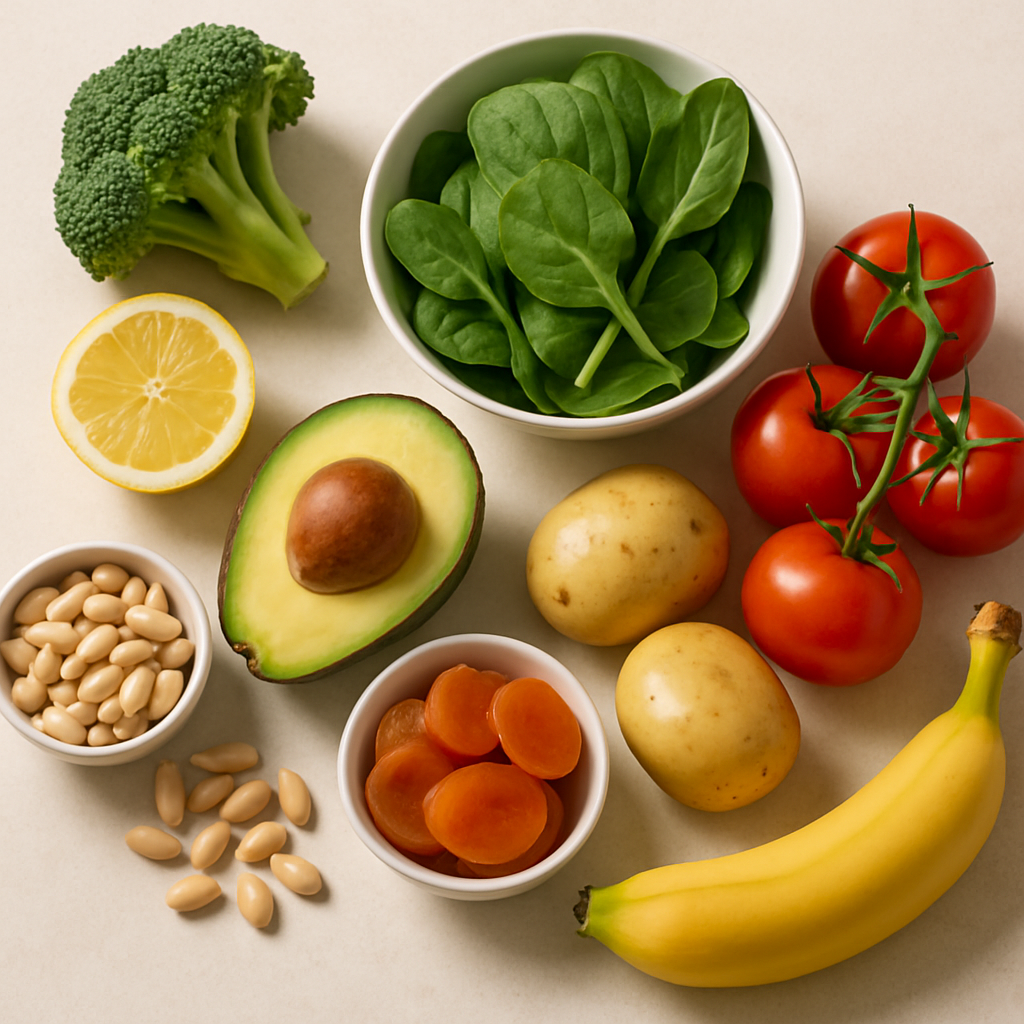
- White and sweet potatoes (with skin) — one of the richest sources, with a medium baked potato providing around 600–900mg
- Pulses and legumes — lentils, chickpeas, kidney beans, and butter beans are all excellent and also deliver fibre
- Leafy greens — spinach, Swiss chard, and kale offer meaningful amounts alongside other micronutrients
- Bananas — a reliable, portable source, though not quite as potassium-dense as commonly believed (around 350–450mg per medium banana)
- Tomato products — particularly tomato purée and passata, which are concentrated and easy to add to everyday cooking
- Dairy — milk and yoghurt provide a surprisingly useful contribution, particularly for people who eat them regularly
- Oily fish and white fish — both offer moderate amounts alongside their well-documented heart health benefits
The key point is variety. No single food will hit your daily target, but a diet that regularly includes vegetables, pulses, and minimally processed staples will generally look after potassium intake without needing to track it obsessively.
A Note on Supplements and Who Should Be Cautious
With potassium's reputation growing, it's worth addressing the supplement question directly. For most healthy people, getting potassium from food is both safer and more effective than reaching for a supplement.
High-dose potassium supplements can be genuinely dangerous for people with kidney disease or those taking certain medications — including ACE inhibitors and some diuretics — because impaired kidneys cannot clear excess potassium efficiently, leading to a potentially serious condition called hyperkalaemia. If you have any of these conditions, changes to potassium intake are worth discussing with a GP or dietitian first.
For the general population without these conditions, the research firmly points towards dietary sources as the most practical and evidence-based approach.
Practical Takeaways
The research is consistent enough to act on without waiting for more certainty. Here are some specific, low-effort ways to shift your potassium intake in the right direction:
- Default to potatoes as your starchy base where possible — they're cheap, filling, and far higher in potassium than pasta or white rice
- Add a tin of lentils or chickpeas to soups, stews, or curries — this is one of the simplest ways to significantly boost both potassium and fibre in a single step
- Use tomato purée generously in sauces — a tablespoon or two adds flavour depth and a concentrated hit of potassium
- Keep a bag of spinach in the fridge and throw a handful into eggs, pasta, or curries — it wilts down to almost nothing but adds genuine nutritional value
- Don't rely on bananas alone — they're a fine snack but treating them as your primary potassium strategy undersells how much more you could be getting from meals
The sodium-potassium relationship also means that reducing ultra-processed food intake — even partially — tends to move both levers simultaneously: less sodium in, more potassium in. That's a meaningful shift for blood pressure risk without any dramatic dietary overhaul.
---
If you want to build meals that naturally hit your potassium and macro targets without the guesswork, Macrology generates macro-perfect meal plans in seconds — https://macrology.app/signin
Want meals like this planned to your exact macros?
Macrology generates a personalised meal plan in seconds — breakfast, lunch, dinner and snacks, all hitting your daily targets.
Start your free 14-day trialMore from news
New Research: What UK Studies Reveal About the Link Between Food Delivery App Usage and Dietary Quality
7 min readNew Research: What UK Studies Reveal About the Link Between Food Environment at Home and Children's Eating Habits
7 min readNew Research: What UK Studies Reveal About the Link Between Cooking Frequency at Home and Overall Diet Quality
7 min read