New Research: What UK Studies Reveal About the Link Between Fibre Intake and Cholesterol Levels
# New Research: What UK Studies Reveal About the Link Between Fibre Intake and Cholesterol Levels
Most of us know fibre is good for us in a vague, eat-your-greens sort of way. But a growing body of UK research is making the case far more precisely — and the findings on cholesterol are worth paying attention to.
Why Cholesterol Still Matters
Cardiovascular disease remains the leading cause of death in the UK, responsible for around 160,000 deaths every year according to the British Heart Foundation. Cholesterol — specifically elevated LDL cholesterol, often called "bad" cholesterol — is one of the most well-established risk factors for heart disease and stroke.
The conversation around cholesterol has become more nuanced over time. It's not simply a case of high cholesterol equals bad health — the ratio of LDL to HDL (the so-called "good" cholesterol), along with triglyceride levels, paints a more complete picture. But the fundamental point holds: chronically elevated LDL cholesterol raises the risk of arterial plaque build-up, and that matters for long-term health.
What's increasingly clear is that diet — and fibre in particular — has a meaningful role to play in managing those levels.
The UK Fibre Problem
Before getting into the research, it's worth understanding the baseline. The UK government recommends that adults consume 30g of fibre per day. The average Briton currently gets around 18g — barely more than half the recommended amount.
This isn't a niche shortfall. Data from the National Diet and Nutrition Survey (NDNS) consistently shows that fibre is one of the nutrients most widely under-consumed across all age groups in the UK. Adults, teenagers, and older people alike are falling short, and the gap isn't small.
This matters because fibre isn't just one thing. It's a broad category of plant-based compounds that the body can't fully digest, and different types behave very differently — particularly when it comes to cholesterol.
Soluble vs. Insoluble: The Detail That Changes Everything
When researchers talk about fibre and cholesterol, they're almost always talking about soluble fibre specifically. This is the type that dissolves in water and forms a gel-like substance in the gut — and it's this gel that appears to interfere with cholesterol absorption.
Insoluble fibre — the kind found in wholegrain wheat, nuts, and many vegetables — is valuable for digestive health and bowel regularity, but it doesn't have the same direct effect on blood cholesterol.
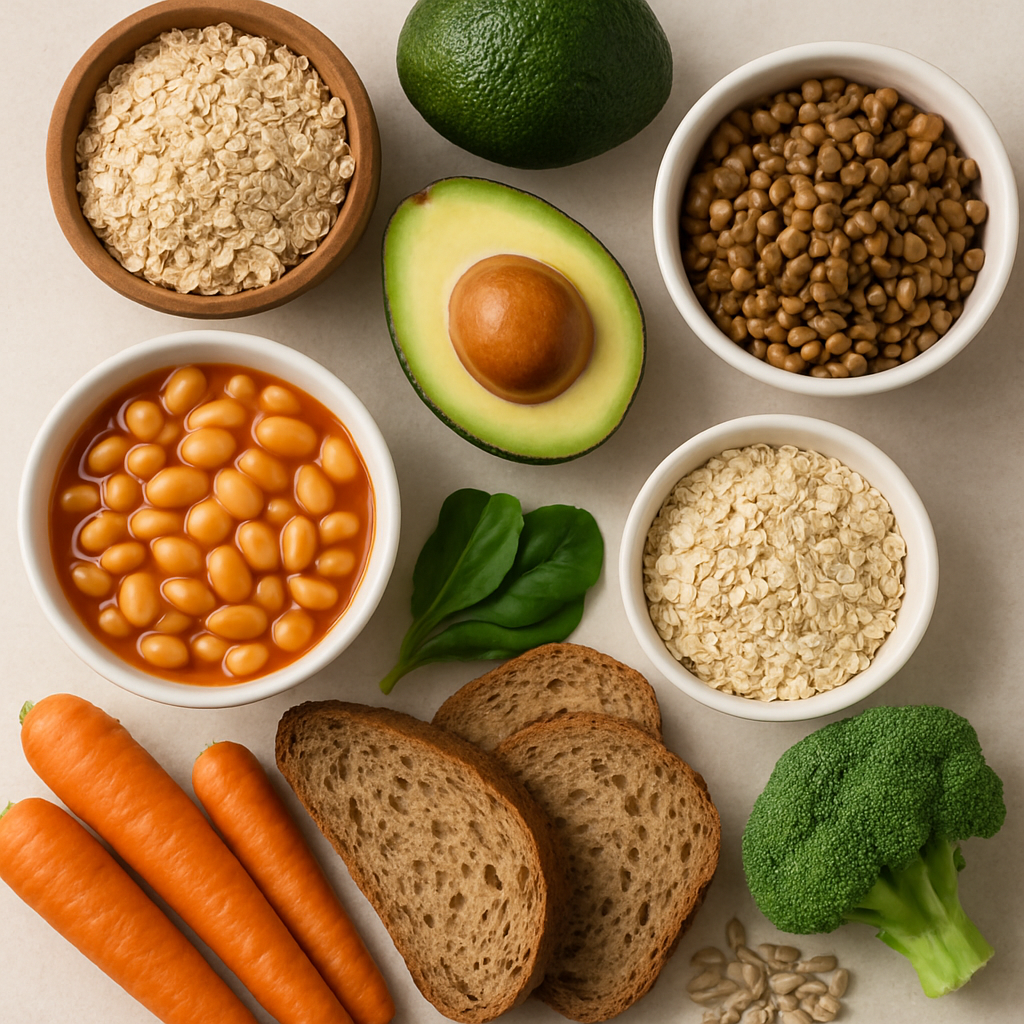
Soluble fibre is abundant in oats, barley, legumes (lentils, chickpeas, beans), apples, and citrus fruits. Of these, oats and barley have attracted the most research attention, largely because of their high beta-glucan content — a specific type of soluble fibre with a particularly well-documented cholesterol-lowering effect.
What the Evidence Shows
UK research has played a significant role in building the evidence base here. Studies conducted at institutions including the University of Leeds and through large-scale cohort data from Biobank UK have consistently found associations between higher fibre intake and lower LDL cholesterol levels.
A major systematic review and meta-analysis — drawing heavily on European and UK population data — found that increasing soluble fibre intake by just 5–10g per day was associated with a reduction in LDL cholesterol of approximately 5%. That might sound modest, but epidemiological research suggests that a 1% reduction in LDL cholesterol corresponds to roughly a 1–2% reduction in cardiovascular disease risk. Consistent, sustained dietary changes compound over time.
The mechanism behind this is reasonably well understood. Soluble fibre binds to bile acids in the gut — bile acids being substances the body produces from cholesterol to aid digestion. When fibre carries those bile acids out of the body through excretion, the liver responds by pulling more cholesterol from the blood to make new bile acids. The net result: lower circulating LDL cholesterol.
The European Food Safety Authority (EFSA) has formally approved a health claim for beta-glucan from oats stating that it contributes to the maintenance of normal blood cholesterol levels — one of very few dietary components to have cleared that evidential bar.
Common Misconceptions Worth Addressing
One misconception that surfaces regularly is that you need to make dramatic dietary changes to see any meaningful effect on cholesterol. The research doesn't support this.
Studies show that relatively small, consistent changes in fibre intake — the sort you could achieve by swapping white bread for wholegrain, adding a portion of lentils to a meal a few times a week, or having oat-based porridge for breakfast — are associated with measurable improvements in lipid profiles over weeks to months.
Another misconception is that cholesterol-lowering is only relevant to people who already have high cholesterol or a diagnosed cardiovascular condition. In fact, population-level dietary patterns matter enormously. Research from the UK Biobank has highlighted that people who consistently eat higher-fibre diets tend to have better cardiometabolic profiles across the board — not just those who start from an elevated baseline.
It's also worth noting that fibre doesn't work in isolation. Saturated fat intake, physical activity, smoking, and genetics all influence cholesterol levels. Fibre is one lever, not a cure-all — but it's a well-evidenced and accessible one.
The Food vs. Supplement Question
With fibre supplements — psyllium husk being the most common — increasingly available and marketed for heart health, it's fair to ask whether they're a reasonable alternative to getting fibre from food.
The honest answer is: they can help, but food wins in almost every comparison. Psyllium husk is soluble fibre, and there is decent evidence that it lowers LDL cholesterol. A 2020 review published in the American Journal of Clinical Nutrition found it to be effective at meaningful doses.
But whole foods bring additional compounds alongside fibre — polyphenols, vitamins, minerals, and other plant constituents that interact with gut bacteria and cardiovascular health in ways that supplements don't replicate. UK dietary guidelines consistently emphasise food-first approaches, and the research tends to support that framing.
Supplements may have a practical role for people who genuinely struggle to meet fibre targets through food — but they're better understood as a top-up than a replacement.
Practical Takeaways
The gap between the average UK intake of 18g and the recommended 30g is significant, but it's not insurmountable. Here's what a realistic uplift looks like in practice:
- Swap your breakfast cereal for porridge — a 40g serving of oats contains around 2g of beta-glucan and approximately 3–4g of total fibre. Over a week, that adds up.
- Add legumes to two or three meals a week — a tin of lentils or chickpeas stirred into a soup, stew, or curry adds 6–8g of fibre per serving, including a useful amount of soluble fibre.
- Don't peel your fruit and veg where you don't need to — the skin of apples, potatoes, and pears contains a meaningful proportion of their fibre content.
- Choose wholegrain versions of bread, pasta, and rice — the difference in fibre content between white and wholegrain versions is substantial, and for most people the taste adjustment is minimal after a short period.
- Eat a wider variety of plant foods — research consistently shows that dietary diversity supports a healthier gut microbiome, which in turn influences how fibre is metabolised and how effectively cholesterol is managed.
None of these changes require an overhaul of how you eat. They're small adjustments that, made consistently, can shift your fibre intake meaningfully closer to the 30g target — and the evidence suggests your cholesterol levels may reflect that over time.
If you want to hit your fibre and macro targets without the mental maths, Macrology generates macro-perfect meal plans in seconds — [https://macrology.app/signin](https://macrology.app/signin)
The Bigger Picture
The link between fibre and cholesterol isn't new science — it's been understood at a broad level for decades. What UK research is adding is precision: more granular data on which fibre types matter most, what realistic intake changes look like across British dietary patterns, and how those changes interact with other cardiovascular risk factors.
The headline finding remains consistent and clear. Most people in the UK eat far less fibre than recommended, and increasing intake — particularly of soluble fibre from oats, legumes, and fruit — is one of the most well-supported dietary strategies for supporting healthy cholesterol levels.
That's not a complicated message. The challenge, as ever, is making it practical — and the evidence suggests that practical, modest changes are exactly what's needed.
Want meals like this planned to your exact macros?
Macrology generates a personalised meal plan in seconds — breakfast, lunch, dinner and snacks, all hitting your daily targets.
Start your free 14-day trialMore from news
New Research: What UK Studies Reveal About the Link Between Food Delivery App Usage and Dietary Quality
7 min readNew Research: What UK Studies Reveal About the Link Between Food Environment at Home and Children's Eating Habits
7 min readNew Research: What UK Studies Reveal About the Link Between Cooking Frequency at Home and Overall Diet Quality
7 min read