New Research: What UK Studies Reveal About the Link Between Protein Intake and Healthy Ageing
# New Research: What UK Studies Reveal About the Link Between Protein Intake and Healthy Ageing
There's a quiet shift happening in nutrition science — and it has big implications for how we eat as we get older. For decades, protein was largely the domain of bodybuilders and athletes, but a growing body of UK-based research is repositioning it as one of the most important nutrients for maintaining health, independence, and quality of life well into later years.
Why Protein Matters More As We Age
Most people don't give much thought to how much protein they eat until something goes wrong — a slow recovery from illness, a fall, unexpected muscle loss. But the underlying biology starts changing much earlier than most of us realise.
From around the age of 30, adults begin to lose muscle mass at a rate of roughly 3–8% per decade, a process known as sarcopenia. After 60, that rate can accelerate. The consequences aren't just cosmetic — reduced muscle mass is closely linked to falls, fractures, metabolic changes, and a loss of functional independence.
What makes this particularly relevant is that protein is the primary dietary driver of muscle protein synthesis — the process by which the body builds and repairs muscle tissue. Getting enough of it, and getting it at the right times, appears to matter considerably more as we age.
What the Research Says
Some of the most compelling recent evidence comes from UK and European cohort studies examining real-world dietary patterns rather than controlled clinical trials, giving us a clearer picture of how protein intake plays out across diverse populations.
The UK Biobank, one of the largest long-term health studies in the world, has provided researchers with a rich dataset linking dietary patterns to health outcomes in hundreds of thousands of UK adults. Analyses drawing on this data have consistently found associations between higher protein intake and better preservation of muscle mass, particularly in adults over 50.
A 2023 study published in Age and Ageing — the British Geriatrics Society's journal — found that older adults consuming protein below the current recommended level of 0.75g per kilogram of body weight per day showed significantly greater muscle loss over time compared to those meeting or exceeding that threshold. Crucially, the researchers noted that the current UK reference nutrient intake (RNI) for protein may itself be too conservative for older adults, echoing calls from groups like the PROT-AGE Study Group, which recommends 1.0–1.2g per kilogram per day for healthy older people.
A separate analysis from the English Longitudinal Study of Ageing (ELSA) highlighted another layer of complexity: it wasn't just total protein intake that mattered, but protein distribution across the day. Participants who spread their protein intake more evenly across meals — rather than loading most of it into the evening meal, which is common in British eating patterns — had better outcomes for muscle function and grip strength.
The Protein Distribution Problem
This point about distribution is worth sitting with, because it challenges how most people in the UK actually eat.
Typical British meal patterns tend to be protein-light at breakfast (toast, cereal, or nothing at all), moderate at lunch, and heavily weighted towards dinner. Research suggests this isn't the most effective pattern for muscle protein synthesis, which appears to be optimised when protein is spread more evenly — roughly 25–40g per meal, three times a day.
The mechanism behind this is related to leucine, an amino acid that acts as a trigger for muscle protein synthesis. Each meal needs to contain enough leucine to hit a threshold that activates this process. A protein-heavy dinner followed by a light breakfast doesn't deliver two effective muscle-building signals — it delivers one large one and one that barely registers.
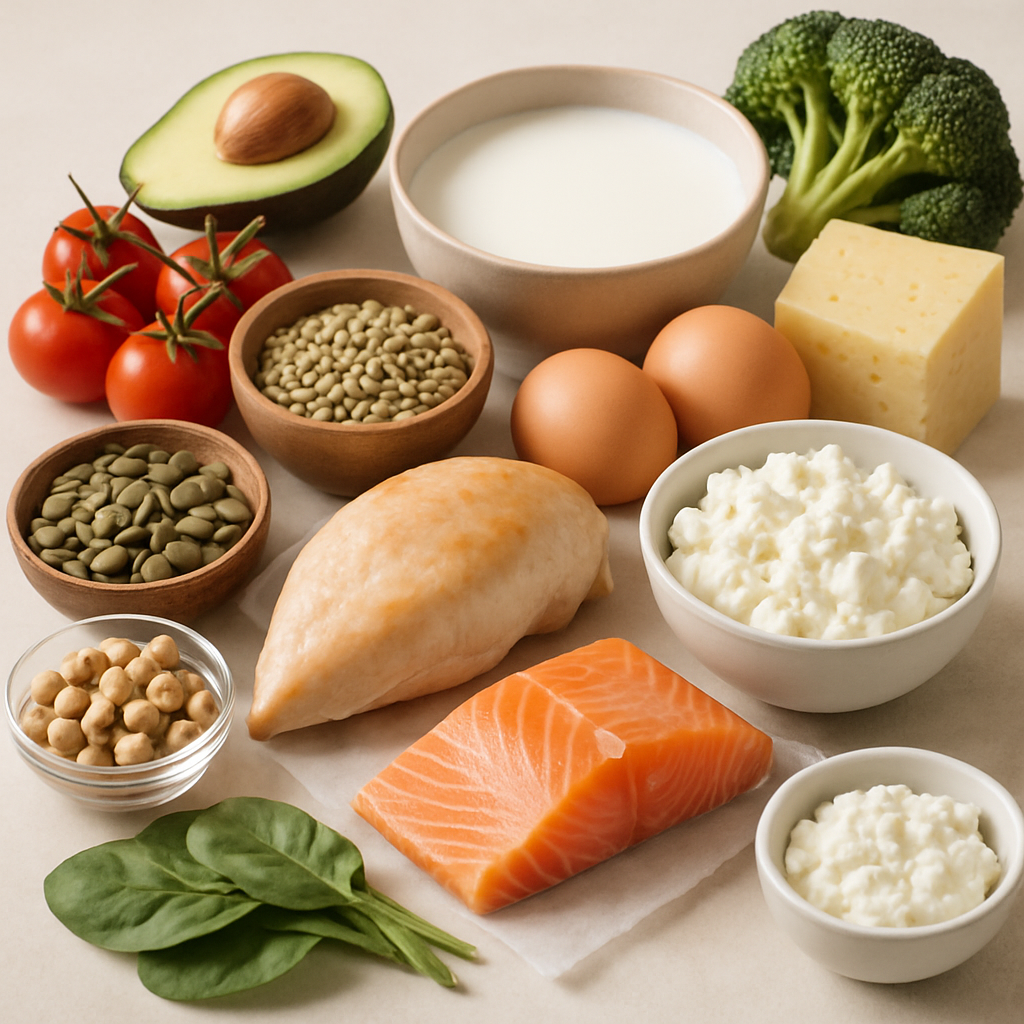
This doesn't mean overhauling everything at once. Even shifting breakfast towards eggs, Greek yoghurt, or smoked salmon can meaningfully change the protein distribution picture across the day.
Plant Protein, Animal Protein, and the Quality Question
One area where the conversation gets more nuanced is around protein quality — specifically, whether the source of protein matters as much as the total amount.
Animal proteins (meat, fish, eggs, dairy) are generally considered complete proteins, meaning they contain all nine essential amino acids in proportions well-suited to human physiology. Plant proteins, with a few exceptions like soy and quinoa, tend to be lower in one or more essential amino acids.
However, the picture isn't as simple as "animal protein good, plant protein less so." Research from the MRC Epidemiology Unit at Cambridge has explored how plant-rich dietary patterns affect muscle health, finding that with thoughtful food combining and adequate total intake, plant-based eaters can achieve comparable muscle preservation outcomes.
The key phrase there is "adequate total intake." Because plant proteins are less digestible on average, older adults following primarily plant-based diets may need to aim slightly higher on total protein — some researchers suggest up to 1.4g per kilogram per day — to achieve the same anabolic response. Leucine-rich plant sources like edamame, lentils, and tofu become particularly important in this context.
Beyond Muscle: Bone Health, Immunity, and Cognitive Function
The conversation around protein and ageing extends well beyond muscle, and UK research is starting to map these connections more carefully.
Bone health is one area of growing interest. Contrary to an older concern that high protein intake might leach calcium from bones, more recent evidence points in the opposite direction — adequate protein intake appears to support bone mineral density by enhancing calcium absorption and stimulating the production of IGF-1, a growth factor involved in bone formation. A study from the University of Sheffield's Mellanby Centre for Musculoskeletal Research found positive associations between protein intake and bone density markers in post-menopausal women.
There's also emerging evidence linking protein adequacy to immune function — relevant given that older adults are more vulnerable to infections and slower to recover. Antibodies and immune cells are themselves proteins, and chronic low intake may compromise immune response over time.
More tentatively, some researchers are exploring connections between dietary protein and cognitive ageing, with amino acids serving as precursors to neurotransmitters including serotonin and dopamine. The evidence here is less settled, but it adds another layer to why protein's role in healthy ageing deserves attention.
Common Misconceptions Worth Addressing
A few persistent myths tend to muddy the waters around protein and ageing.
"High protein intake damages the kidneys." This concern has a long history, but the evidence consistently shows it applies only to people with pre-existing kidney disease. For healthy adults, there is no robust evidence that protein intakes in the ranges discussed here — 1.0–1.4g per kilogram — pose any kidney risk.
"Older people need less food, so they need less protein." This conflates total calorie needs with protein needs. While energy requirements do tend to decrease with age, protein requirements stay the same or increase. This makes protein density — how much protein you get per calorie — increasingly important in later life.
"Protein supplements are the only reliable way to hit higher targets." Whole food sources are perfectly adequate for most people. A 150g chicken breast, a tin of tuna, a pot of Greek yoghurt, or a serving of lentils and cheese can each contribute meaningfully to daily targets without a supplement in sight.
Practical Takeaways
Here's what the current evidence points towards, in concrete terms:
- Aim for at least 1.0–1.2g of protein per kilogram of body weight per day if you're over 50, rather than relying on the general UK recommendation of 0.75g/kg, which may not be sufficient for muscle maintenance.
- Spread protein across all three meals rather than concentrating it at dinner. Aim for a meaningful protein source at breakfast — eggs, yoghurt, smoked fish, or legumes all work well.
- Each meal should ideally contain 25–40g of protein to reliably trigger muscle protein synthesis.
- If you eat a primarily plant-based diet, prioritise leucine-rich sources (edamame, lentils, tofu, tempeh) and consider aiming slightly higher on total daily intake.
- You don't need supplements to meet these targets — but they can be a practical tool if whole food sources aren't accessible or convenient.
These are population-level insights, not personal prescriptions. Individual needs vary based on health status, activity level, and body composition — a GP or registered dietitian can give tailored guidance if you have specific concerns.
If you want to make sure your meals are consistently hitting the right protein targets as you age, Macrology generates macro-perfect meal plans in seconds — https://macrology.app/signin
Want meals like this planned to your exact macros?
Macrology generates a personalised meal plan in seconds — breakfast, lunch, dinner and snacks, all hitting your daily targets.
Start your free 14-day trialMore from news
New Research: What UK Studies Reveal About the Link Between Food Delivery App Usage and Dietary Quality
7 min readNew Research: What UK Studies Reveal About the Link Between Food Environment at Home and Children's Eating Habits
7 min readNew Research: What UK Studies Reveal About the Link Between Cooking Frequency at Home and Overall Diet Quality
7 min read