How Portion Sizes in the UK Have Changed Over the Past 20 Years
# How Portion Sizes in the UK Have Changed Over the Past 20 Years
The average British meal looks quite different to what it did two decades ago — and not just because avocado toast wasn't a thing in 2004. Portion sizes across the UK have quietly crept upward, reshaping what we consider a "normal" amount of food without most of us noticing.
The Slow Creep Nobody Noticed
There's a well-documented phenomenon in nutrition research called portion size normalisation — the idea that as larger servings become more common, our perception of what constitutes a reasonable amount recalibrates accordingly.
It doesn't happen overnight. A biscuit gets 10% bigger. A ready meal gains an extra 50 calories. A restaurant main comes on a plate the size of a hubcap. Each change feels minor in isolation, but over twenty years, these shifts accumulate into something significant.
Research published in the British Medical Journal has highlighted that portion sizes in the UK have increased substantially since the 1990s, particularly for ultra-processed foods, takeaways, and eating-out occasions. The concern isn't moral — it's practical. When portions grow, so does the gap between what people think they're eating and what they're actually consuming.
What the Evidence Shows
A landmark study by researchers at the University of Cambridge, published in BMJ Open, analysed the portion sizes of over 1,000 food products sold in UK supermarkets and found that many everyday items had grown considerably over time. Muffins, for instance, were found to be up to twice the size they were in the 1990s. Bagels had expanded similarly. Even some ready meals had increased in weight by 30–50%.
The same research found that standard portions depicted on packaging often didn't reflect what people were actually serving themselves — and that people tend to eat what's in front of them, regardless of hunger cues. This is sometimes called the unit bias, where we treat whatever portion we're given as the "correct" amount.
A separate report from the British Nutrition Foundation noted that UK adults consistently underestimate their calorie intake, often by as much as 30–50%. Larger portions don't help. When your reference point for "a serving of pasta" has quietly doubled, it becomes genuinely difficult to estimate accurately.
How the Food Industry Played a Role
It would be too simple to pin this entirely on consumer demand. The food industry has structural incentives to increase portion sizes: larger portions can be produced at a relatively low marginal cost, but justify higher price points. Supersize options, meal deals, and promotional bundles all nudge people toward consuming more.
Takeaway culture has been a major driver. The growth of platforms like Deliveroo and Uber Eats — alongside the longer-standing expansion of high-street chains — has made restaurant-style portions the norm for weeknight meals. A study published in Public Health Nutrition found that takeaway meals in the UK contained, on average, significantly more calories than equivalent home-cooked dishes, often exceeding 1,000 calories for a single main course.
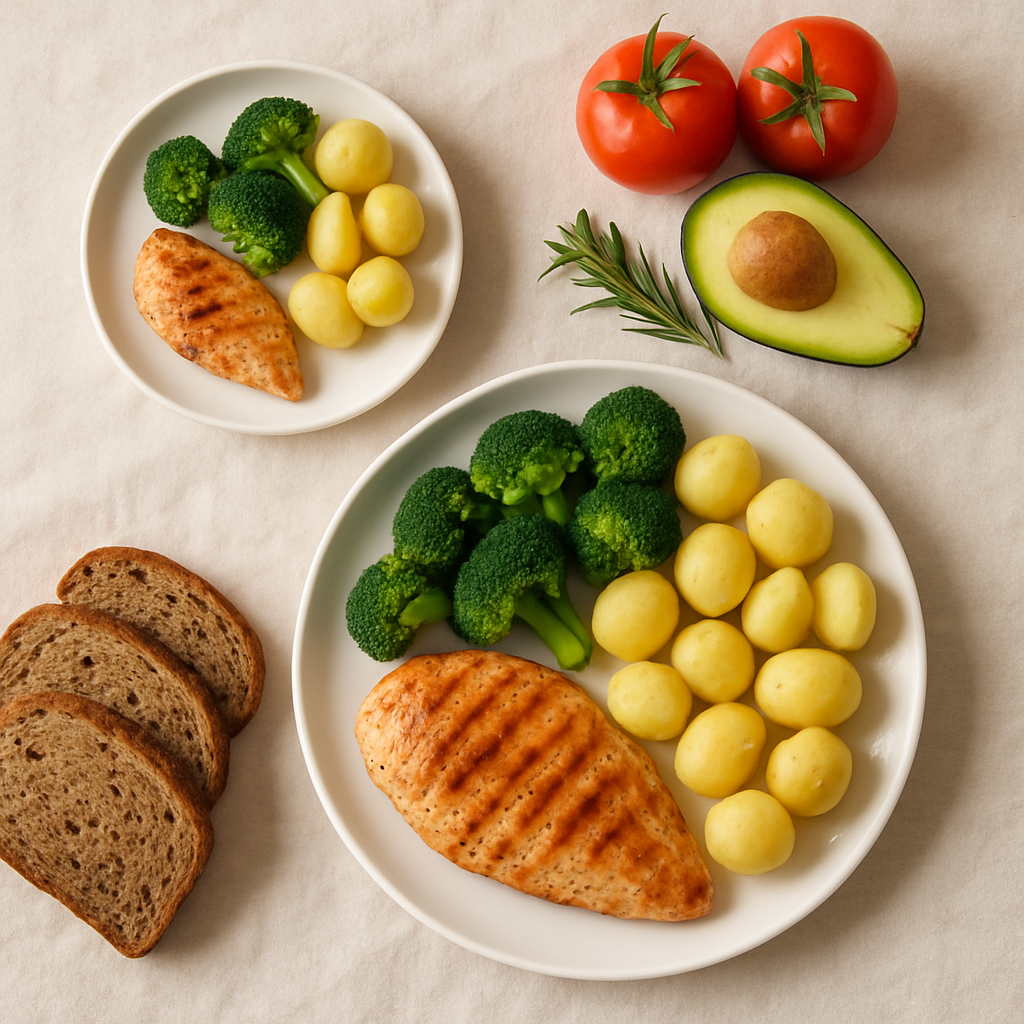
It's also worth noting the plate size effect. Research consistently shows that people serve themselves more food on larger plates and eat more as a result, without feeling any fuller. Average plate diameters in UK homes have increased from around 25cm in the 1990s to closer to 28–30cm today — a seemingly small difference that has a measurable impact on how much ends up on them.
Restaurant and Café Portions: A Different World
Eating out used to be an occasional treat. In the UK, it's now a regular part of life for many people, and the portions served in restaurants have scaled accordingly — partly to justify prices, partly to compete for perceived value.
A 2022 report by the Food Standards Agency found that calorie counts for meals eaten outside the home were frequently much higher than people expected, even when consumers believed they were making "sensible" choices. A chicken Caesar salad at a high-street chain, for example, can easily run to 700–900 calories — more than a Big Mac.
The introduction of mandatory calorie labelling for large restaurant chains in England in 2022 was a direct policy response to this. The idea wasn't to police what people eat, but to close the information gap. Early evidence suggests it has had some modest effect on purchasing choices, though the research is still developing.
Supermarket Packaging and the Illusion of a Serving
If you've ever looked at the back of a bag of crisps and seen "serving size: 30g" while holding a 150g bag, you'll know the disconnect between stated portions and reality.
Packaging portion sizes in the UK are largely self-regulated, which means they vary wildly and often bear little relation to what people actually eat. Some products define a serving as roughly what most people would eat; others define it in a way that makes the nutritional profile look more favourable than it would if you ate the whole thing — which, for single-serve-sized packaging, most people do.
The National Food Strategy (2021), an independent review commissioned by the UK government, flagged this as a genuine problem. It recommended clearer front-of-pack labelling and better consistency in how portions are defined and communicated. Progress has been slow, but the issue has at least made it onto the policy agenda.
Does Any of This Actually Matter?
Here's where it gets nuanced. Larger portions aren't inherently a problem for everyone. Athletes, people in physically demanding jobs, those with higher energy needs, or anyone actively trying to gain weight might find current portion norms quite reasonable or even insufficient.
The issue arises when there's a mismatch — when someone's energy needs are lower than what's being routinely served, and they have no reliable way to gauge that gap. Over time, a consistent surplus of even 100–200 calories a day adds up.
It's also worth being clear: portion size is one factor among many. Sleep, stress, movement, food composition, and individual metabolism all play a role in how the body responds to what you eat. Framing portion size as the single cause of anything would be an oversimplification.
That said, awareness is useful. Understanding that your reference points for "normal" have been shaped by two decades of gradual inflation means you can engage with them critically rather than just defaulting to whatever lands on your plate.
Practical Takeaways
You don't need a food scale on every meal to get a handle on this. A few practical approaches that hold up in real life:
Use your hand as a rough guide. A palm-sized portion of protein, a cupped-hand of carbohydrates, and a thumb of fats is a rough heuristic that travels well — no equipment needed. It's not precise, but it's calibrated to your body size.
Check in with hunger before finishing the plate. Not every meal needs to be finished just because it's there. Pausing halfway through and asking whether you're still hungry is a simple habit that costs nothing.
Look at labelled portions for packaged food. Even if you don't follow them exactly, knowing that a "serving" of a given food is 40g rather than the 80g you typically use is genuinely useful information.
Cook at home more often when you can. Not for moral reasons — just because home cooking gives you far more control over what goes into a meal and how much of it ends up in a bowl.
Don't try to recalibrate everything at once. Pick one or two meals where portion sizes feel vague and get a clearer picture there. That's enough to make a difference without turning every meal into a project.
If you want a clearer picture of what you're actually eating without the mental overhead of tracking everything manually, Macrology generates macro-perfect meal plans in seconds — https://macrology.app/signin
---
Portion sizes have changed — that's not a scare story, just a fact worth knowing. Having an accurate map of what you're eating is one of the most practical tools available, and it starts with understanding that "normal" is a moving target.
Want meals like this planned to your exact macros?
Macrology generates a personalised meal plan in seconds — breakfast, lunch, dinner and snacks, all hitting your daily targets.
Start your free 14-day trialMore from news
New Research: What UK Studies Reveal About the Link Between Food Delivery App Usage and Dietary Quality
7 min readNew Research: What UK Studies Reveal About the Link Between Food Environment at Home and Children's Eating Habits
7 min readNew Research: What UK Studies Reveal About the Link Between Cooking Frequency at Home and Overall Diet Quality
7 min read