What the Latest Research Says About Protein and Muscle
For decades, the advice around protein and muscle has been surprisingly simple: eat enough, lift weights, repeat. But the science has moved on considerably, and some of what researchers have uncovered in the last few years is genuinely worth knowing — especially if you're putting real effort into training.
How Much Protein Do You Actually Need?
The old rule of thumb — 0.8g of protein per kilogram of bodyweight — was never really designed for active people. It was set as a minimum to prevent deficiency, not to support muscle growth or maintenance. More recent research points to a significantly higher target for anyone doing regular resistance training.
A 2022 meta-analysis published in the British Journal of Sports Medicine found that muscle protein synthesis plateaus at around 1.6g per kg of bodyweight per day for most people, with some evidence suggesting benefits up to 2.2g per kg — particularly for those in a calorie deficit or older adults trying to hold on to muscle mass. If you weigh 75kg, that's roughly 120–165g of protein per day, which is a fair bit more than most people are actually eating.
Does Protein Timing Still Matter?
The "anabolic window" — the idea that you need to slam a protein shake within 30 minutes of training — has largely been debunked. Research now suggests the window is considerably wider than once thought, likely several hours either side of a session.
That said, timing isn't entirely irrelevant. Spreading protein intake evenly across the day appears to be more effective than consuming most of it in one or two meals. A 2023 study in the Journal of the International Society of Sports Nutrition found that four evenly distributed protein meals stimulated greater muscle protein synthesis than the same total consumed in fewer, larger servings.
In practical terms, this means breakfast matters — skipping it and loading protein into lunch and dinner leaves gains on the table.
What Types of Protein Work Best?
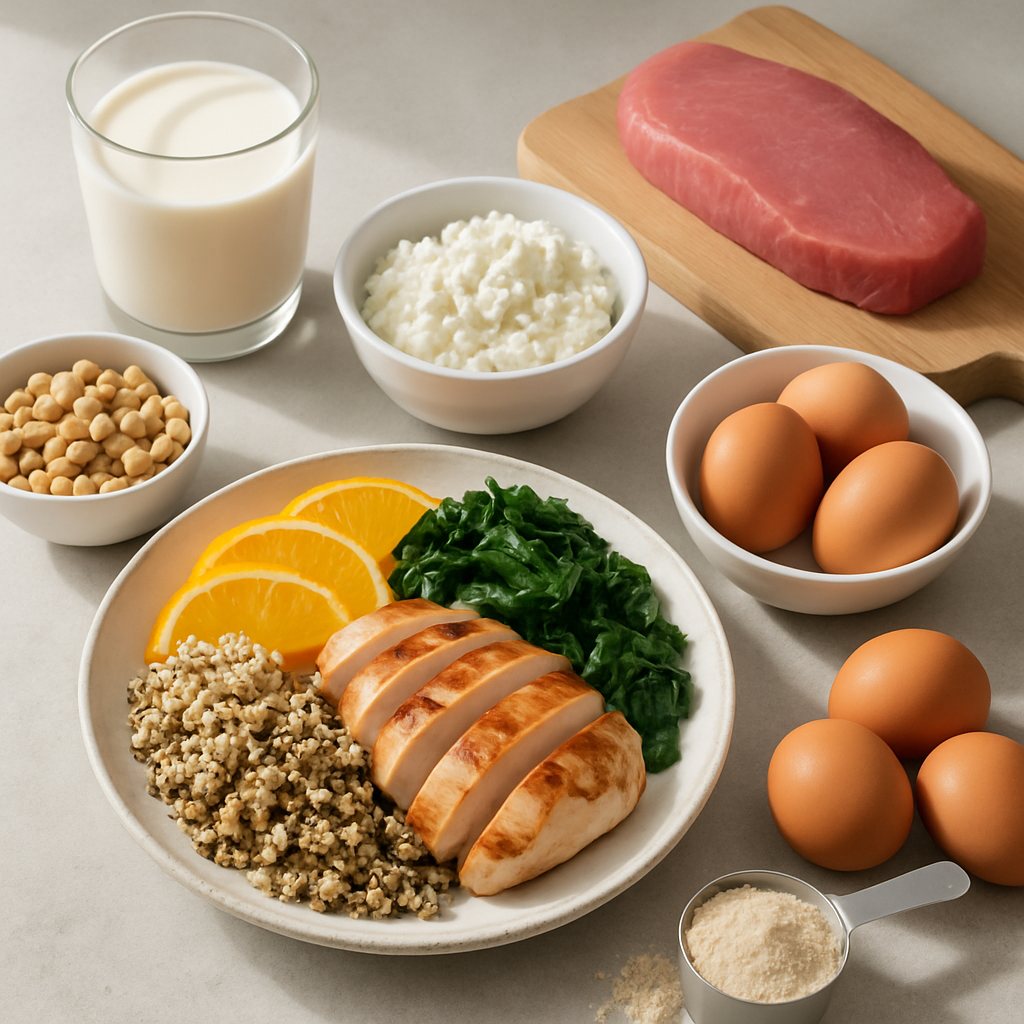
Not all protein sources are created equal, and the research on protein quality has become more nuanced. Leucine content is now understood to be a key driver of muscle protein synthesis — leucine is the amino acid that essentially flips the switch on muscle building. Animal proteins (meat, fish, eggs, dairy) tend to be high in leucine and contain all essential amino acids, which is why they've historically been favoured in sports nutrition research.
But plant proteins are catching up in the literature. A notable 2023 trial found that a blend of plant proteins — combining sources like soy, pea, and rice to cover the full amino acid spectrum — produced comparable muscle gains to whey protein when total intake was matched. The key is variety and volume. Relying on a single plant source, particularly one low in leucine like wheat protein, is less effective than mixing sources strategically.
Older adults also have a specific consideration here: protein anabolic resistance means muscles become less responsive to protein stimulation with age, suggesting that both total intake and leucine-rich sources become even more important from around your mid-40s onwards.
The Calorie Context You Can't Ignore
Protein doesn't work in isolation. One of the clearest findings in recent muscle research is that total calorie intake shapes what protein can actually do. In a meaningful deficit, even optimal protein intake will result in some muscle loss — the body prioritises survival over muscle retention. This is why extremely low-calorie approaches tend to undermine physique goals, even when protein looks good on paper.
Conversely, research consistently shows that a modest surplus — combined with adequate protein and progressive training — is the most reliable environment for muscle gain. The surplus doesn't need to be large; studies suggest even 200–300 extra calories per day is sufficient for most people.
If you want to hit your protein targets without having to do the maths yourself, Macrology generates macro-perfect meal plans in seconds — https://macrology.app/signin
Want meals like this planned to your exact macros?
Macrology generates a personalised meal plan in seconds — breakfast, lunch, dinner and snacks, all hitting your daily targets.
Start your free 14-day trialMore from news
New Research: What UK Studies Reveal About the Link Between Food Delivery App Usage and Dietary Quality
7 min readNew Research: What UK Studies Reveal About the Link Between Food Environment at Home and Children's Eating Habits
7 min readNew Research: What UK Studies Reveal About the Link Between Cooking Frequency at Home and Overall Diet Quality
7 min read