How Much Sugar Is Actually in Your Favourite UK Supermarket Sauces?
# How Much Sugar Is Actually in Your Favourite UK Supermarket Sauces?
That pasta sauce sitting in your cupboard might look innocent enough — tomatoes, herbs, a bit of garlic. But flip the jar around and the sugar content can genuinely catch you off guard.
Sauces are one of the easiest places for sugar to quietly accumulate in an otherwise balanced diet, not because anyone is being sneaky, but simply because they're an afterthought. Here's what the labels are actually telling you.
Why Sauces Tend to Be High in Sugar
Manufacturers add sugar to sauces for a few legitimate reasons: it balances acidity, improves shelf life, and enhances flavour. The problem isn't that sugar is inherently villainous — it's that it can add up fast when you're not expecting it.
The NHS recommends that free sugars make up no more than 5% of your daily energy intake, which works out to roughly 30g per day for most adults. A couple of generous spoonfuls of the wrong sauce can eat into that meaningfully before you've even thought about the rest of your meal.
It's also worth knowing that on UK nutrition labels, the "of which sugars" figure includes both added sugars and naturally occurring ones — so a tomato-based sauce will always show some sugar even with nothing added.
The Numbers Behind Common Supermarket Sauces
Let's look at some of the usual suspects on British supermarket shelves.
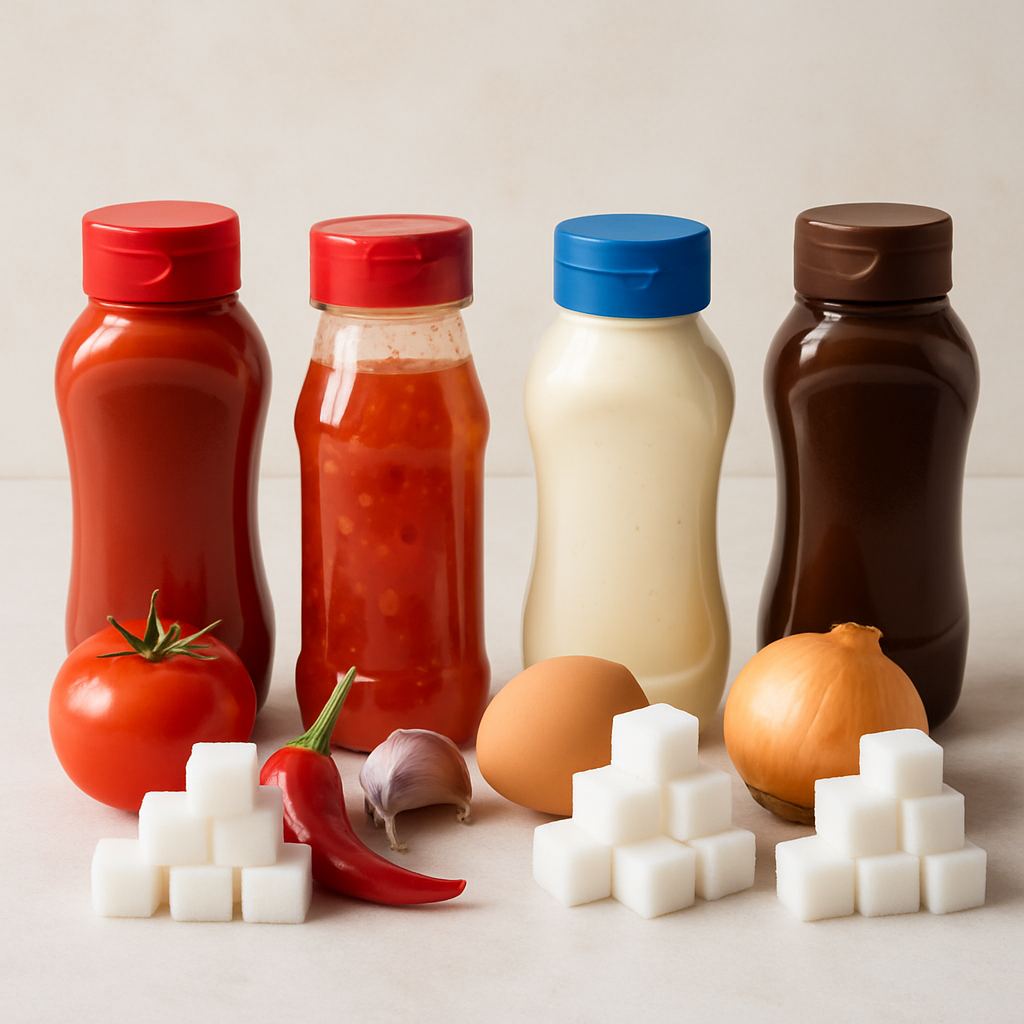
Pasta sauces vary enormously. A standard jar of tomato and basil pasta sauce typically contains around 8–10g of sugar per 100g — and most people use well over 100g in a meal. Some premium or "slow-cooked" varieties push past 12g per 100g.
Ketchup is probably the most talked-about offender. Heinz Tomato Ketchup contains around 23g of sugar per 100g, though a standard portion (one tablespoon) is about 15g, so you're looking at roughly 3–4g per squeeze. It adds up if you're liberal with it.
Sweet chilli sauce is exactly what it says on the tin — a 15g serving often contains 5–7g of sugar, making it one of the higher-sugar condiments per portion. Barbecue sauce sits in similar territory, frequently landing between 20–30g of sugar per 100g.
Soy sauce, by contrast, is very low in sugar (usually under 1g per 100g), and hot sauces like Tabasco are negligible. If flavour is the goal, these are worth keeping in your rotation.
How to Read the Label Without Losing Your Mind
You don't need to scrutinise every jar you pick up. A few simple habits make it much easier.
First, check per 100g rather than per serving — serving sizes on labels are often unrealistically small, so the per-100g figure gives you a more honest comparison between products.
Second, look at where sugar sits in the ingredients list. Ingredients are listed in descending order by weight, so if sugar (or glucose syrup, or any variation) appears in the first three or four ingredients, it's a significant component of the product.
Third, use the traffic light system if it's on the pack. Red for sugars means more than 22.5g per 100g — a useful quick check when you're in a hurry.
Supermarket own-brand versions of popular sauces are sometimes surprisingly competitive on sugar content — occasionally lower than their branded equivalents, and usually cheaper. Worth a look.
Practical Takeaways
- Pasta sauces: aim for under 7g of sugar per 100g where possible — they do exist, especially in the "no added sugar" ranges now stocked by most major supermarkets.
- Ketchup and barbecue sauce: fine in sensible amounts, but worth being aware of if you're using them generously across multiple meals.
- Swap sweet chilli for sriracha or a plain chilli sauce — similar flavour hit, often a fraction of the sugar.
- Make your own tomato base when you have ten minutes — a tin of chopped tomatoes, garlic, and olive oil has a fraction of the sugar of most jarred sauces and tastes better.
- Don't obsess — a tablespoon of ketchup with your eggs isn't derailing anything. Awareness is the goal, not anxiety.
If you want a clearer picture of how your everyday meals and condiments fit into your overall nutrition, Macrology generates macro-perfect meal plans in seconds — https://macrology.app/signin.
Knowing what's in your sauces isn't about cutting anything out — it's just useful information to have. The more you know, the easier it is to make choices that actually work for you.
Want meals like this planned to your exact macros?
Macrology generates a personalised meal plan in seconds — breakfast, lunch, dinner and snacks, all hitting your daily targets.
Start your free 14-day trial